

How to Find Reliable Movers Across the Country
To choose movers across the country, check each company’s interstate registration, get a written estimate, and ask for a clear delivery window. Compare what the price includes, how your belongings are covered, and how the mover will keep you updated throughout transit. You can verify an interstate mover through the Federal Motor Carrier Safety Administration.
If you are organizing a relocation from Chicago, Melrose Park, or surrounding Illinois communities to destinations like Texas, Florida, Arizona, or California, thorough verification helps you avoid unexpected surprises and maintain a firm schedule around your family’s arrival.

Understanding standard long distance moving company rates helps homeowners establish realistic expectations for their cross-country budget. When researching carriers, partnering with a dependable moving company across states ensures that your goods travel in fully compliant commercial vehicles operated by licensed drivers. Anyone relocating across country benefits from establishing an early plan that covers packing, scheduling, inventory documentation, and route management.
According to U.S. Census Bureau migration data, approximately 26.5 million Americans relocate in a single year, with 28% of interstate movers packing up for a new job or corporate transfer. Leaving your familiar home in Illinois to start fresh in a new region is an exciting milestone, but managing interstate logistics across hundreds or thousands of miles demands structured coordination. Choosing an established, properly licensed carrier turns a complex interstate journey into an organized, efficient transition.
How to Evaluate and Select Movers Across the Country

Selecting an interstate carrier requires more than simply choosing the first search result. Crossing state borders with household goods demands strict compliance with federal consumer protection regulations and motor carrier safety statutes. Reviewing our Interstate Moving Companies Ultimate Guide helps clarify the federal licensing standards, insurance minimums, and operational rules that every professional carrier must maintain.
Every legitimate long-distance transportation team must hold active operating authority registered with the U.S. Department of Transportation (USDOT) and comply with FMCSA interstate moving regulations. Checking these public databases allows you to review a mover’s safety track record, registered fleet size, physical terminal address in Illinois, and formal complaint history before signing a contract or authorizing loading.
Watch out for these common warning signs during your initial consultations:
- Demands for large cash deposits or upfront wire transfers before any labor or loading begins.
- Quotes provided strictly over the phone without a detailed virtual or in-person visual survey of your home.
- Unbranded rental trucks arriving on moving day instead of official company fleet vehicles.
- Generic phone greetings like “Movers” rather than the official registered business entity name.
- Unwillingness to present an active USDOT number, motor carrier authority, or the mandatory federal consumer rights booklet.
Pricing Models and Estimating Costs with Movers Across the Country
Long-distance move pricing depends primarily on total shipment weight (or certified cubic volume) and the overall highway mileage between your origin in Illinois and your new destination. A typical long-distance move exceeding 1,000 miles averages around $4,890 for a standard three-bedroom home, though specialized crating, bulky items, piano handling, and stair carries will influence the final total. Learning practical budget-friendly cross-country moving strategies ensures you keep overall moving expenses structured, transparent, and predictable.
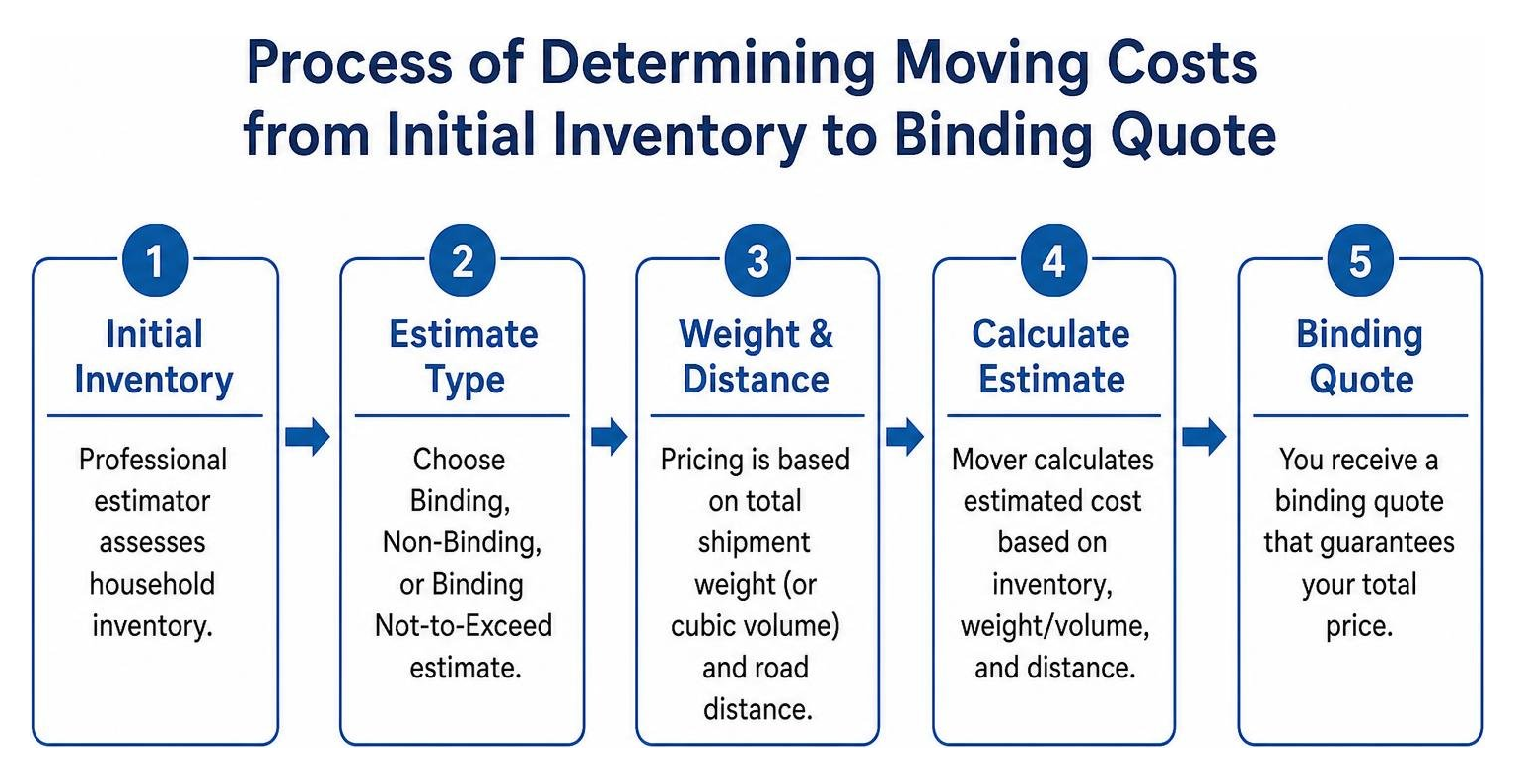
Understanding the contract structure protects your household budget from unexpected adjustments:
- Binding Estimate: Guarantees the total price based on the exact itemized inventory list. Even if the shipment weighs more than projected on the certified scale, your agreed price remains unchanged.
- Non-Binding Estimate: Provides an educated projection based on estimated weight. Your final invoice reflects the actual certified scale weight recorded at licensed weigh stations.
- Binding Not-to-Exceed Estimate: Ensures you never pay more than the agreed total if your belongings are heavier, while adjusting your balance lower if your shipment weight ends up below the initial estimate.
Key Credentials to Verify for Movers Across the Country
Beyond federal USDOT registration, examine how a carrier handles valuation coverage and tariff requirements. By law, licensed interstate carriers must provide Released Value Protection as standard baseline coverage, which reimburses items at 60 cents per pound per article. For high-value electronics, antique furniture, and fine art, selecting Full Value Protection ensures comprehensive repair, replacement, or settlement based on current market replacement value if unexpected transit damage occurs.
Reputable carriers also publish clear public tariff schedules outlining their auxiliary service fees. These include long-carry surcharges if the truck cannot park near your entrance, shuttle vehicle requirements for narrow suburban or mountain roads, elevator fees, and flight-of-stairs charges. Reviewing options with trusted out-of-state moving services gives you complete clarity so no unexpected line items appear when the crew arrives at your new residence.
What to Expect from Full-Service Long-Distance Movers
Hiring a full-service team transforms a demanding interstate relocation into an orderly, professionally managed experience. When moving from Chicago neighborhoods or suburbs like Melrose Park, Elmhurst, Park Ridge, Naperville, or Evanston across the country, a complete service package oversees every physical requirement from start to finish.
A dedicated professional moving team manages each stage of the process:
- Custom Crating and Packing: Securing fragile glassware, electronics, mirrors, and fine art with commercial-grade cartons, acid-free packing paper, heavy bubble wrap, and custom wooden crates.
- Heavy Lifting and Disassembly: Dismantling complex sectional sofas, executive desks, bed frames, and dining sets while protecting structural joints and hardware.
- Padded Transit Loading: Utilizing heavy-duty furniture blankets, durable straps, and weight-balanced loading techniques to prevent shifting across long highway routes.
- Direct Route Transportation: Managing long-haul interstate routes, mandatory weigh station stops, and strict commercial driver rest cycles.
- Placement and Reassembly: Unloading boxes into designated rooms, reconstructing primary furniture pieces, and removing used packing materials.
Choosing full-service moving across the country allows you to focus on travel plans, family adjustments, and your new career while experienced movers handle the heavy lifting.
Planning and Executing Your Interstate Move Seamlessly

A successful cross-country relocation begins well in advance of moving day. Coordinating departures from Illinois communities such as Melrose Park, Chicago, Des Plaines, Franklin Park, Oak Park, or Glenview requires careful planning around building access, street parking permits, freight elevator reservations, and seasonal weather patterns. Our specialized long-distance moving from Chicago playbook provides practical guidelines for navigating city logistics and preparing your home for long-distance transit.
Essential Moving Timeline and Administrative Checklist
Staying organized prevents last-minute stress when managing administrative duties across multiple states. Maintaining a structured seamless cross-country relocation planning schedule keeps every phase of your move aligned from initial consultation to final delivery.
Follow these key milestones during the weeks leading up to departure:
- Eight Weeks Out: Audit every room, closet, basement, and attic space. Sort belongings into retention, donation, and disposal categories to streamline shipment weight and reduce clutter.
- Six Weeks Out: Gather physical and digital copies of school transcripts, veterinary health certificates, dental files, medical histories, and vital legal documentation.
- Four Weeks Out: Submit official change-of-address requests with the United States Postal Service, update financial institutions, notify insurance providers, and review voter registration requirements.
- Two Weeks Out: Arrange utility disconnections at your current Illinois address for the day following departure, and schedule electric, water, gas, and high-speed internet activation at your destination address before your planned arrival date.
- One Week Out: Pack dedicated “first-night” essentials containers containing toiletries, prescription medications, device chargers, important paper records, and several changes of clothes.
Protecting Belongings and Managing Complex Move Logistics
Long-distance transit exposes household items to constant vibrations, temperature variations, and road movement over hundreds of miles. Professional moving crews wrap finished wood surfaces, mirrors, and upholstered furniture in thick fabric moving blankets secured with heavy stretch wrap to guard against abrasion. Dense cartons and heavy appliances are placed low along the trailer floor to keep the vehicle’s center of gravity stable, while lighter containers and fragile items ride securely on upper tiers.
If your destination home is not ready for immediate occupancy upon delivery, coordinating climate-controlled short-term storage keeps your household goods secure until closing or lease commencement. At Bernard Movers, our professional coordinators oversee moving schedules from our Illinois base to destinations nationwide. With detailed preparation, verified licensing, and professional packing support, your interstate relocation will be an organized, dependable start to your next chapter.