

Moving Out of Chicago Is Bigger Than You Think
Long distance moving in Chicago affects thousands of families and businesses every year — and it’s rarely as simple as renting a truck and hitting the road.
Here’s a quick overview of what you need to know:
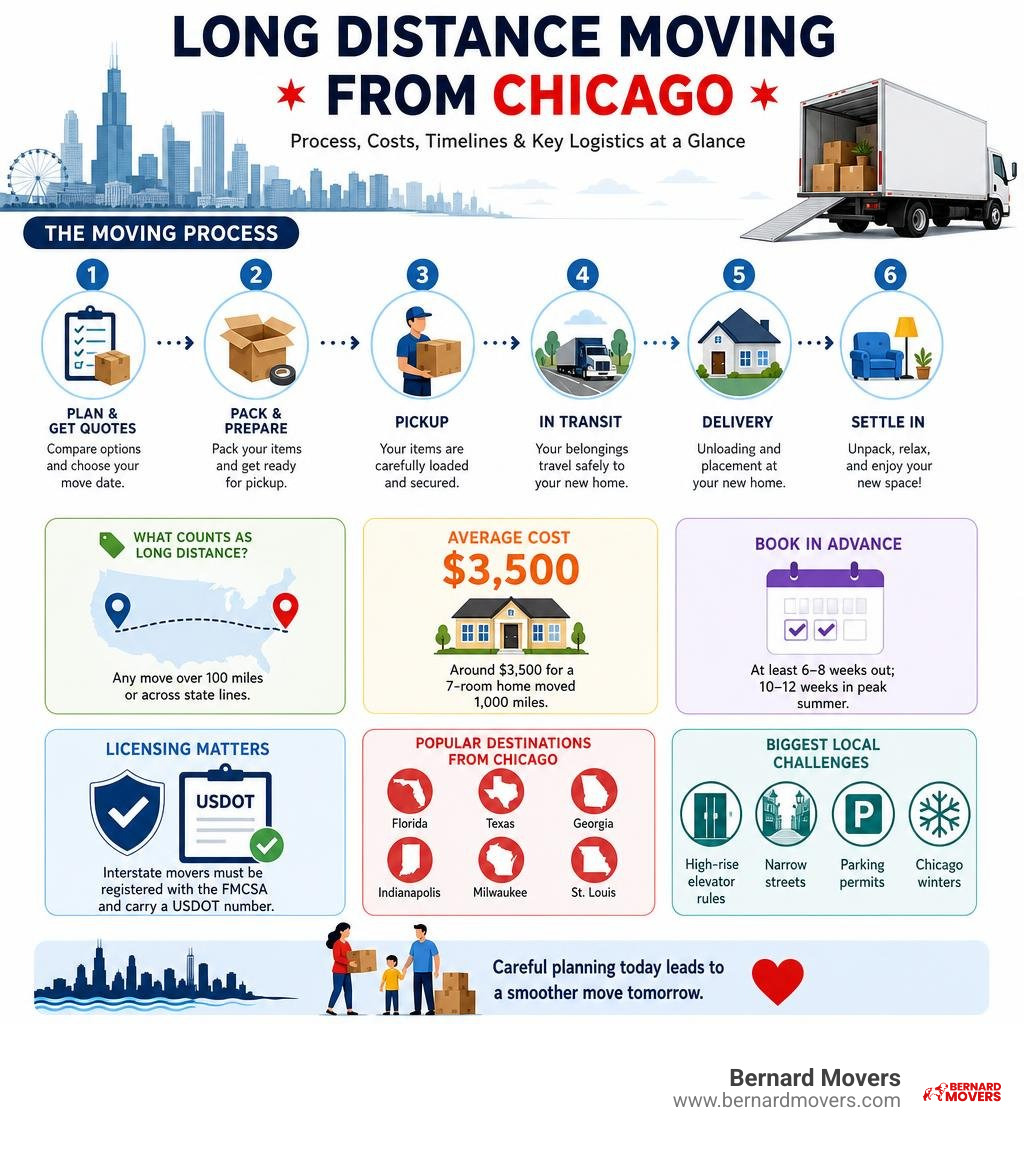
- What counts as long distance? Any move over 100 miles or across state lines.
- Average cost: Around $3,500 for a 7-room home moved 1,000 miles.
- Book in advance: At least 6–8 weeks out; 10–12 weeks in peak summer.
- Licensing matters: Interstate movers must be registered with the FMCSA and carry a USDOT number.
- Popular destinations from Chicago: Florida, Texas, Georgia, Indianapolis, Milwaukee, and St. Louis.
- Biggest local challenges: High-rise elevator rules, narrow streets, parking permits, and Chicago winters.
Chicago is the third-largest city in the United States, home to nearly 2.7 million residents spread across more than 77 neighborhoods. Cook County alone has over 5.1 million people — making it one of the busiest moving regions in the country.
That scale creates real logistical pressure. You’re not just packing boxes. You’re coordinating parking permits, elevator access, interstate regulations, and hundreds (or thousands) of miles of transit — all while trying to keep your family’s life on track.
Many families relocating out of Illinois head to states like Florida and Texas. If that’s you, the stakes feel even higher. The further you go, the more things can go wrong — and the harder they are to fix from a distance.
This guide walks you through everything you need to make a smart, stress-free long distance move from Chicago or Melrose Park.
Basic long distance moving Chicago glossary:
Navigating Long Distance Moving Chicago Logistics

When you cross state lines, your move transitions from a simple haul to a highly regulated federal transport process. In the moving industry, any relocation that crosses state lines or exceeds a 100-mile threshold is legally classified as a long-distance or interstate move. This means the transport is governed by federal laws rather than just Illinois state regulations. These federal rules are designed to protect consumers from fraudulent operators and ensure that safety standards are maintained across state borders.
To protect your belongings and ensure a legal transit, we strictly adhere to all Federal Motor Carrier Safety Administration (FMCSA) guidelines and maintain active U.S. Department of Transportation (USDOT) licensing. Working with a registered carrier is non-negotiable for cross-country moves. Before hiring any interstate mover, you can verify registration details through the FMCSA mover search tool. Unlicensed movers often try to bypass highway inspection checkpoints by operating unmarked rental trucks, which can lead to severe transit delays or impounded shipments. Legitimate carriers are also required by law to provide you with the federal “Your Rights and Responsibilities When You Move” booklet, which outlines your legal protections during an interstate relocation.
Before signing any contract, we highly recommend reading our Interstate Moving Companies Ultimate Guide to understand how professional carriers operate. You can also research competitive Interstate Moving Company Rates to understand how legitimate, licensed companies structure their long-haul tariffs when moving companies across state lines.
What to Expect from Long Distance Moving Chicago Costs
Understanding how interstate moving tariffs are calculated will save you from major surprises. Unlike local moves that are billed at an hourly rate, long-distance moving costs are calculated based on two primary factors: the total weight of your shipment and the total distance traveled. Additional accessorial services, such as custom crating, stair carries, or long carries (where the truck cannot park close to your entrance), can also influence the final price.
According to national moving statistics, the average cost of a long-distance move is approximately $3,500. This benchmark is based on an average shipment weight of 7,000 pounds (typically a 7-room household) traveling a distance of 1,000 miles.
When you request a quote, a professional estimator will conduct an in-person or virtual walkthrough to inventory your home. To learn more about how these numbers are generated, read our Long Distance Movers Cost Guide or explore our breakdown of the Average Cost to Move a 3 Bedroom House Long Distance.
To ensure complete pricing transparency, always insist on a binding estimate. A binding estimate guarantees that you will not pay more than the quoted price as long as your inventory does not change. If you add items on moving day, the mover can draft an amendment, but a binding agreement protects you from unexpected price hikes at delivery. For a deeper look into pricing structures, check out Moving Rates Unpacked What to Expect from Long Distance Quotes.
Choosing Your Long Distance Moving Chicago Service Type
We believe every household deserves flexibility when planning a cross-country relocation. That is why we provide two distinct service models for long-distance transit:
- Expedited Moving: This service places your belongings on an exclusive truck dedicated solely to your move. You receive guaranteed pickup and delivery dates, a faster transit time, and the exact same crew handling your items from start to finish. This is ideal for time-sensitive moves or larger households. Learn more about our Expedited Moving Services.
- Consolidated Moving: If you are working with a flexible timeline and want to utilize the most affordable way to move long distance, consolidated moving is an excellent choice. With this option, your shipment shares truck space with other customers traveling along the same geographic route. While delivery windows are wider, it dramatically lowers your overall transportation costs because fuel and labor expenses are shared among multiple shipments.
Planning Your Out-of-State Relocation
Relocating across the country requires a fully managed approach to logistics. When you are planning to move out of state, you are not just shifting boxes—you are coordinating a major life transition. Successful out of state moving relies heavily on route coordination, securing proper transit permits, and managing the timing between your move-out date in Illinois and your move-in date at your new destination.
Overcoming Chicago-Specific Relocation Challenges
Moving out of the Chicago metropolitan area presents a unique set of structural and environmental challenges. Whether you are moving from a historic home in Hyde Park, a high-rise in Streeterville, or a suburban property in Melrose Park, local logistics require expert navigation.
Narrow streets, low-hanging tree branches, and strict neighborhood parking restrictions can make parking a massive commercial moving truck nearly impossible without city-approved parking permits. In Chicago, you must secure a residential parking permit or a temporary “No Parking” sign from the local alderman’s office or the Chicago Department of Transportation (CDOT) at least 3 to 5 days before your move. Furthermore, if you are moving out of a multi-unit building, you must coordinate with building management weeks in advance to reserve freight elevator schedules and adhere to strict building association rules. To prepare for these hurdles, review our guide on High Rise Moving.
We also operate extensively throughout the surrounding suburbs, helping families navigate transitions in areas like Park Ridge and coordinating logistics in Franklin Park. Our teams are fully prepared to handle these tight spaces, and we are equally equipped to manage the brutal wind, bitter cold, and heavy snow of Chicago’s winter weather. For practical advice on managing these local quirks, read How to Move in Chicago Without Losing Your Marbles.
Packing, Storage, and Prohibited Items

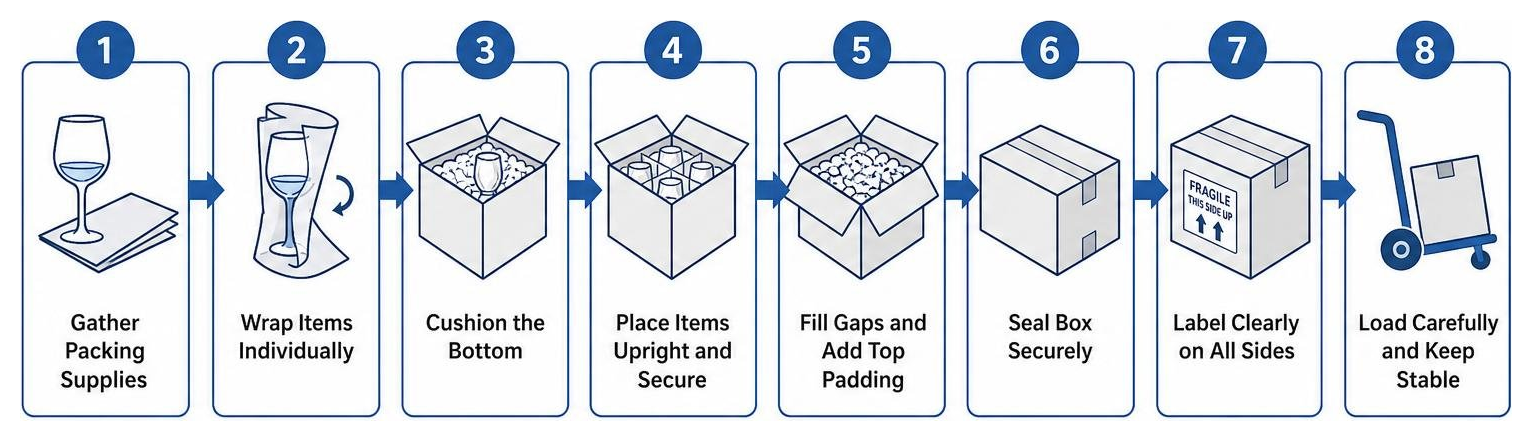
A successful long-distance transit depends heavily on how your items are packed. Road vibrations over hundreds of miles can cause items to shift inside the truck. Our professional packing services utilize premium moving blankets, heavy-duty padding, shrink wrap, and specialized stacking techniques to secure your furniture and valuables. We also recommend creating a detailed high-value inventory list for items worth more than $100 per pound, ensuring they are properly documented and covered under your chosen valuation plan.
If your new home isn’t quite ready when your shipment arrives, we offer secure, monitored storage solutions. Our climate-controlled facilities keep your sensitive wooden furniture, electronics, and artwork safe from seasonal temperature extremes. For a complete look at our integrated relocation and storage options, explore Long Distance Moving and Storage Chicago.
Before you begin packing, it is critical to understand that long-distance movers are legally prohibited from transporting certain items. These restrictions exist for safety and compliance with federal transit laws.
Prohibited Items Include:
- Hazardous Materials: Aerosols, propane tanks, paint, paint thinners, gasoline, fireworks, and matches.
- Perishable Goods: Frozen food, fresh produce, and open food containers.
- Restricted Personal Items: Prescription medications, cash, high-value jewelry, open liquid bottles, and alcohol.
For a comprehensive breakdown of packing protocols, read our Packing and Moving Cross Country Tips for a Sane Relocation and learn how to pack fragile items for long distance move safely.
Corporate Relocation and Scheduling Timelines
Coordinating a corporate move requires balancing business continuity with personal transition. When managing an employee relocation Chicago complete guide, minimizing downtime is the top priority. Moving sensitive office equipment, servers, and professional workstations requires specialized commercial handling and meticulous inventory tracking.
Timing is everything. The moving industry experiences peak demand during the summer season (typically May through September). If you plan to relocate during these busy months, we suggest booking your moving date at least 10 to 12 weeks in advance. For off-peak moves, 6 to 8 weeks is usually sufficient. To stay on track, download our comprehensive Moving Out of State Checklist and learn more about our specialized Corporate Relocation Services.
Finding Your Trusted Chicago Relocation Partner
Choosing a reliable relocation partner is the most important decision you will make during your cross-country journey. A reputable moving company should have decades of local experience, highly rated customer reviews, and a deep understanding of Midwestern logistics.
If you are planning to leave Illinois, you are not alone; many families are currently relocating to high-growth southern states. At Bernard Movers, we specialize in these exact long-distance routes. To help make your transition as smooth and affordable as possible, we are proud to offer an exclusive 20% additional discount on moves to Georgia and Florida booked for delivery by March 15, 2025.
Whether you are moving from Chicago, Melrose Park, or any of our other active service areas across Illinois, our experienced team is here to manage the heavy lifting. To learn more about selecting the right team, read Illinois Long Distance Moving How to Choose the Best Relocation Partner and check out our guide on moving from Chicago to Florida. We serve a wide range of locations, including Elmhurst and other surrounding communities, to ensure comprehensive geographic coverage.
Ready to plan your cross-country move? Contact us today to receive an accurate, customized moving estimate from the premier Chicago Moving Companies in the industry.