

Choose the Right Cross-Country Shipping Option First
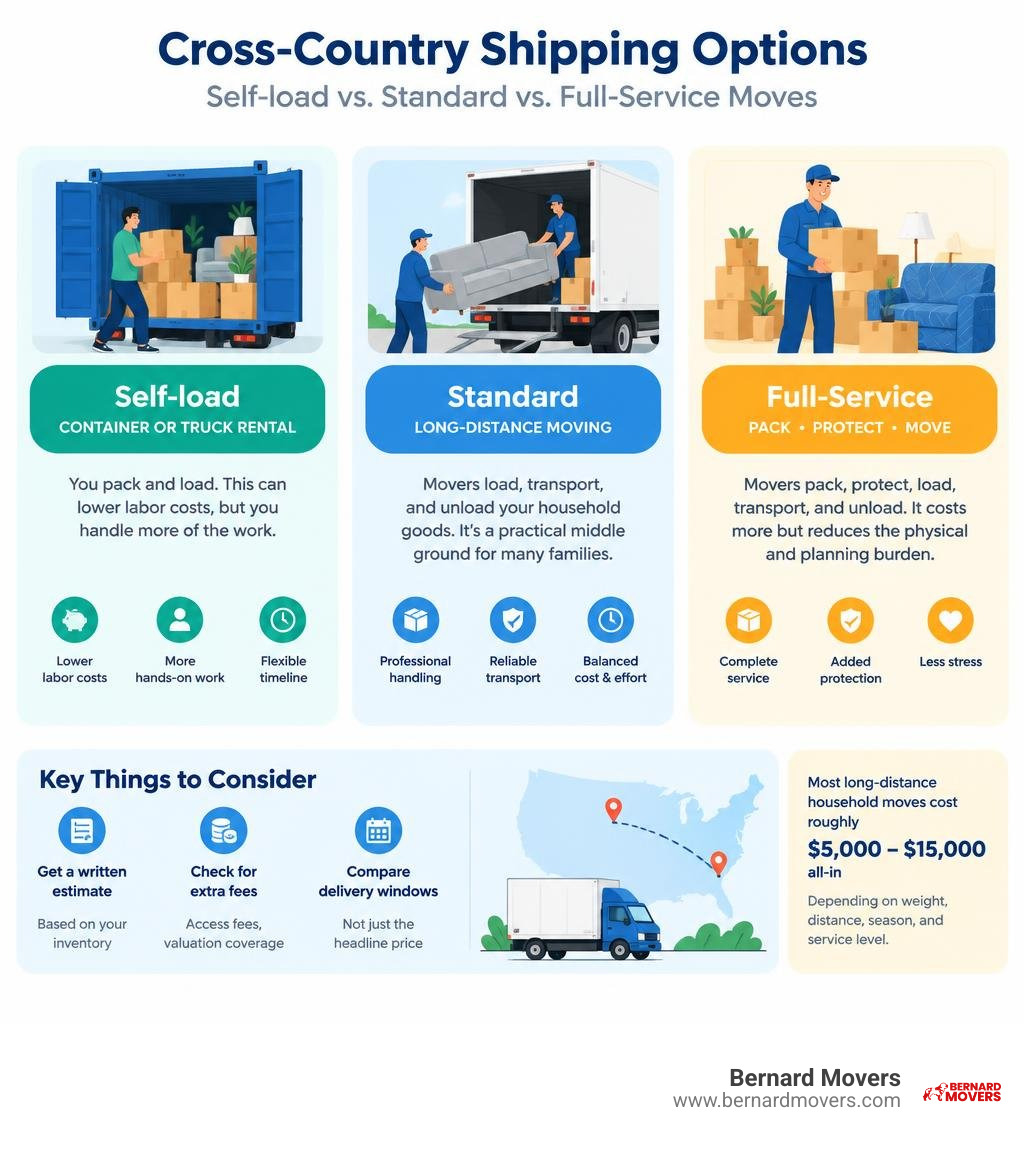
When planning for moving across the country, shipping your household goods requires matching the service method directly to your household budget, relocation timeline, and the volume of physical labor you are willing to manage personally:
- Self-load container or truck rental: You handle all packing, wrapping, and loading yourself. While this reduces upfront labor costs, it demands significant physical effort, equipment sourcing, and rigorous packing discipline to prevent highway transit damage.
- Standard long-distance moving: Professional movers manage loading, linehaul transport, and destination unloading. This approach provides a practical middle ground for Illinois families seeking professional handling without full packing fees.
- Full-service moving: Professional movers handle packing, custom padding, loading, linehaul freight transit, and destination unloading. While it requires a higher financial investment, it eliminates the immense physical strain and planning burden of an interstate relocation.
For families planning an interstate departure from Chicago, Melrose Park, or surrounding Illinois suburbs, evaluating a detailed written estimate based on a thorough physical or virtual inventory is essential. Inquire whether your quote includes potential accessorial fees, fuel surcharges, and comprehensive valuation coverage, and compare binding delivery windows rather than simply selecting the lowest headline price. On average, long-distance household moves from Illinois range from $5,000 to $15,000 all-in, dictated by total shipment weight, exact mileage, seasonal demand, and chosen service tiers.
Initial low-ball quotes often escalate when long carries, multi-story stairs, narrow suburban driveways, packing labor, and transit storage are factored in later. Reviewing the advantages of full service moving across country helps clarify which tasks are best delegated to professionals. Planning early is crucial, especially when evaluating the best way to move cross country or deciding whether modular solutions like moving cubes cross country suit your timeframe.
Understanding Modern Cross-Country Relocation Logistics

Navigating long-distance freight involves precise planning and strict adherence to federal transportation standards. When managing an interstate move, logistics revolve around two primary metrics: total shipment weight (measured in certified gross and tare pounds) and overall cubic volume. Federal motor carrier regulations govern how interstate shipments are officially weighed at certified weigh stations, manifested on formal bills of lading, and transported across state borders.
Originating a move from key Midwestern transit hubs such as Chicago or Melrose Park requires coordinating around busy metropolitan arterial routes, commercial parking restrictions, and multi-state transit corridors. Illinois serves as a central junction for transcontinental freight lines connecting the East Coast, the Sun Belt, and the Pacific Northwest. Coordinating an interstate route demands accounting for regional weigh stations, Department of Transportation rest mandates for drivers, and variable delivery windows dictated by distance.
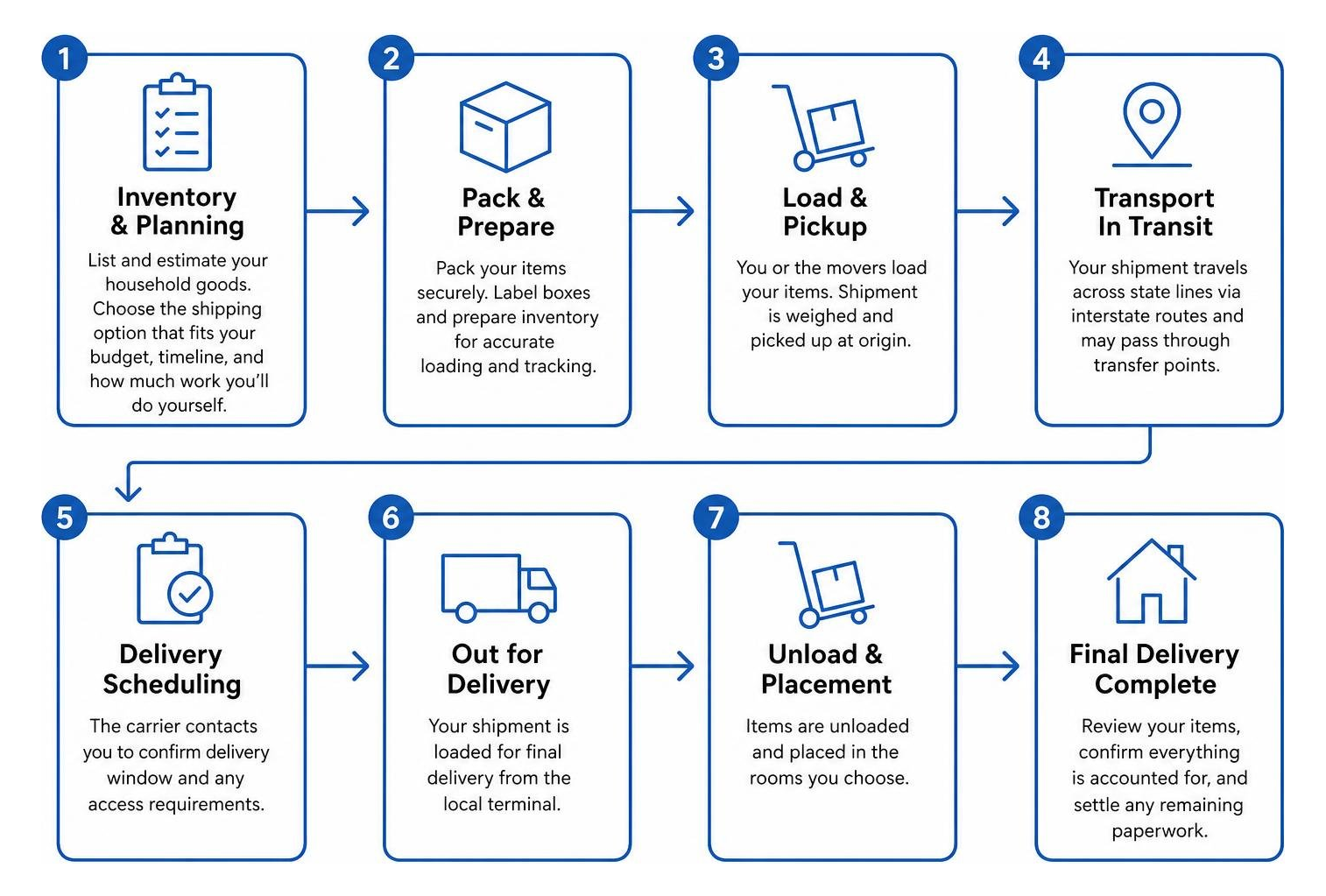
As of 2026, macroeconomic factors have fundamentally shifted freight economics across the United States. From departure in Cook County to destination delivery across state lines, your shipment journeys through regional transfer points and interstate highway networks where carrier route efficiency, dedicated linehaul scheduling, and load consolidation dictate the final delivery timeframe.
Comparing Moving Across the Country Shipping Methods and Service Models

Selecting an optimal transportation model depends on balancing budget limitations against the physical labor you are willing to undertake. Long-haul carriers leverage freight consolidation and dedicated linehaul routes to transport household goods across regional corridors efficiently.
Freight Containers and Self-Load Moving Across the Country Shipping
Self-load freight containers offer a modular alternative to traditional moves. Under this model, a carrier drops a container curbside at your residence in Chicago, Evanston, Melrose Park, or Oak Park. You manage all packing, staging, and loading within an allotted window, after which the carrier transports the container across interstate freight lanes to your destination.
Utilizing moving cubes cross country gives you flexible loading intervals, making it a viable option for smaller shipments. If you prefer driving yourself, renting a commercial moving truck eliminates freight transit schedules altogether, though it requires handling all long-distance highway driving, fuel stops, and toll logistics across multiple states.
Full-Service Solutions for Moving Across the Country Shipping
For homeowners seeking an end-to-end relocation experience, full-service cross-country moving manages every stage of the process. Professional crews handle custom wrapping, heavy lifting, specialty crating for fragile artwork, secure loading, and linehaul transport.
Whether you require comprehensive cross-country relocation services for an entire estate or specialized handling for shipping single furniture pieces, full-service crews protect your property against the rigors of multi-day highway transit using professional-grade padding and secure tie-downs.
Evaluating Real 2026 Freight and Operational Cost Drivers
Since 2020, sustained cost spikes across operational inputs have altered moving industry rates. Long-haul carrier expenses have surged dramatically across national transit lanes:
- Diesel Fuel: Average diesel costs climbed over 47%, rising from $2.55 per gallon in 2020 to $3.76 in 2025.
- Equipment & Fleet: Monthly truck and trailer payments rose 52.3% since 2019, while new moving trailer MSRPs climbed 44.5% (from $80,185 in 2020 to $115,870 by 2025).
- Insurance Overheads: Commercial carrier insurance premiums climbed 40.92%, with commercial auto liability rates surging 88.28%.
- Warehousing & Storage: Warehouse lease rates rose 50% nationally, with regional spikes reaching 60% to 70% in Midwestern distribution hubs.
- Packing Supplies: Industrial packaging materials experienced steep inflation, with corrugated boxes up 35%, bubble wrap and stretch film up 45%, and protective mattress covers up 40%.
- Skilled Labor: Blue-collar transportation and material handling wages increased 18% to 22%.
| Service Model | 1-Bedroom (2,000-4,000 lbs) | 2-3 Bedrooms (4,000-8,000 lbs) | 4+ Bedrooms (10,000+ lbs) | Labor Requirement |
|---|---|---|---|---|
| Self-Load Container | $2,200 – $4,100 | $3,800 – $7,200 | $6,500 – $10,800 | Full DIY packing & loading |
| Standard Professional Move | $3,400 – $5,800 | $5,500 – $9,800 | $9,000 – $14,500 | Loading, transit, unloading |
| Full-Pack & Custom Crating | $4,500 – $7,200 | $7,500 – $13,200 | $12,000 – $18,500+ | Zero physical effort required |
For consumer rights, interstate tariff rules, and federal carrier safety records, consult the Federal Motor Carrier Safety Administration.
How to Plan, Budget, and Protect Your Interstate Relocation
Accurate interstate budgeting requires accounting for logistical variables that sit outside base mileage rates. Departures from Illinois headed toward Sun Belt, East Coast, or Western destinations involve regional permits, toll networks, and local access constraints that should be documented early in your planning cycle.
Navigating Hidden Line Items and Accessorial Fees
The final moving invoice often lands 20% to 35% higher than initial base quotes due to accessorial fees:
- Long-Carry Fees: Charged when a semi-trailer cannot park within 75 feet of your residence entrance, typically billed at $1 to $2 per foot per loaded item over standard distances.
- Stair and Flight Fees: Applied when crews must navigate multiple flights of stairs or tight apartment building stairwells in multi-level residential structures.
- Shuttle Fees: If congested urban streets in Chicago or destination neighborhoods cannot accommodate an 18-wheel tractor-trailer, goods must be transferred to a smaller shuttle truck.
- Storage-In-Transit (SIT): Necessary if your destination residence is not ready for immediate delivery upon carrier arrival.
Reviewing our interstate moving estimates guide and examining practical considerations for out of state relocation will help prevent unexpected line items on moving day.
Selecting Proper Valuation Coverage and Crew Gratuities
Federal law mandates that interstate carriers provide basic Released-Value Protection at no additional charge. However, this caps carrier liability at $0.60 per pound per article. Under default coverage, a destroyed 50-pound flat-screen television worth $1,000 yields a reimbursement of only $30. Upgrading to Full-Value Protection (typically costing $5 to $15 per $1,000 of declared household value) ensures items are repaired, replaced, or compensated at true market value.
Tipping long-haul crews is standard practice for exceptional care and heavy labor. Customary gratuity ranges from $50 to $100 per crew member at pickup and a matching amount for the unloading crew at delivery.
Strategic Timing and Cost-Saving Relocation Tactics
Strategic scheduling reduces moving costs significantly. Moving during the off-season—between September and April—yields savings of 15% to 25% compared to peak summer dates. Booking mid-month dates on a Tuesday, Wednesday, or Thursday further optimizes pricing compared to high-demand weekend slots.
Downsizing your household inventory before requesting a quote reduces shipment weight. For hands-on strategies, read our guide on budget cross-country packing alongside essential packing and moving tips.
When you are ready to plan your relocation, our team at Bernard Movers provides reliable interstate service. As experienced Chicago long-distance movers serving Melrose Park and the greater Chicago metropolitan area, we deliver transparent estimates and professional transport across the country.