

Finding Reliable Movers in the Chicago Suburbs: What You Need to Know
If you’re searching for movers in the Chicago suburbs, here’s a quick look at the top factors to consider before you hire:
- Verify licensing — Check for a valid USDOT number and Illinois Commerce Commission registration.
- Confirm insurance — Active liability coverage protects your belongings during the move.
- Read reviews — Look for consistent patterns on Google and Yelp, not just star ratings.
- Match the mover to your move type — Local suburban moves and long-distance relocations need different expertise.
- Get a written estimate — Always request an upfront, itemized quote before committing.
Moving within or out of the Chicago suburbs is a different experience than moving inside the city. Suburban communities like Melrose Park, Evanston, and Glenview come with their own challenges — think longer travel distances between neighborhoods, HOA parking rules, and streets that weren’t built with large moving trucks in mind.
Add in the unpredictability of Illinois traffic on I-290 or I-294, and it’s easy to see why so many families feel stressed before the first box is even packed.
The good news? Knowing what to look for in a suburban mover makes the whole process far less overwhelming.
This guide breaks down everything you need — from licensing and insurance to pricing and specialized services — so you can make a confident, informed decision.
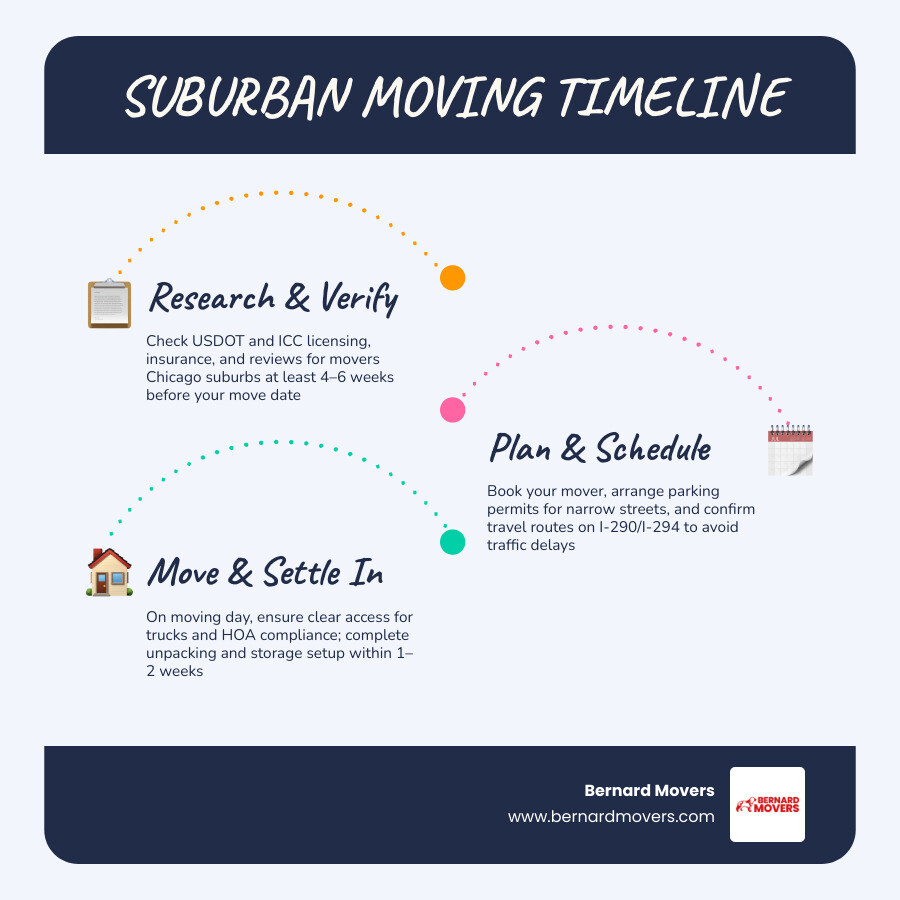
Simple guide to movers Chicago suburbs:
- long distance moving Chicago
- moving services chicago il
- same day movers
How to Choose the Best Movers Chicago Suburbs Offers
Finding the right team to handle your belongings in the Chicago suburbs is about more than just typing “movers near me” into a search engine. Suburban moves require a different level of logistical planning than a quick apartment hop in the Loop.
When you’re relocating to or from areas like Elmhurst, Park Ridge, or Wilmette, you need a company that understands the suburban landscape. This means knowing which neighborhoods have strict street parking regulations, how to navigate low-clearance trees in older suburbs like Evanston, and how to manage transit times when navigating the Tri-State Tollway.
Licensing and Insurance for Movers Chicago Suburbs
The absolute first step in vetting any moving company is verifying their legal credentials. In the state of Illinois, moving companies must be registered with the Illinois Commerce Commission for intrastate moves. If they cross state lines, they must also hold active credentials with the Federal Motor Carrier Safety Administration and have a valid USDOT number.
Working with licensed local movers chicago il ensures that you are protected by state consumer safety regulations.
Insurance is just as critical. A legitimate business will carry active cargo insurance and general liability coverage. This protects your household goods from unexpected damage during transit and shields you from liability if an accident occurs on your property. When researching moving companies chicago il, never hesitate to ask for proof of active insurance policies.
Navigating Suburban Logistics: Parking, Permits, and HOA Rules
Unlike the city where you often deal with tight alleyways and metered parking, the Chicago suburbs present a different set of logistical hurdles. In communities like Naperville, Oak Park, or Arlington Heights, local ordinances can vary wildly. Some suburbs require overnight parking permits for moving trucks, while others restrict commercial vehicles from parking on residential streets altogether.
Furthermore, if you are moving into a gated community or a condominium complex in areas like Schaumburg or Northbrook, you will likely have to coordinate with a Homeowners Association (HOA). HOAs often have strict rules regarding moving hours, elevator reservations, and where moving trucks can park to avoid blocking emergency lanes. A professional moving company familiar with the Chicago suburbs will know how to navigate these local regulations, ensuring you avoid costly fines or delays on moving day.
Evaluating Reputation and Reviews of Movers Chicago Suburbs
While licensing keeps things legal, customer feedback tells you how a company actually operates on moving day. When looking at Google reviews and Yelp ratings, look for detailed stories rather than just the overall star rating.
Pay close attention to how companies handle challenges. A great track record isn’t just about flawless moves; it’s about how a team resolves issues when they arise. Look for mentions of punctuality, care with fragile items, and clear communication.
To find the best movers near me, cross-reference third-party platforms with the company’s dedicated customer reviews page. Be on the lookout for red flags, such as sudden price hikes on moving day, extremely lowball estimates that seem too good to be true, or a lack of physical address.
Local vs. Long-Distance Suburban Moves
Are you moving from Melrose Park to Glenview, or are you packing up for a move across state lines? The logistics of these two projects are entirely different.
- Local Suburban Moves: These are typically charged by the hour. The focus is on efficiency, careful packing, and navigating local traffic. Having a team with deep roots in chicago local moving means they know the best routes to take to avoid construction bottlenecks.
- Long-Distance Relocations: These are priced by weight or volume and distance. They require interstate authority and meticulous tracking.
Whether you need local professional moving services or help moving to another state, we coordinate the entire process from our central Melrose Park hub to keep your transition seamless.
Essential Services and Costs for Suburban Relocations
Suburban homes often have more square footage, more furniture, and more complex layouts than city apartments. This means your moving plan should be tailored to the specific layout of your home.
Full-Service Packing and Storage Solutions
For many busy families in suburbs like Skokie, Northbrook, or Winnetka, packing is the most exhausting part of the process. Opting for a full-service package means professional packers handle everything from your delicate glassware to your basement storage racks.
If your new home isn’t quite ready, or if you are downsizing, you may also need temporary storage. Combining your move with secure storage options keeps your belongings safe without the hassle of coordinating with separate self-storage facilities. To learn more about how this works, check out our full service moving complete guide and explore our professional packing services chicago il.
Specialized Moving for Pianos and Heavy Items
Not all household items fit neatly into a standard moving box. If you have a grand piano in your living room or a heavy treadmill in your basement, you need specialized equipment and training.
Moving heavy items down narrow suburban basement stairs or around tight corners requires specific safety protocols to prevent personal injury and property damage. We use specialized techniques for piano moving chicago to ensure these delicate instruments are transported without a scratch. For other oversized belongings, consult our heavy item movers complete guide.
How to Prepare for Your Suburban Move: A Step-by-Step Checklist
To ensure your moving day goes as smoothly as possible, preparation is key. Here is a quick checklist designed specifically for suburban relocations:
- 8 Weeks Before: Declutter your home. Suburban homes often accumulate years of belongings in basements, attics, and multi-car garages. Host a garage sale or donate items you no longer need.
- 6 Weeks Before: Research and book your movers. Secure your date early, especially if you are moving during the busy summer peak season.
- 4 Weeks Before: Notify utility companies (gas, electricity, water, internet) of your move date. Ensure services are transferred so you aren’t left in the dark at your new suburban home.
- 2 Weeks Before: Check with your local municipality regarding parking permits for the moving truck. If you live in an HOA, submit any required moving notices.
- 1 Week Before: Pack an “essentials box” containing toiletries, a change of clothes, basic tools, chargers, and important documents. Keep this with you instead of loading it onto the truck.
Understanding Suburban Moving Costs and Pricing
How much does it actually cost to hire movers in the Chicago suburbs? Pricing is influenced by several key factors: the size of your home, the distance between locations, the time of year, and any specialized services you require.
To help you plan your budget, here is a general breakdown of average suburban moving costs:
| Home Size | Average Number of Movers | Estimated Hours | Average Cost Range |
|---|---|---|---|
| 1–2 Bedroom Apartment | 2 Movers | 3–5 Hours | $450 – $800 |
| 3 Bedroom House | 3 Movers | 6–8 Hours | $900 – $1,600 |
| 4+ Bedroom House | 4+ Movers | 8–12+ Hours | $1,800 – $3,200+ |
To get a clearer picture of how these rates are calculated, read through our moving cost chicago complete guide.
When you are ready to plan your budget, working with experienced moving companies chicago il like Bernard Movers ensures you receive a clear, upfront written estimate with no hidden surprises. Whether you are moving down the street in Melrose Park or relocating across the country, we are here to make your suburban transition smooth, safe, and stress-free.