


Why Moving a Piano Requires Expert Handling
When you need to ship a piano, you’re not just moving another piece of furniture; you’re transporting a complex, delicate, and often priceless instrument. Understanding the intricacies involved is the first step toward a successful move. Here’s what you need to know:
Quick Answer: The Three Main Ways to Ship a Piano
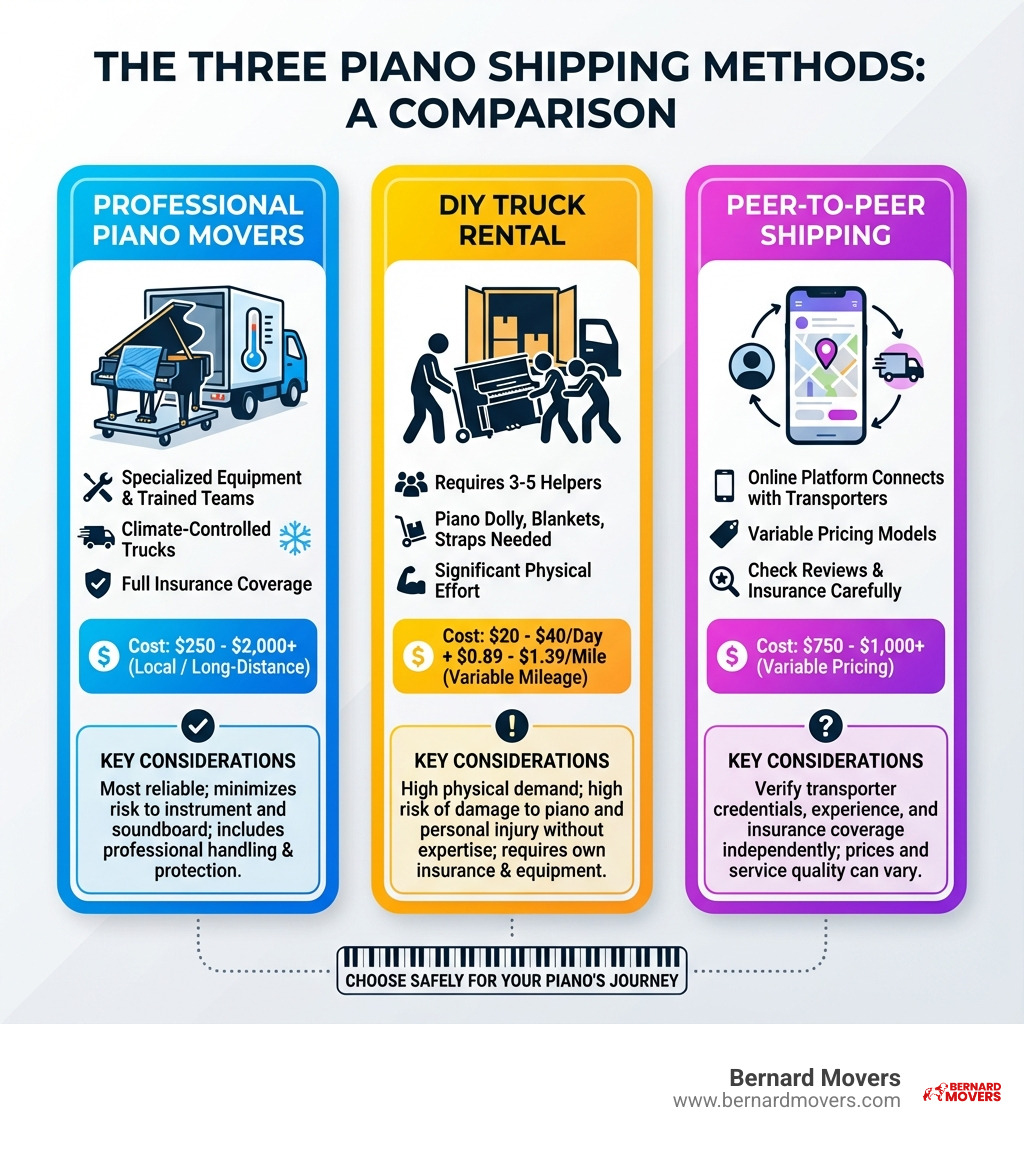
- Professional Piano Movers – The most reliable and secure option. Specialists use proper equipment and offer comprehensive insurance. Costs range from $250-$1,000 for local moves in the Chicago/Illinois area and $500-$2,000+ for long-distance shipping.
- DIY Truck Rental – The most hands-on approach. This requires renting a truck, securing specialized equipment, and recruiting 3-5 strong helpers. The base cost is low ($20-$40/day for a truck plus $0.89-$1.39/mile), but the risk of costly damage is extremely high.
- Peer-to-Peer Shipping Services – Online marketplaces that connect you with independent transporters. Costs can be variable, often ranging from $750-$1,000+, but quality and expertise are not guaranteed.
Pianos are deceptive marvels of engineering. They aren’t just heavy—they are a combination of immense weight and extreme fragility. The variety in size and weight is vast: a small spinet or console piano can weigh 300-500 pounds, a full-size upright can be 500-800 pounds, and a baby grand often starts around 600 pounds. At the top end, concert grand pianos can easily exceed 1,300 pounds. Crucially, this weight is not evenly distributed; the cast-iron plate (or harp) holding the strings accounts for most of the mass, creating a high and unstable center of gravity that makes them awkward and dangerous to lift without proper technique. Inside the beautiful wooden case are over 10,000 moving parts, all working in harmony. The strings are under immense tension, collectively exerting over 20 tons of pressure on the frame. A single jolt or drop can have catastrophic consequences.
The delicate internal mechanisms are highly susceptible to damage. The soundboard, a large, thin wooden plate, amplifies the strings’ vibrations but can crack with impact or drastic humidity changes. The pin block, a dense block of wood that holds the tuning pins, can be compromised by moisture, causing the piano to lose its ability to stay in tune. The intricate action, consisting of thousands of tiny wooden and felt parts, can be easily jarred out of alignment. These components are all vulnerable to improper handling, sudden temperature fluctuations, or changes in humidity during transport. Exposure to a damp environment can cause wood to swell, while a dry environment can cause it to shrink and crack. The stakes are incredibly high. A cracked soundboard can cost upwards of $5,000 to repair, while a damaged pin block—the part that holds the tuning pins—might require an $8,000 rebuild. Even cosmetic damage like deep scratches or a broken leg can lead to expensive restoration work. These aren’t risks worth taking with an instrument that often holds irreplaceable sentimental value in addition to its financial worth.
Moving a piano in an urban environment like Chicago or its surrounding suburbs like Melrose Park and Elmhurst presents unique challenges. The city’s iconic architecture, from historic greystones and three-flats to modern high-rises, often features narrow hallways, tight 90-degree turns, and steep staircases. Navigating these obstacles with a heavy, unwieldy instrument requires more than just muscle; it demands a strategic approach, precise maneuvering, and specialized equipment like stair-climbing dollies and custom ramps. Attempting to pivot a grand piano in a tight vestibule or hoist an upright up multiple flights of stairs without experience is a recipe for disaster, risking damage to the piano, the building, and the movers themselves. This is where professional expertise becomes invaluable. Whether you’re relocating within Illinois or planning a long-distance move to Florida or Georgia, understanding your options is crucial for protecting your investment.
I’m Mina Georgalas, owner and president of Bernard Movers, and I’ve spent nearly 30 years helping families and businesses in the Chicago area ship a piano safely across town and across the country. Our team specializes in handling these delicate instruments with the care and expertise they require, ensuring your peace of mind from start to finish.
Ship a piano word roundup:
How to Ship a Piano: A Step-by-Step Guide
Deciding how to ship a piano is the first critical step in ensuring its safe journey. We understand that your piano is more than just a musical instrument; it’s an heirloom, a source of joy, and a significant investment. That’s why we’re here to guide you through the various methods, their pros and cons, and how to make the best choice for your unique situation, especially for moves originating in or around our service areas like Chicago, Melrose Park, or Elmhurst.
Understanding Your Piano Shipping Options
When it comes to transporting a piano, you essentially have three primary methods: hiring professional piano movers, attempting a DIY move with a rented truck, or utilizing peer-to-peer shipping services. Each comes with its own set of considerations regarding cost, safety, and effort. To help you decide, here’s a breakdown of what each method entails:
| Method | Cost (Estimate) | Safety (Risk Level) | Required Effort (Your End) | Pros | Cons |
|---|---|---|---|---|---|
| Professional Piano Movers | $250 – $2,000+ | Low | Low | Specialized equipment, trained experts, full insurance, peace of mind. | Highest upfront cost. |
| DIY Truck Rental | $100 – $400+ | Very High | Very High | Lowest potential cost. | High risk of injury and damage, requires heavy lifting, hidden costs. |
| Peer-to-Peer Shipping | $750 – $1,000+ | Medium to High | Medium | Can be cost-effective for long distance, flexible scheduling. | Inconsistent quality, insurance uncertainty, less specialization. |
Method 1: Professional Piano Movers
This is, without a doubt, the safest and most reliable way to ship a piano. Companies like Bernard Movers are not generalists; we are specialists. Our teams are trained specifically in the art of moving pianos. We use custom equipment, including piano dollies, skid boards (also known as piano boards), heavy-duty moving blankets, and secure straps to protect every inch of your instrument. Our trucks are often equipped with climate control to protect the piano from damaging humidity and temperature swings, as well as air-ride suspension and hydraulic lift gates for the smoothest possible loading and transit.
What to Expect from a Professional Piano Move:
- Assessment: The movers will assess the piano and the route, noting any tight corners, stairs, or obstacles.
- Preparation: They will lock the keyboard lid and secure any moving parts. For grand pianos, this often involves carefully removing the lid, music rack, and pedal lyre, wrapping each piece separately.
- Wrapping: The piano is meticulously wrapped in thick moving blankets and often secured with plastic shrink wrap to keep the padding in place and protect the finish.
- Moving: The piano is carefully placed on a specialized piano dolly or skid board, which distributes the weight and allows for controlled movement. It is then carefully navigated out of the home.
- Loading: Using a hydraulic liftgate, the piano is gently raised to the level of the truck bed and rolled into a secure position, often against the front wall for maximum stability.
- Securing: The piano is strapped securely to the walls of the truck to prevent any shifting during transit.
Most importantly, professional movers carry comprehensive insurance. You will typically be offered Full Value Protection, which means the moving company is liable for the replacement value of any lost or damaged item. This is far superior to the basic, legally-required Released Value Protection, which only covers a nominal amount per pound (e.g., $0.60 per pound), a sum that would not come close to covering the cost of a damaged piano. When vetting companies, especially for interstate moves, it’s wise to verify their credentials. You can check a mover’s registration with the FMCSA to ensure they are properly licensed and insured. While the upfront cost is higher, it buys you complete peace of mind.
Method 2: DIY with a Rented Truck
The primary appeal of a DIY move is the perceived cost savings, but this path is fraught with risk. First, you’ll need to gather a team of at least 3-5 strong, capable friends who understand the plan and are able to lift heavy, awkward objects. Next, you must rent not only a truck but the right truck—ideally one with a low deck and a long, sturdy ramp with a gentle incline. A steep ramp dramatically increases the risk of the piano getting away from you. You must also rent or buy all the necessary equipment: a four-wheel piano dolly (not a two-wheel appliance dolly, which can damage the piano’s underside), at least a dozen thick moving blankets, and multiple heavy-duty straps or webbing. The physical effort is immense, and the high, unstable center of gravity makes a piano prone to tipping. The risk of serious personal injury from dropping a 500-pound object is very real. Furthermore, any damage to the piano, your old home, or your new home will come directly out of your pocket. It’s crucial to know that your homeowner’s or renter’s insurance policy will almost certainly not cover damage that occurs during a self-move, and rental truck insurance typically only covers the truck itself. A single slip can result in thousands of dollars in repairs, quickly erasing any initial savings.
Method 3: Peer-to-Peer (P2P) Shipping Services
Peer-to-peer platforms connect people who need items shipped with independent drivers or small companies heading in the same direction. This can sometimes be a cost-effective option for long-distance moves, but it comes with significant uncertainty. The person you hire may be a general freight hauler with no specific experience moving pianos. They may not have the right equipment, and their vehicle is unlikely to be climate-controlled. Insurance is a major concern; you must carefully verify what their policy covers and if it’s sufficient for your piano’s value. While you might find an experienced mover on these platforms, it requires extensive vetting.
Essential Vetting Questions for P2P Providers:
- Experience: “How many pianos of my specific type (upright, baby grand, etc.) have you moved in the last year?”
- Equipment: “What specific equipment will you use? Do you have a piano skid board, a proper dolly, thick blankets, and a truck with a liftgate or a low-angle ramp?”
- Insurance: “Can you provide a Certificate of Insurance (COI) showing your active cargo insurance policy? What is the coverage limit, and what is the deductible?” Do not rely on the platform’s insurance alone, as it is often limited.
- Process: “Can you walk me through your step-by-step process for wrapping, moving, and securing the piano?”
- References: “Can you provide references from recent piano-moving clients?”
Thoroughly read all reviews, looking for specific mentions of piano moves. Be wary of bids that seem too good to be true—they often are. The risk of hiring an unqualified individual who could cause irreparable damage is much higher in this marketplace.
