


Why Moving a Piano in a U-Haul Is Harder Than It Looks
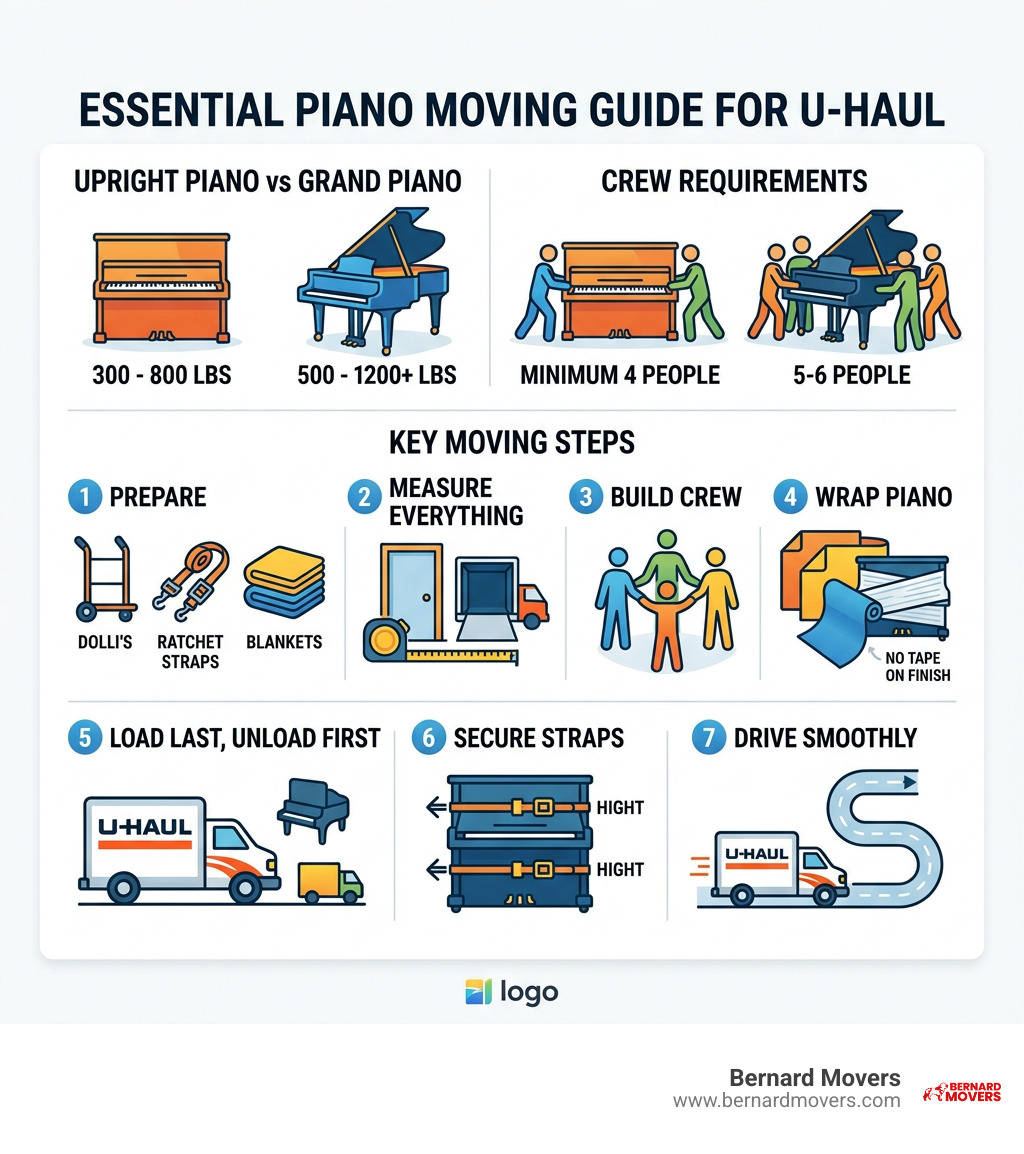
Knowing how to move a piano in a U-Haul can save you from a costly mistake — here’s the short version:
- Gather the right gear — 4-wheel dolly, ratchet straps, and thick moving blankets
- Measure everything — doorways, hallways, and the truck opening before moving an inch
- Build your crew — at least 4 people for an upright, 5-6 for a grand
- Wrap the piano completely — moving blankets first, then stretch wrap (no tape on the finish)
- Load it last, unload it first — position the piano against the front wall of the truck
- Secure with 2-3 ratchet straps at different heights, snug but not over-tightened
- Drive slowly and smoothly — no hard braking, sharp turns, or sudden starts
Pianos aren’t just heavy — they’re deceptively difficult to move. An upright piano can weigh anywhere from 300 to 800 pounds, and a grand piano can push past 1,200 pounds. That’s roughly the weight of a small car, except this one is top-heavy, has fragile legs, and contains thousands of delicate internal parts. Inside that wooden exterior is a massive cast-iron plate that holds the tension of over 200 strings, which can exert up to 20 tons of pressure. When you move a piano, you aren’t just moving furniture; you are moving a high-tension machine that is sensitive to every bump and vibration.
For families relocating from Chicago or anywhere across Illinois, the challenge gets even more real. You’re often dealing with tight city doorways, staircases in older buildings, and unpredictable weather that can make ramps slippery and pathways treacherous. The logistics of navigating a 15-foot U-Haul through narrow residential streets while carrying a half-ton instrument requires more than just muscle—it requires a strategic plan.
Most piano damage doesn’t happen on the road — it happens during loading and unloading. One wrong move on the ramp, one loose strap, or one moment of miscommunication among your crew, and you’re looking at repairs that can cost far more than the move itself. This guide walks you through everything you need to know to do it right, ensuring your instrument arrives in tune and in one piece.
Quick how to move a piano in a u-haul terms:
Essential Gear and Preparation for How to Move a Piano in a U-Haul
Before you even think about backing that U-Haul into your driveway in Melrose Park or Des Plaines, you need to understand that a piano move is a specialized operation. You cannot simply “muscle” a 700-pound upright through a hallway. Success lies in the equipment and the preparation of the environment.
The Necessity of Specialized Gear
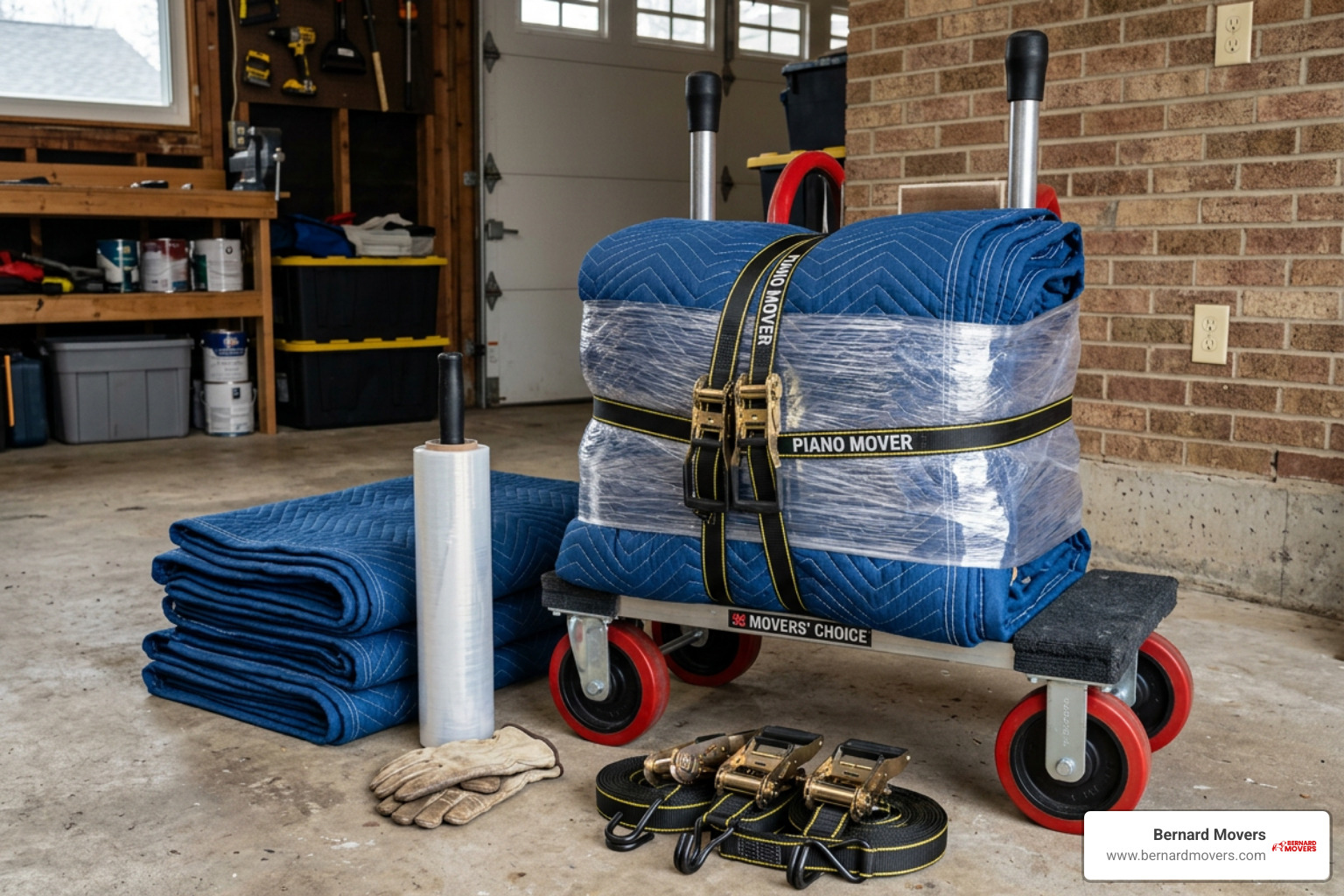
If you are attempting a DIY move, your standard household tool kit won’t cut it. To figure out how to move a piano in a u-haul safely, you need to rent or buy the following:
- 4-Wheel Furniture Dolly: Not just any dolly. You need a heavy-duty, rubber-capped, non-slip dolly rated for at least 1,000 pounds. The rubber caps are vital because they provide the friction necessary to keep the piano from sliding off the dolly frame during transitions. Avoid dollies with swivel wheels on all four corners if possible; fixed wheels on one end provide much better straight-line stability on narrow U-Haul ramps.
- Ratchet Straps: Forget bungee cords or rope. You need high-tensile nylon ratchet straps with a high break-strength rating. These allow you to apply precise, incremental tension to keep the instrument from shifting during the drive down I-90. The mechanical advantage of the ratchet ensures the piano becomes one with the truck wall.
- Furniture Pads (Moving Blankets): You’ll need at least 4 to 6 thick, professional-grade blankets. Pianos are made of softwoods and delicate veneers that scratch if you so much as look at them wrong. These pads also provide a buffer between the piano and the ratchet straps.
- Piano Skid (Piano Board): This is essential for grand pianos. It’s a specialized padded board that the piano body is strapped to once the legs are removed. It provides a flat, stable surface for the piano to rest on its side.
- Stretch Wrap and Tape: Use the wrap to hold blankets in place. Never apply tape directly to the piano’s wood finish, as it can strip the lacquer or leave permanent residue. The stretch wrap also acts as a moisture barrier.
Measuring Your Path: The “Chicago Squeeze”
In areas like Evanston or Skokie, many homes feature narrow hallways and tight 90-degree turns. You must measure the piano’s height, width, and depth, then compare those numbers to every doorway, stairwell, and hall on your route. Don’t forget to measure the U-Haul opening itself!
We often see DIY moves grind to a halt because someone “eyeballed” a doorway that turned out to be half an inch too narrow. If you’re dealing with a tight Chicago bungalow, you might even need to remove doors from their hinges to gain that extra clearance. Remember to account for the “swing” of the piano; a long upright needs more room to turn a corner than its width suggests. For more details on the tools the pros use, check out our guide on piano moving equipment.
The Importance of Communication and Commands
Before the first lift, establish a leader. Moving a piano requires synchronized effort. Use clear, one-word commands like “Lift,” “Set,” “Pivot,” and “Stop.” If one person loses their grip or feels the weight shifting, they must shout “Stop” immediately. In the tight confines of a moving truck or a narrow hallway, a lack of communication is the fastest way to sustain an injury or damage the instrument.
Step-by-Step: How to Move a Piano in a U-Haul Truck
Once your gear is ready and your path is clear, it’s time for the heavy lifting. Moving a piano is like a choreographed dance—everyone needs to know their steps before the music starts.
1. Preparing and Wrapping the Piano
Start by closing and locking the keyboard lid (the fallboard) to protect the keys. If it doesn’t lock, use a small piece of padding and stretch wrap to keep it shut. Wrap the entire body in moving blankets, overlapping them so no wood is exposed. Secure the blankets tightly with stretch wrap. Pay special attention to the corners and the pedals, as these are the most likely points of impact. For a deep dive into the packing process, see our article on how to pack a piano for moving.
2. The Lift and the Dolly
With at least two people on each side, lift the piano just enough to slide the 4-wheel dolly underneath. Center the piano on the dolly perfectly. For uprights, the back of the piano is where the weight is concentrated. If the piano is top-heavy (which most are), ensure your strongest helpers are on the “downhill” side of any incline. Never attempt to roll the piano on its own small brass casters; they are designed for minor adjustments in a room, not for moving across different surfaces.
3. Navigating the Ramp
This is the most dangerous part of how to move a piano in a u-haul. Pull the U-Haul ramp out fully and ensure it is locked into the slots.
- Upward: One person should be inside the truck pulling the dolly, while 3-4 people push from behind. The person inside acts as the guide, ensuring the wheels stay centered on the ramp.
- Downward: Never let the piano get ahead of you. The people at the bottom of the ramp are there to slow the momentum, not just guide it. Keep the piano tilted slightly back toward the uphill side to maintain control.
4. Positioning Inside the Truck
Place the piano against the “attic” wall (the front wall closest to the cab). This is the most stable part of the truck and experiences the least amount of “bounce” from the rear suspension. Always keep an upright piano… well, upright. Laying it on its back or side can cause the internal hammers and strings to shift or break. For grand pianos, they are placed on their long, flat side on a piano board, with the straight edge facing down.
Safety Tips for How to Move a Piano in a U-Haul Trailer
If you’ve opted for a U-Haul trailer instead of a box truck, the rules change slightly. Trailers often have a lower center of gravity but can be “bouncier” on the road due to their lighter weight.
- Keyboard-to-Wall Placement: Position the piano so the keyboard side is facing the wall of the trailer. This protects the delicate keys and pedals from any shifting cargo. Ensure there is a thick layer of padding between the keyboard and the trailer wall.
- Utilizing Rub Rails and E-Tracks: U-Haul trucks and trailers come equipped with rub rails or E-track systems. Thread your ratchet straps through these points. Use at least two straps: one across the upper third of the piano and one across the middle. This prevents the piano from tipping forward or sliding laterally.
- The “Shake Test”: Once strapped, give the piano a firm shake. If it moves even a fraction of an inch, tighten the straps. However, don’t over-tighten; you want it snug like a firm handshake, not so tight that you crack the wooden frame or compress the soundboard.
- Padding the Straps: Place a folded moving blanket or a piece of cardboard between the ratchet strap and the piano. The pressure of the strap during a long drive can “bite” into the wood or the finish if it isn’t padded properly.
- Highway Safety: When driving through Illinois, especially on windy stretches or near construction zones, avoid sudden lane changes. Check your straps after the first 10 miles; vibrations often cause straps to settle and loosen. Learn more about securing a piano in a moving truck.
Handling Upright vs. Grand Pianos Safely
The technique for an upright is vastly different from a grand. An upright is a heavy box; a grand is a heavy, awkward puzzle.
| Feature | Upright Piano | Grand / Baby Grand |
|---|---|---|
| Average Weight | 300 – 800 lbs | 600 – 1,400 lbs |
| Minimum Crew | 4 People | 5 – 6 People |
| Disassembly | Minimal (Lid/Panels) | Extensive (Legs, Lyre, Lid) |
| Main Risk | Tipping over (Top-heavy) | Leg collapse / Plate cracking |
| Transport Position | Always Upright | On its side (on a skid board) |
The Grand Challenge
To move a grand piano, you must remove the legs. This starts by removing the leg to the left of the keyboard and gently tipping the piano onto a padded piano skid. This is a high-risk maneuver that requires a “spotter” who does nothing but watch the balance. The pedals (the lyre) must also be removed and wrapped separately. Because of the extreme weight and complexity, we strongly recommend professional help for any instrument over 6 feet. One mistake during the leg removal can cause the entire instrument to crash to the floor.
Unloading and Acclimation in the Chicago Climate
You’ve arrived at your new home in Park Ridge or Wilmette. The hard part is over, right? Not quite. Unloading is where fatigue sets in, and fatigue leads to accidents. Ensure your crew is still focused and hasn’t started celebrating prematurely.
- Ramp Safety: When descending the ramp, go slow. Ensure there is a clear “landing zone” at the bottom of the ramp so the dolly doesn’t hit a crack in the sidewalk and tip the piano forward.
- Floor Protection: Pianos have metal casters (wheels) that are mostly decorative. If you try to roll the piano across your new hardwood floors in Elmhurst, you will leave deep gouges. Use “floor runners,” Masonite sheets, or plywood to create a smooth, protected path.
- Placement: Place the piano against an interior wall. Exterior walls experience more temperature fluctuations and potential drafts, which can knock the piano out of tune faster and cause the wood to warp over time.
- Acclimation and Tuning: Do not tune the piano the day it arrives. The wood needs to adjust to the humidity and temperature of the new house. Ideally, you want to maintain a humidity level between 40% and 50%. Wait at least 2 to 4 weeks for the instrument to “settle” before calling a tuner. In the volatile Chicago climate, where indoor air can become incredibly dry in the winter, this waiting period is crucial for a stable tuning. For a full list of what we offer, visit our moving piano service page.
Conclusion: Expert Assistance with Bernard Movers
While knowing how to move a piano in a u-haul is a great skill and can be a rewarding DIY project for those with the right equipment and a dedicated crew, there is no shame in admitting when a job is too big. Pianos are heirlooms, often carrying sentimental value that far outweighs their market price. They are also incredibly dangerous if handled incorrectly. One slip on a Chicago staircase or a moment of instability on a U-Haul ramp can lead to a lifetime of regret, serious physical injury, and a very expensive repair bill that could have been avoided.
At Bernard Movers, we have spent years perfecting the art of the “Chicago Move.” We understand the nuances of local architecture and the specific challenges posed by the Illinois climate. Whether you are moving a small spinet in Skokie or a concert grand in Winnetka, we have the specialized skids, the heavy-duty dollies, and the experienced crews to get it done without a scratch. We treat every instrument as if it were our own, ensuring it is protected from the moment we arrive until it is perfectly placed in its new home.
Why choose us?
- Local Expertise: We know the streets of Chicago, Melrose Park, and the surrounding suburbs like the back of our hand, allowing us to navigate logistics efficiently.
- Safety First: We use professional-grade equipment, including custom-built piano boards and high-grade padding, that goes far beyond what you can find at a standard rental center.
- Special Offer: Planning a longer move? We are currently offering a 20% additional discount on moves to Georgia and Florida booked for delivery by March 15, 2025.
Don’t risk your back, your floors, or your piano. If the DIY route feels a bit too daunting or if you simply want the peace of mind that comes with professional handling, we are here to help. Get a professional touch for your most prized instrument. Explore our professional piano moving services today and let us handle the heavy lifting while you focus on settling into your new home.
