


Understanding Heavy Duty Piano Trolleys for Safe Instrument Transport
A heavy duty piano trolley is a specialized moving platform designed to safely transport pianos weighing 300-1,200+ pounds. Here’s what makes them essential for piano relocation:
Key Features:
- Load Capacity: 550-1,200 lbs (250-544 kg) – handles uprights through concert grands
- Construction: Extruded aluminum or tubular steel frames with powder-coat finish
- Wheels: 5-10 inch diameter with options for pneumatic, rubber, swivel, or rigid casters
- Safety Features: Rubber corner buffers, non-slip ribbed tops, and fixed axles for stability
- Dimensions: Typically 18-28 inches wide, 26-71 cm long, platform height 8 inches
Why Standard Dollies Won’t Work: Piano casters are mostly decorative and unsuitable for moving. Regular furniture dollies lack the load capacity, stability, and protective features needed to prevent damage to both the instrument and property during transport.
Moving a piano isn’t like hauling a couch across the room. Whether you’re relocating an upright from a Chicago brownstone or transporting a concert grand to a performance hall in Melrose Park, the weight and awkward dimensions create unique challenges. Upright pianos typically weigh between 300-800 pounds, while grand and baby-grand models easily exceed 1,000 pounds. Without proper equipment, you’re risking not just the instrument’s integrity but potential injury and property damage.
Beyond the sheer weight, pianos are notoriously top-heavy. An upright piano’s center of gravity is surprisingly high, often located near the middle of the back casing. This makes them prone to tipping if the trolley’s base is too narrow or if the wheels encounter a sudden obstruction like a door threshold. A heavy duty piano trolley isn’t just about weight support; it’s about widening the footprint of the instrument to create a stable, low-center-of-gravity unit that can be controlled with precision.
Heavy duty piano trolleys solve this problem through engineered design. The extruded aluminum or steel construction distributes weight evenly across a stable platform, while specialized wheels—whether pneumatic for uneven terrain or rubber for indoor floors—provide controlled movement. Protective features like rubber buffers on corners and ribbed non-slip surfaces prevent both floor damage and piano slippage during transport.
I’m Mina Georgalas, and in nearly 30 years leading Bernard Movers through thousands of piano relocations across Chicago and 45 states, I’ve learned that the right heavy duty piano trolley makes the difference between a smooth move and a costly disaster. This guide breaks down everything you need to know about selecting and using these specialized tools for safe piano transport.
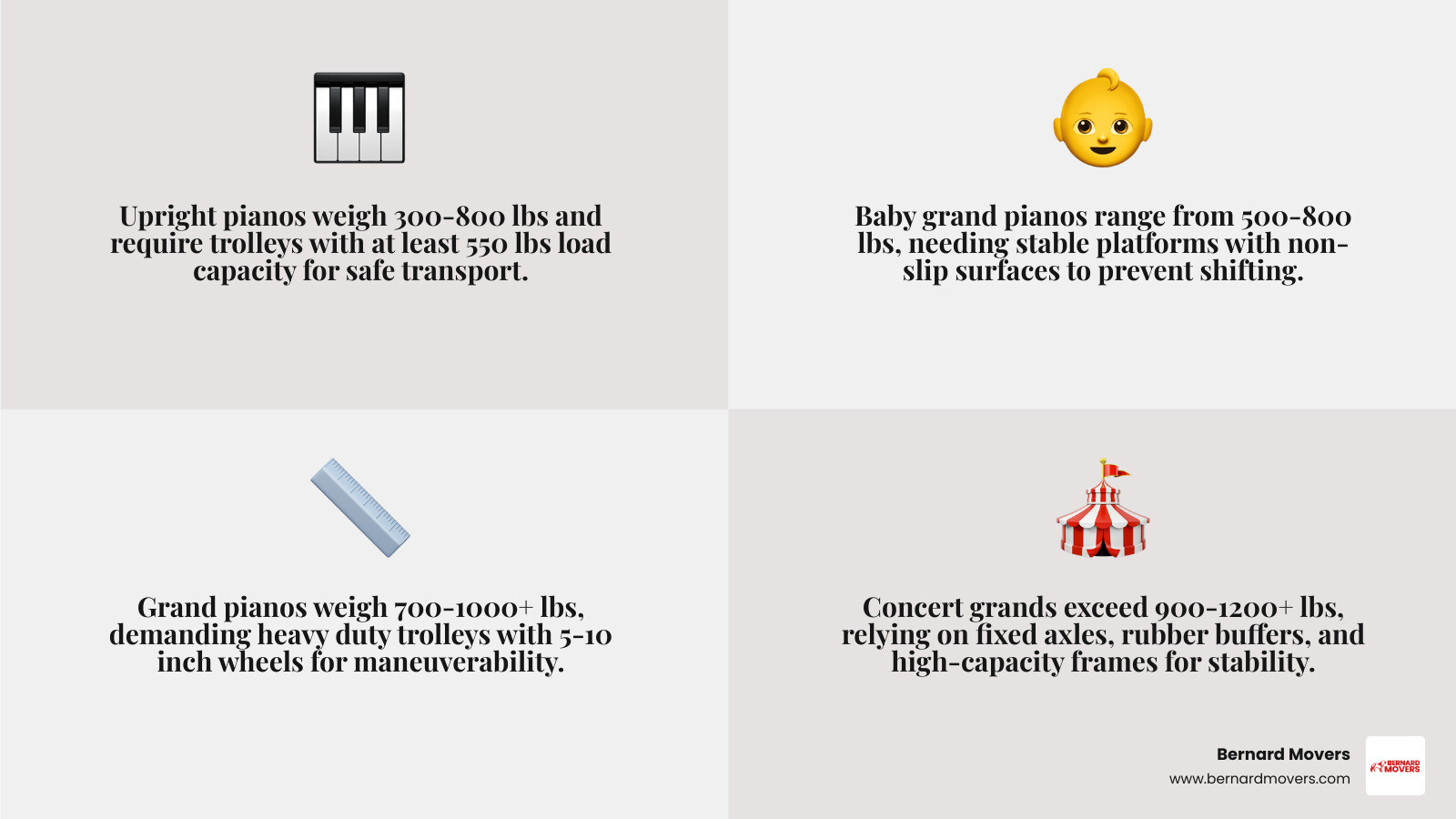
Heavy duty piano trolley terms made easy:
Key Features and Specifications of a Heavy Duty Piano Trolley
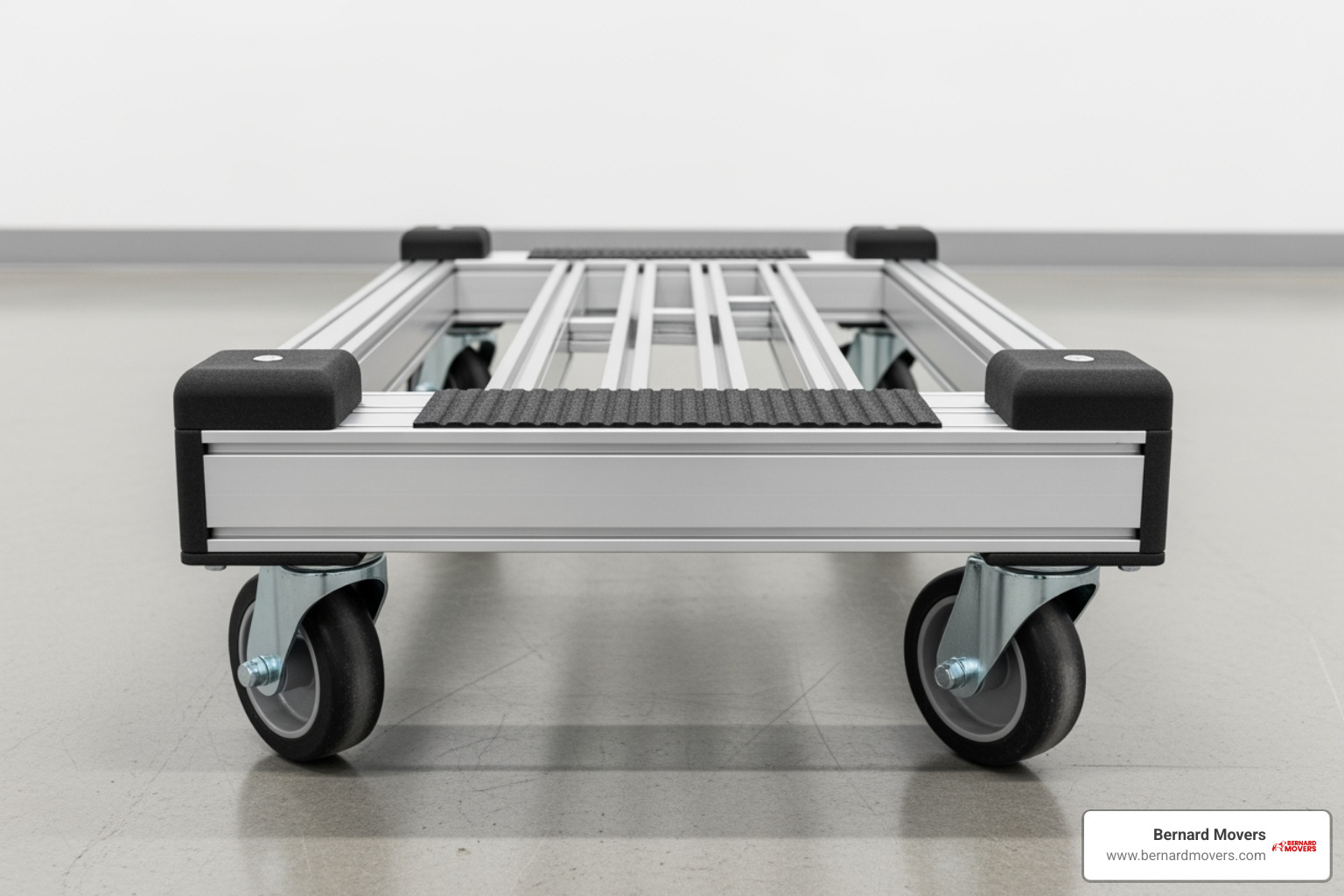
When we talk about a heavy duty piano trolley, we aren’t talking about the flat carts you see at big-box home improvement stores. Those are fine for a few bags of mulch, but they will literally buckle under the concentrated weight of a Steinway. A professional-grade trolley is an industrial-strength tool designed specifically for the unique “center of gravity” challenges that pianos present.
The construction of these trolleys usually falls into two camps: extruded aluminum or tubular steel. Aluminum models, like those often used by professional technicians, are prized for being lightweight (around 14kg or 30 lbs) while maintaining an incredible load capacity of up to 550kg (roughly 1,212 lbs). This high strength-to-weight ratio is vital when we have to carry the trolley up a flight of stairs before the piano even touches it.
Steel-framed dollies, such as those from industrial suppliers like Commander Warehouse, often feature a powder-coat finish. This isn’t just for looks; the powder coating prevents rusting and withstands the harsh, salty slush we often deal with during Chicago winters. These frames are frequently topped with carpeted wood or ribbed rubber to provide a cushioned, high-friction surface for the instrument.
Load Capacity and Dimensions for Professional Moves
Understanding load capacity is the first step in avoiding a catastrophic equipment failure. In our experience moving pianos in Des Plaines and Park Ridge, we categorize equipment based on the instrument’s size.
- Acoustic Uprights: These range from 300 to 800 pounds. A standard heavy-duty trolley with a 1,000-lb capacity is usually sufficient.
- Grand and Baby Grand Pianos: These often exceed 1,000 pounds. For these, we utilize trolleys rated for at least 1,200 lbs to ensure a safety margin.
- Concert Grands: These are the giants of the music world, often weighing 1,200 lbs or more. A specialized heavy duty piano trolley with a 550kg (1,212 lb) limit is the bare minimum required.
It is also vital to distinguish between static and dynamic load. A trolley might be rated for 1,000 lbs of static weight (sitting still), but the stresses of moving over a threshold or up a ramp can double the effective force on the axles. This is why we always recommend a trolley with a capacity at least 20-30% higher than the actual weight of the piano. This “safety buffer” accounts for the kinetic energy generated during movement, ensuring the frame doesn’t flex and the bearings don’t seize under pressure.
Dimensions also matter. A typical professional trolley might measure 18″W x 28″L x 8″H. This compact footprint allows us to navigate tight hallways in Evanston or Skokie while providing enough surface area to support the piano’s “belly” or side. For more technical details on the gear we use, you can find More info about piano moving equipment on our dedicated resource page.
| Piano Type | Typical Weight Range | Recommended Trolley Capacity |
|---|---|---|
| Spinet / Console | 300 – 500 lbs | 800 lbs+ |
| Studio / Professional Upright | 500 – 800 lbs | 1,000 lbs+ |
| Baby Grand | 500 – 800 lbs | 1,000 lbs+ |
| Grand Piano | 700 – 1,000 lbs | 1,200 lbs+ |
| Concert Grand | 1,000 – 1,300 lbs | 1,200 lbs+ (Industrial) |
Choosing the Right Wheels for a Heavy Duty Piano Trolley
The wheels are the most critical component of any trolley. If the wheels fail, the move stops—usually in a very dangerous position. We look for three main types of wheel configurations depending on the terrain:
- Pneumatic Wheels: These are air-filled tires, often 10 inches in diameter. They are the “off-roaders” of the piano moving world. If we are moving a piano across a gravel driveway or uneven pavement in a Northbrook backyard, a Pneumatic Piano Trolley – The Piano Accessory Shop is essential. The air cushions the instrument against vibrations and helps the trolley “climb” over small bumps.
- Solid Rubber Casters: For indoor moves on hardwood or tile in Wilmette or Winnetka, we use non-marking solid rubber wheels. These provide excellent grip without leaving black streaks on a client’s pristine floors. The choice of wheel material also impacts the “Point Pressure” or PSI (pounds per square inch) exerted on the flooring. In many high-end Chicago homes with soft pine or antique oak floors, a thin, hard wheel can leave permanent indentations even if it doesn’t scratch the surface. Wider, high-rebound rubber wheels distribute the weight over a larger surface area, protecting delicate flooring while still providing the necessary maneuverability.
- Fixed Axles vs. Swivel Casters: High-end trolleys often use a combination. For example, a dolly might have two swivel casters for maneuverability and two rigid (fixed) casters for tracking. However, many specialized piano trucks use fixed axles with large 200mm (8-inch) wheels. Fixed axles provide superior stability; they won’t “flutter” or kick out sideways when you are pushing an 800-pound upright.
Safety Features and Best Practices for Secure Transport
A heavy duty piano trolley is only as safe as the person operating it. We follow strict protocols to ensure the instrument stays on the cart. Most professional trolleys feature a “ribbed” rubber top. This texture creates friction that prevents the piano from sliding off the trolley during an incline.
Furthermore, rubber buffers on the corners of the trolley are a lifesaver. When navigating tight corners in a Melrose Park school, these buffers protect the walls and the piano from nicks and scratches.
Securing the load is non-negotiable. We use heavy-duty cotton webbing or ratchet straps to “marry” the piano to the trolley. This is especially important for uprights, which can be top-heavy. If you’re curious about the logistics of the truck ride itself, check out our guide on how to secure a piano in a moving truck. We never rely on the piano’s weight alone to keep it in place.
Comparing Equipment: Why Use a Heavy Duty Piano Trolley?
In relocation, you have several options, but the heavy duty piano trolley is often the MVP. Let’s look at the alternatives:
- Skid Boards (Piano Boards): These are long, padded boards used primarily for moving grand pianos. The piano is strapped to the board, which is then placed on a trolley. You can Buy Grand Piano Dollies on Sale that are designed specifically to accommodate these boards.
- Dual Trucks: These are two separate units that strap to either end of a piano. They are great for one-person moves in a warehouse setting, but they lack the stability of a single-frame trolley when navigating ramps or uneven ground.
- Leg Dollies: These are small, triangular dollies that fit under each leg of a grand piano. They are perfect for moving a piano across a stage at a concert venue, but they should never be used for a residential move or transport across rough surfaces.
The trolley wins because of its versatility. It offers the best maneuverability in tight Chicago hallways while providing a solid, unified base that minimizes the risk of the instrument tipping.
Applications in Chicago Schools and Concert Venues
Our work often takes us to institutions across Illinois, from the bustling schools in Skokie and Morton Grove to concert venues in Glenview and Mount Prospect. In these environments, the heavy duty piano trolley is a daily necessity.
Schools frequently need pianos moved from the gymnasium to the auditorium. Because these moves happen often, they require trolleys with steel-centered roller bearing wheels that won’t wear down after a few miles of hallway travel. In performance halls, where a 9-foot concert grand might need to be repositioned several times a week, a Jansen-style stage dolly is often permanently kept under the instrument.
For those looking for professional assistance in these high-stakes environments, our piano-moving-service-in-chicago provides the expertise and equipment needed to handle these delicate assets.
Maintenance and Longevity of Professional Moving Gear
To ensure our gear remains safe, we perform regular maintenance. Industrial equipment is durable, but it isn’t invincible.
- Rust Prevention: We keep our steel frames clean and dry. If the powder coating chips, we touch it up to prevent the Chicago humidity from causing structural weakness.
- Axle Lubrication: We regularly grease the roller bearings in the wheels. A “sticky” wheel can cause a trolley to jerk, which is the last thing you want when balancing a thousand-pound instrument.
- Caster Inspection: We check for “flat spots” on rubber wheels. If a trolley sits under a heavy load for too long, the rubber can deform, making it difficult to roll smoothly.
- Buffer Replacement: Rubber corner buffers eventually wear down or tear. Replacing these cheap parts prevents expensive damage to a client’s doorframe or a piano’s finish.
Conclusion
At Bernard Movers, we believe that moving a piano is an art form that requires the right tools. Whether you are a DIY mover or a professional, understanding the power of a heavy duty piano trolley is the first step toward a successful relocation. From the aluminum frames used in Glencoe to the pneumatic-wheeled trucks we deploy in Northfield, the right equipment ensures that these beautiful instruments continue to make music for generations to reach.
Furthermore, the longevity of your instrument depends on how it is handled during these transitions. A piano that is jarred or dropped, even slightly, can suffer from hairline fractures in the soundboard or shifts in the plate that affect tuning stability for years. By investing in or hiring a team with a professional heavy duty piano trolley, you are essentially buying insurance for the musical life of your instrument.
As Chicago relocation experts, we are proud to serve our local community across Melrose Park, Elmhurst, and beyond. If your move takes you further afield, we offer specialized transit to Georgia and Florida. In fact, if you book a move to Georgia or Florida for delivery by March 15, 2025, we offer a 20% additional discount to help you get settled.
Ready to move your instrument with the care it deserves? Visit our Professional Piano Moving Services page to get started with a team that knows exactly which trolley to bring to the job.
