


Why Choosing the Right Interstate Moving Company Matters for Your Budget
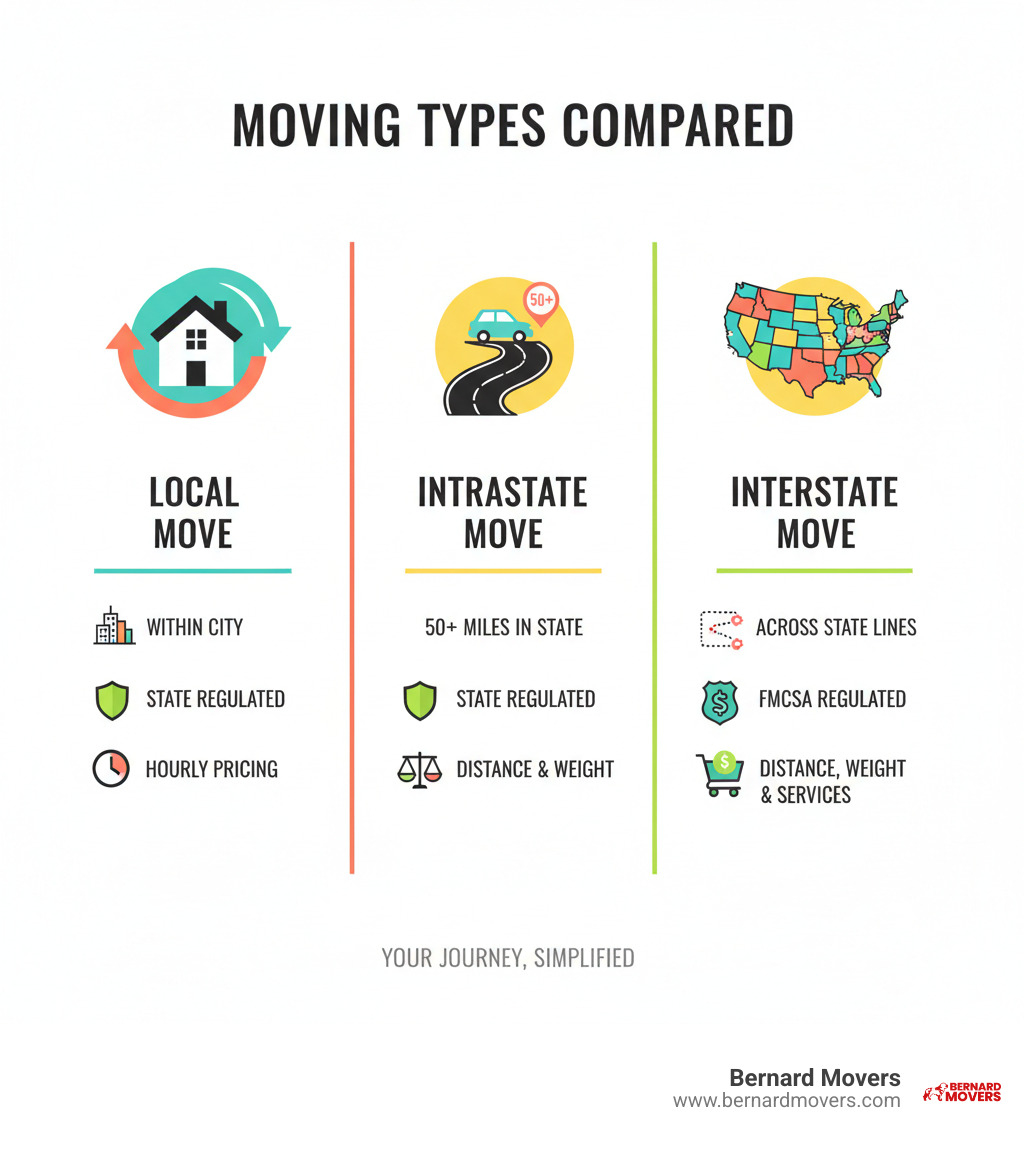
Interstate moving companies are professional movers licensed to transport household goods across state lines. This distinction is crucial because all interstate moves are regulated by a federal agency: the Federal Motor Carrier Safety Administration (FMCSA). The FMCSA sets rules for estimates, liability, and insurance, providing a layer of consumer protection not present in local moves. Unlike local or intrastate moves, which are governed by state-level regulations and often priced by the hour, interstate moves require federal licensing and involve far more complex logistics based on weight and distance.
What to Expect from Interstate Movers:
- Services: Full-service options include professional packing and unpacking, furniture disassembly and reassembly, loading, transportation, short- or long-term storage, and specialty item handling for things like pianos or artwork.
- Average Costs: A 2-bedroom home move (approx. 5,000 lbs) traveling 1,500 miles can range from $4,000-$10,000, while larger homes can cost $10,000-$17,000 or more, depending on the weight of goods and services selected.
- Verification: Always check for a valid U.S. DOT number on the mover’s website and vehicle. Use this number to confirm their FMCSA registration, check their safety record, and review any official complaints filed against them.
Moving to a new state, whether from Illinois to Florida or Georgia, is a significant undertaking. The challenge lies not just in the logistics but in finding affordable movers who are reliable and transparent. The industry can be fraught with potential pitfalls for the uninformed. Hidden fees for things like stairs or long carries (if the truck can’t park close to your door), confusing estimate types, and outright scams from fraudulent brokers can quickly turn your moving budget upside down.
I’m Mina Georgalas, owner of Bernard Movers. With nearly 30 years of experience helping families relocate from our Chicago base, I know that understanding how interstate moving companies operate is key to a successful, budget-friendly move. This guide will help you steer the process without sacrificing quality.
How to Find Affordable Interstate Moving Companies
Finding affordable interstate moving companies doesn’t mean sacrificing quality. The secret to a budget-friendly move from Chicago or Melrose Park is understanding what you’re paying for and how to identify legitimate movers.

At Bernard Movers, we believe an informed customer is a happy customer. Whether you’re moving to Florida or Georgia, this knowledge is key. For more ideas, explore our guide on cheap interstate moving options.
Understanding Interstate Moving Costs and Services
No two interstate moves cost the same because several key factors influence the final price:
- Distance: The mileage between your old and new home is a primary cost driver, affecting fuel expenses and labor hours for the driving team. A move from Illinois to Florida will naturally cost more than a move to a neighboring state like Indiana.
- Shipment Weight: This is the most significant factor for interstate moves. The total weight of your household goods determines the bulk of the cost. This is why we always recommend decluttering before you pack—it’s the most effective way to save money. Your shipment will be weighed on a certified scale before and after loading to determine the final charge.
- Time of Year: The moving industry has a distinct peak season, typically from May through September. Demand is highest during these months, leading to premium pricing. For lower rates, aim for a move between October and April. Moving mid-week and mid-month can also offer savings compared to weekends or the end of the month.
- Add-On Services: You have significant control over your budget here. While we offer comprehensive full service moving that includes packing every box, you can opt for a partial pack or pack everything yourself to reduce costs. Other common add-ons include unpacking, debris removal, and temporary affordable moving and storage if your new home isn’t ready upon arrival.
- Specialty Items: Pianos, grandfather clocks, large safes, antiques, and oversized gym equipment require special handling, custom crating, or additional manpower, which adds to the cost. Be sure to discuss these items with your move coordinator during the estimate process to ensure they are accounted for properly.
- Accessorial Charges: These are fees for services beyond standard loading and transportation. Common examples include charges for flights of stairs, long carries (if the truck must park a significant distance from your entrance), or the use of a smaller shuttle truck if a full-size semi-trailer cannot access your street.
For a two-bedroom home moving about 1,500 miles, budget between $4,000 and $10,000. For a personalized quote, see our page on the cost to relocate to another state.
Comparing Pricing Models for Your Budget
Understanding pricing models is essential to avoid surprise charges:
- Binding Estimate: A guaranteed, fixed price based on a detailed inventory. The price won’t change unless you add items or services. This option provides cost certainty.
- Non-Binding Estimate: An educated guess of your moving costs. The final cost is determined after your goods are weighed. By law, you only pay up to 110% of the estimate at delivery, with the rest billed later. This can be risky.
- Not-to-Exceed Estimate (or Binding-Not-to-Exceed): The most consumer-friendly option. It provides a price ceiling—you won’t pay more than the quote. If the actual weight is less, your final cost will be lower.
The most accurate quotes come from a virtual or in-home assessment. Be wary of any company giving a quote over the phone without a visual inventory—this is a common bait-and-switch tactic. Always ask for a written estimate and inquire about potential hidden fees. A reputable company provides a transparent moving estimate.
Vetting Reputable and Qualified Interstate Moving Companies
Finding a legitimate mover is the most critical step in protecting yourself from scams. Here’s how to vet them:

First, verify their credentials. Every legal interstate moving company must be registered with the FMCSA and have a U.S. DOT number. Use the FMCSA’s online search the Mover Database to check their operating status, insurance, and complaint history. We encourage clients to look us up as licensed insured movers.
Watch for these common red flags:
- Suspiciously Low Quotes: A drastically low estimate is a warning. This tactic is often used to secure your business, only to inflate the price later with hidden fees.
- Large Upfront Deposits: Reputable movers don’t require large deposits. A small fee to reserve a date is normal, but demands for 25% or more upfront are a warning sign.
- Lack of Transparency: A legitimate company will be upfront with its DOT number and physical address. If a mover is evasive, walk away.
- No In-Home or Virtual Survey: A company insisting on a binding quote without seeing your belongings cannot provide an accurate estimate.
- Generic Branding: Be cautious of companies with generic names like “Interstate Movers” and no local address. Fraudulent operators use these to avoid accountability.
Also, understand the difference between a moving carrier and a broker. A carrier (like Bernard Movers) owns the trucks and physically transports your belongings. A broker subcontracts your move to a carrier. Using a broker means you may not know who will show up, creating potential communication issues and lack of accountability. Working directly with a carrier provides a single point of contact. Finally, read recent customer reviews on independent sites like Google and the Better Business Bureau.
Your Interstate Move: A Step-by-Step Guide
Moving from Illinois to a new state like Georgia or Florida is the start of a new chapter. A well-planned move protects your belongings and your peace of mind. At Bernard Movers, we’ve guided thousands of families from Chicago and Melrose Park through this process.

A clear roadmap makes all the difference. For general advice, see our moving tips.
Preparing for Your Long-Distance Relocation
Starting the planning process 8-12 weeks before your move date ensures a smoother, less stressful transition. Here are the key steps:
- Use a Comprehensive Checklist: A moving out of state checklist is essential. Use it to track tasks like forwarding mail, transferring utilities, updating addresses, and gathering important records. If moving from Illinois, research state-specific tasks like getting a new driver’s license.
- Declutter to Save Money: Since interstate moves charge by weight, every item you don’t move saves you money. Sort items into keep, sell, donate, or discard piles.
- Create a Detailed Home Inventory: Document your belongings with photos or videos, especially valuables. This is crucial for your records and for filing any potential claims.
- Pack Smart and Strategically: Use sturdy boxes and quality materials. Pack heavy items in small boxes and light items in large ones. Label each box with its contents and destination room. For expert advice, see our guide on how to pack fragile items for a long distance move.
- Prepare a “First Night” Essentials Box: Pack a box with everything you’ll need for the first 24-48 hours: toiletries, medications, chargers, tools, documents, and snacks.
Understanding Valuation and Protecting Your Belongings
It’s vital to understand how your belongings are protected during transit. Valuation is not the same as insurance; it is the carrier’s level of liability as defined by federal law. You have two options:
- Released Value Protection (RVP): This is the default, no-cost option included in every interstate move. However, it provides only minimal coverage at a rate of 60 cents per pound per item. For example, if a 10-pound, $1,500 laptop is damaged, you would only be compensated for $6.00 (10 lbs x $0.60). For this reason, we rarely recommend RVP for a long-distance move with valuable possessions.
- Full Value Protection (FVP): This option costs more but offers comprehensive coverage and real peace of mind. Under FVP, the moving company is liable for the current market replacement value of any lost or damaged items. The mover has the option to either repair the item, replace it with a similar item, or make a cash settlement for the cost of the repair or replacement. The cost of FVP varies based on the total declared value of your shipment and the deductible you choose. For a significant move from Illinois to Florida, FVP is a worthwhile investment in protecting your assets.
For items of extraordinary value (defined as items worth more than $100 per pound, such as jewelry, fine art, or antiques), you must declare them on a separate “high-value inventory” form provided by your mover. Failure to do so may limit the mover’s liability for those items. You can also purchase separate moving insurance from a third-party provider, which may offer broader coverage than FVP. Check with your homeowner’s insurance agent to see if your policy offers any coverage for goods in transit.
Final Steps and What to Expect on Moving Day
As moving day approaches, clear communication with your mover is key. Here’s what to expect:
- Delivery Window: Interstate moves operate on a delivery window (e.g., 2-14 days), not a specific date. Confirm this window in writing. Many movers, like Bernard Movers, offer shipment tracking.
- The Bill of Lading: This is your contract and receipt. Before the truck leaves, read it carefully to ensure all information is correct (names, addresses, services, cost, valuation). Do not sign a blank document. Keep your copy safe.
- Upon Delivery: Be present to accept the delivery. Check items off your inventory list as they are unloaded. Note any visible damage on the mover’s copy of the bill of lading before signing off.
- Final Payment: Most movers require payment before unloading. Confirm accepted payment methods beforehand and have it ready.
- Tipping: Tipping is customary but not required. A general guideline is 5-10% of the total cost, divided among the crew, or a flat amount per mover.
Bernard Movers: Your Partner for an Affordable Interstate Move
We are committed to providing exceptional service at competitive rates. For customers in the Chicago area, including Melrose Park, Evanston, and surrounding suburbs, who are relocating to Georgia or Florida, we have a special offer. Book your move with us for delivery by March 15, 2025, and receive an additional 20% discount.
Ready to start your next chapter? Contact our professional state-to-state movers today for a personalized estimate.
