

Why Most Business Relocations Go Wrong — and How to Get Yours Right
Finding the right commercial moving solutions for your Illinois business doesn’t have to feel like a second job on top of running your company.
But for most businesses, it does. A lease ends. A team doubles. A warehouse outgrows its walls. And suddenly you’re coordinating crews, IT disconnects, building permits, and employee schedules — all while trying to keep operations running.
Here’s a quick look at what commercial moving solutions actually cover, so you can find what you need fast:
What commercial moving solutions typically include:
- Office relocations — moving workstations, furniture, and equipment to a new space
- Warehouse and industrial moves — relocating inventory, racking systems, and heavy machinery
- Retail store relocations — moving fixtures, displays, POS systems, and signage
- Data center and IT moves — disconnecting, transporting, and reconnecting servers and network infrastructure
- Specialized services — modular furniture installation, secure storage, e-waste disposal, and climate-controlled handling
Most businesses in Illinois book commercial movers 6 to 12 weeks before their target move date. Complex moves — multi-floor offices, warehouses, or data centers — often need even more lead time.
The difference between a smooth move and a costly one usually comes down to one thing: planning. A commercial move is not just bigger than a residential move. It’s a different operation entirely — with different equipment, different liability, and zero tolerance for extended downtime.
This guide walks you through exactly what to look for, what to ask, and how to move your Chicago or Melrose Park business without the corporate headache.
Basic commercial moving solutions terms:
Key Factors in Selecting Commercial Moving Solutions
Choosing the right partner to transport your business assets requires looking beyond a basic rate sheet. When evaluating commercial moving solutions, several core factors determine whether your transition will be a success or an operational nightmare.
First, dedicated project management is essential. A commercial move involves dozens of moving parts that require a single point of coordination. A professional project manager keeps the timeline on track, coordinates with building managers, and ensures that resources are allocated efficiently on move day. This manager acts as your primary liaison, handling everything from elevator reservations to unexpected weather delays, allowing your internal team to focus on their daily responsibilities.
Second, you must look at liability coverage and asset protection. Business equipment is expensive, and data is irreplaceable. Standard residential insurance limits do not cover the value of high-end office electronics, lab equipment, or warehouse inventory. Reputable commercial movers carry substantial liability insurance and offer robust valuation coverage options. It is critical to verify that your chosen moving partner has the financial backing and insurance policies necessary to cover your assets fully during transit.
Finally, scheduling flexibility is non-negotiable. To keep your doors open and operations active, your moving partner must be willing to work around your business hours. This often means executing the relocation during evenings, weekends, or in carefully planned phases. For More info about commercial logistics, understanding these operational backbones is the first step toward a seamless transition.
Understanding Different Types of Commercial Moving Solutions
Every business sector has unique physical assets and logistical constraints. A one-size-fits-all approach simply does not work when relocating commercial operations. Each industry requires specialized knowledge, packing materials, and transport vehicles to ensure that valuable assets arrive safely and ready for immediate deployment.

- Office Relocations: This is the most common commercial move, requiring the teardown and setup of desks, chairs, filing cabinets, and communal office areas. It also involves the careful handling of sensitive employee files and administrative records.
- Retail Store Moves: Retail moves focus heavily on preserving visual merchandising setups. This involves dismantling display fixtures, packing sensitive point-of-sale (POS) systems, and transporting inventory racks systematically so the sales floor can be rebuilt quickly. For a closer look, see our Detailed guide to retail moves.
- Warehouse Logistics: Moving an industrial or warehouse space requires heavy-duty machinery. It involves dismantling massive racking systems, coordinating pallets of inventory, and utilizing specialized equipment to load heavy items safely.
- Data Center and IT Transfers: This is the most sensitive type of move. It requires certified handling of server racks, network cabling, and high-value electronics. The focus here is on absolute physical security and climate-controlled transport to prevent hardware damage.
How Commercial Relocation Differs from Residential Moves
It is a common mistake to assume that a residential mover can handle a corporate relocation. The differences in scale, equipment, and liability are massive. Residential moves focus on personal comfort and the careful handling of household goods, whereas commercial moves prioritize minimizing business downtime and maintaining operational continuity.
Commercial moves rely on specialized equipment such as heavy-duty dollies, machine skates, panel carts, and lift-gate trucks. While a residential move might require a few dozen cardboard boxes, a commercial move uses hundreds of standardized, stackable plastic crates and color-coded labeling systems to ensure every item lands in its exact designated department. This systematic approach prevents confusion during the unpacking phase and ensures that employees can return to work immediately.
| Feature | Residential Moving | Commercial Moving |
|---|---|---|
| Primary Goal | Personal comfort & care | Minimizing business downtime |
| Scheduling | Typically daytime, weekdays | Nights, weekends, and phased shifts |
| Asset Value | Household goods, personal items | High-value IT, servers, specialized machinery |
| Equipment | Standard trucks, hand trucks | Forklifts, toe jacks, specialized crates |
| Project Management | Self-managed or basic coordinator | Dedicated professional project manager |
| Security/Liability | Basic valuation coverage | High-limit commercial liability & data security |
Specialized Commercial Moving Solutions for Complex Assets
If your business relies on specialized infrastructure, you cannot afford to hire general laborers. Modern office spaces require technical expertise to dismantle and reassemble. Without the proper training, attempting to move complex systems can result in broken equipment, voided warranties, and extended operational delays.
IT relocation is a prime example. Your internal tech team should focus on data backups and network configurations, while your moving partner handles the physical disconnect, secure packing in anti-static wrap, and physical transport of the hardware. This division of labor ensures that your digital assets are protected while the physical infrastructure is moved safely.
Additionally, modular office furniture and cubicle systems are notoriously difficult to assemble. Professional movers employ specialists who understand the structural layouts of major office furniture brands, ensuring your new layout is structurally sound and ready for use on day one. Finally, if you are downsizing or upgrading, your moving partner should assist with responsible e-waste disposal and offer secure, climate-controlled storage for surplus assets. To learn more about managing these moving pieces, read our Ultimate guide to business relocation.
Executing Your Illinois Business Relocation Seamlessly
At Bernard Movers, we have spent years refining our commercial moving solutions to serve businesses throughout Chicago, Melrose Park, and the surrounding suburbs. We understand the local landscape because we live and work here. Whether you are moving a boutique office in Park Ridge, a retail space in Elmhurst, or a distribution center in Wood Dale, we bring local expertise to every project.
Our track record speaks for itself. We maintain a 9.3 out of 10 customer satisfaction rating and a 98% client retention rate, built on our commitment to reliable, damage-free transitions. In fact, our damage claims rate is 10 times less than the moving company industry average, and we boast a 98% claim-free performance across our years of relocation expertise.
We also offer specialized regional programs to support businesses expanding beyond state lines. For example, our hallmark program offers an additional 20% discount on moves to Georgia and Florida booked for delivery by March 15, 2025. When you need to relocate with confidence, you can Partner with expert commercial movers who know how to protect your bottom line.
Navigating Chicago and Melrose Park Logistics
Relocating a business in the Chicago metropolitan area presents unique physical and regulatory challenges that suburban or rural movers rarely encounter.

In downtown Chicago, navigating low clearances, tight alleyways, and strict parking restrictions is a daily reality. Most commercial buildings in the Loop, River North, and surrounding business districts require building access permits and proof of high-limit liability insurance before a moving crew can even step foot on the property.
Furthermore, loading dock access must be reserved weeks in advance, often restricted to specific off-peak hours. In Melrose Park and nearby industrial corridors, logistics may focus more on zoning laws, heavy truck routes, and coordination with warehouse facility managers. Partnering with a mover who understands these local nuances prevents costly delays and building fines. For a deeper dive into these logistical strategies, read our Complete guide to commercial moving. (Note: Please consult our Commercial Moving Services Complete Guide for full regional compliance details.)
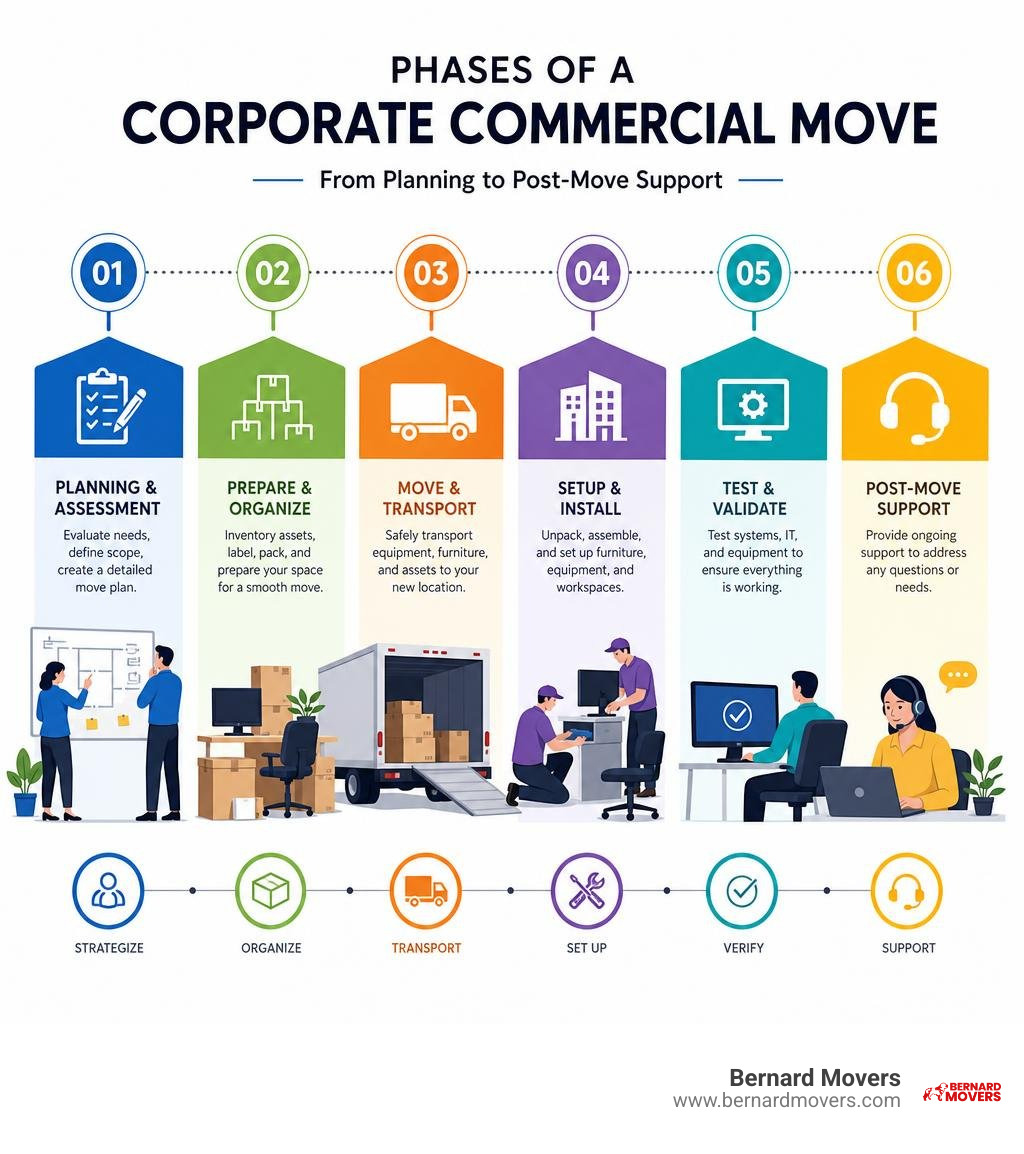
Your Step-by-Step Office Relocation Timeline
A successful business move is built on a structured timeline. Trying to rush a commercial relocation in a couple of weeks is a recipe for operational chaos.
Here is the ideal timeline we recommend for Illinois businesses:
- 8 to 12 Weeks Before: Finalize your new lease, establish your moving budget, and select your commercial moving partner. Begin auditing your current inventory and identifying what will be moved, stored, or recycled.
- 4 to 6 Weeks Before: Coordinate with building management at both locations to secure loading dock reservations and elevator access. Work with your IT department to map out the network infrastructure in the new space.
- 1 to 2 Weeks Before: Distribute packing materials and color-coded labels to your staff. Finalize the floor plan layouts for the new office so the moving crew knows exactly where to place every desk and crate.
- Move Day: Establish clear points of contact at both the origin and destination sites. Let the professional moving crew handle the heavy lifting while your project managers oversee the flow.
- Post-Move: Reconnect IT systems, unpack essential files, and conduct a walkthrough to ensure all furniture is properly assembled.
To make sure your team doesn’t miss a single detail, keep our Comprehensive office moving checklist handy throughout your planning process. With the right partner and a clear plan, you can transition your business smoothly and get back to what you do best.