


Why a Checklist for Moving Office Premises is Essential for Success
An office move involves hundreds of moving parts, from lease negotiations and IT infrastructure to employee communication and logistics. A structured checklist for moving office premises is your roadmap to avoiding costly mistakes and minimizing downtime. Without one, businesses across Chicago and nearby suburbs risk misplaced equipment, delayed reopenings, and confusion about who owns each task. The complexity of relocating a commercial entity is significantly higher than a residential move, as it involves not just physical assets, but the continuity of business operations and the preservation of professional data.
A good checklist also helps you make better decisions, not just move faster. When you document requirements early (power needs, conference room capacity, storage, ADA access, and internet availability), you can compare locations objectively and reduce last-minute change orders. That matters in dense areas like Chicago, where loading docks, elevator reservations, and street parking restrictions can impact timing. Furthermore, a checklist serves as a vital communication tool, aligning the expectations of executive leadership with the ground-level reality of the facilities team. It ensures that whether you are dealing with a historic Loop skyscraper or a modern West Loop loft, no detail is overlooked.
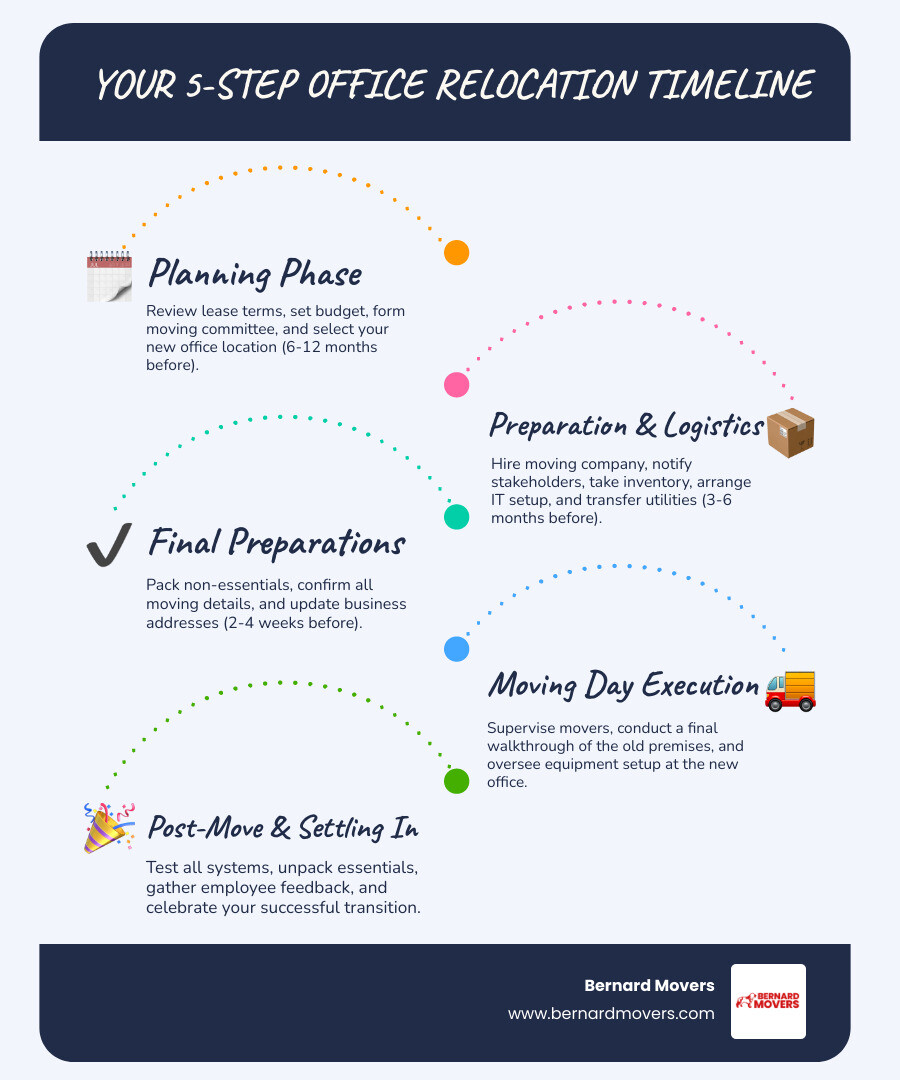
Key phases of a comprehensive office moving checklist:
- Planning (6-12 months before) – Review lease terms, set a budget, define your move goals, and shortlist a new location in Illinois. Assign a dedicated “Move Coordinator” to act as the single point of contact.
- Preparation (3-6 months before) – Select a moving partner, confirm your floor plan, and assign internal owners for IT, facilities, HR, and department leads. Conduct a thorough furniture and equipment audit.
- Logistics (1-3 months before) – Transfer utilities, coordinate building requirements (COI, elevator bookings), and schedule IT installation and testing. Finalize the layout for the new space.
- Final Prep (2-4 weeks before) – Pack non-essentials, label by department and destination, and confirm address updates for vendors and clients. Distribute packing kits to employees.
- Moving Day – Supervise movers, protect building common areas, and prioritize critical departments and IT equipment for first-off/first-on. Establish a “Command Center” at the new location.
- Post-Move – Test systems, complete punch-list items, and standardize where shared supplies and equipment live. Conduct a walkthrough to identify any immediate maintenance needs.
To make the checklist actionable, define what “done” means for each phase. For example, planning is not complete until your move date is approved internally, building access rules are confirmed (hours, dock use, freight elevator capacity), and you have a written budget that includes contingencies for after-hours labor or staged moves.
I’m Mina Georgalas, president of Bernard Movers. With nearly 30 years of experience helping Illinois businesses execute smooth relocations, our family-owned company has completed thousands of moves across Chicago and Melrose Park. We understand the operational realities of moving in the city and suburbs, including coordinating with property managers, working within tight service elevators, and keeping teams productive during the transition.
Checklist for moving office premises further reading:
The Ultimate Checklist for Moving Office Premises
Relocating an office is an opportunity to optimize your workspace, reduce friction in day-to-day operations, and improve how teams collaborate. For Chicago and Illinois businesses, a successful relocation depends on meticulous planning, clear communication, and an execution plan that accounts for building rules, traffic patterns, and the realities of moving high-value equipment. A well-executed move can boost employee morale and provide a fresh start for company culture.
Below is a practical checklist for moving office premises organized by workstream and timeframe. Use it as a living document: assign an owner to every line item, set due dates, and track approvals (especially for IT and building access).
Budget and Lease Management
Start early. A comprehensive budget should cover professional moving services, packing materials, furniture changes, IT setup, building fees (loading dock reservations, elevator attendants when required), and a contingency fund. In Chicago, after-hours moves may be necessary to reduce disruption or comply with building rules, so confirm premium-time labor expectations in advance.
Hidden costs often include “after-hours” premiums for building security, specialized cleaning services required by the outgoing lease, and the cost of decommissioning old IT cabling—a requirement in many Chicago commercial leases to prevent “cable mining” issues. Ensure your budget accounts for the “Certificate of Insurance” (COI) requirements, which in Illinois can be quite stringent regarding workers’ compensation and general liability limits.
Review your current lease 6-12 months before your target date to clarify termination clauses, restoration requirements, and any obligations to patch walls, remove cabling, or return keys and access cards. Clarify what constitutes “normal wear” and what your landlord may bill back. Separately, confirm the new lease includes clear move-in access: freight elevator windows, dock use, and where trucks can stage.
Pros and Cons of Relocation
- Pros: Improved workspace design, strategic location for hiring and commuting, potential cost savings on utilities, and flexibility for growth.
- Cons: Potential business disruption, employee anxiety, complex logistics, and temporary productivity dips if setups are delayed.
According to Scientific research on office occupier sentiment, nearly 60% of small companies contemplate relocation to upgrade their workplace. For strategic insights, consult our Business Relocation Services Ultimate Guide.
Planning Phase: 6-12 Months Before
Form a moving committee with representatives from HR, IT, operations, and finance. Decide early whether you are doing a single-day move, a weekend move, or a phased relocation by department. Many Chicago organizations prefer phased moves for continuity (for example, moving records storage and low-use areas first). This phase is also the time to conduct a furniture audit—decide what is coming with you and what is being liquidated or donated to local Melrose Park charities.
Consider assigning an Office Relocation Project Manager to streamline tasks and keep vendors aligned. Planning tasks to complete in this phase:
- Define your move objectives (more collaboration space, reduced footprint, better client access, improved storage).
- Establish a realistic move date range with blackout periods (busy season, major client deliverables, audits).
- Shortlist locations in Chicago, Melrose Park, and the surrounding Illinois area based on commute patterns and operational needs.
- Confirm building logistics at each potential site: loading dock access, freight elevator size, distance from dock to suites, and any certificate of insurance requirements.
- Identify special items (server racks, lab equipment, file rooms, safes) that may require custom handling.
- Measure every large piece of equipment against the dimensions of the new freight elevator and the narrowest hallway in the new suite.
When selecting a site in Melrose Park or Chicago, prioritize accessibility, infrastructure, and compliance with The Americans with Disabilities Act (ADA). A checklist item that gets missed: confirm accessible routes from parking to reception and from reception to restrooms and meeting rooms.
Resources like this ultimate guide to moving offices can help you compare office types and set relocation costs.
Logistics and IT: 1-3 Months Before
Create a detailed inventory and declutter. Decide what will be moved, stored, recycled, or securely destroyed. For each department, document:
- Number of workstations and specific ergonomic requirements.
- Monitors, docking stations, and specialized peripherals.
- Printers, shared devices, and their proximity to power/data ports.
- File cabinets and records retention requirements (consider digitizing files now).
- Conference room technology, including AV equipment and soundproofing needs.
Pack non-essential items first and use clear, color-coded labeling by floor, department, and destination (for example: “3rd floor – Finance – Pod B”). That labeling reduces unpacking time and prevents equipment from landing in the wrong area.
Coordinate utility transfers and network migration well in advance. Your IT team must back up critical data and ensure internet lines are installed and tested at the new location before move-in. The “IT Cutover” is the most sensitive part of the move. Beyond just moving servers, consider the “Internet of Things” (IoT) devices—smart thermostats, security cameras, and badge readers. Also confirm:
- Network closet readiness (dedicated power, ventilation, rack space).
- Wi-Fi coverage plan for conference rooms and collaboration areas to support hybrid work.
- Any security system or access control cutover timing, including new badge issuance.
- Testing of all phone lines and VOIP systems to ensure no missed client calls.
For sensitive electronics and records, our Office Moving and Storage Solutions ensure expert handling.
Managing Employee Communication and Stakeholders
Transparency is key. Use multiple channels (email, short standups, FAQ docs) to provide updates and address employee concerns about commutes, parking, and workspace changes. A simple internal checklist helps reduce uncertainty:
- Announce move date targets and what is changing (seating, hybrid schedules, new amenities).
- Share packing instructions and deadlines per department. Provide “purge bins” for shredding and recycling.
- Provide a point of contact for accommodations and accessibility needs.
- Publish a day-one map and a “where to go” guide (reception, meeting rooms, supply areas, and local coffee shops).
Notify external stakeholders (clients, suppliers, banks, insurers, and service providers) of your address change. Update your website contact page, Google Business profile, and any vendor portals that depend on a verified business address. While the Information and Consultation of Employees Regulations 2004 is a UK standard, the principle of engaging staff is a global best practice. Our Corporate Relocation Services can help manage communications and coordination.
Moving Day Execution

Confirm all details with your Office Movers Chicago team and your building management. Establish a “Command Center” at the new location where the Move Coordinator can be reached at all times.
Moving-day checklist essentials:
- Reserve freight elevators and confirm dock access windows at both locations.
- Post signage for movers and staff (suite numbers, elevator banks, staging areas).
- Assign internal “floor captains” to answer questions and approve placement of furniture.
- Keep critical items separate and clearly marked (network gear, key files, check stock, essential tools).
- Conduct a final walkthrough of the old office to confirm nothing is left behind and that required restoration is complete.
- Ensure a first-aid kit and basic tool kit are easily accessible at the new site.
Prioritize IT setup at the new location to minimize downtime. If your business cannot pause operations, consider a staged approach where core departments relocate first and secondary areas follow. Ensure that the first thing set up is the breakroom or a designated hydration station to keep the move team and staff energized.
Post-Move and Hybrid Work
Test all systems immediately. Validate internet performance, conference room connectivity, printers, and access control. Create a punch list for any fixes (missing labels, furniture adjustments, or cabling needs) and assign owners with deadlines. Gather employee feedback on the new layout and celebrate the milestone to boost morale. According to Robert Half’s research, flexibility is a top motivator for professionals, making a well-designed office crucial for retention.
Hybrid Work and Legal Compliance Considerations
Hybrid work changes what “ready” looks like. Instead of maximizing assigned desks, many Illinois offices benefit from collaboration zones, phone rooms, and reliable video meeting setups. Ensure your new space supports hybrid needs with robust Wi-Fi and reservable meeting rooms.
| Feature | Traditional Office | Hybrid Office |
|---|---|---|
| Space | Fixed desks | Flexible workstations |
| Tech | Desktop PCs | Video conferencing focus |
| Layout | Cubicles | Collaboration zones |
For setup assistance, explore our New Office Setup services. Our Commercial Movers are ready to help keep your Illinois move organized, efficient, and aligned with your building’s requirements.
Finalizing Your Chicago Office Relocation
Relocating an office in Chicago or Melrose Park is a major transition that requires more than just physical labor; it requires a strategic vision. By following this checklist for moving office premises, you can reduce downtime, protect expensive equipment, and keep employees informed from the initial planning stages through day-one operations. Success in an office move isn’t just about getting boxes from point A to point B; it’s about how quickly your team returns to peak productivity in their new environment.
Post-Move Success Checklist:
- Verify all keys, fobs, and access cards are functional for all staff members.
- Confirm that the “Google Business,” “Yelp,” and “Bing” locations are updated to prevent lost deliveries or confused clients.
- Schedule a “Welcome Breakfast” or “Office Warming” event to encourage staff to explore the new neighborhood and amenities.
- Conduct a “Post-Mortem” meeting with your moving committee to document lessons learned for future growth or subsequent phases.
- Ensure all old lease obligations are settled and security deposits are being processed for return.
At Bernard Movers, we are your partners in transition for moves throughout Illinois, including Chicago and Melrose Park. We pride ourselves on being more than just a moving company; we are consultants who help you navigate the complexities of commercial relocation. We also offer a 20% additional discount on moves to Georgia and Florida booked for delivery by March 15, 2025. To review services and next steps, visit our Office Moves page.
