

When a Test Tube Costs More Than Your Entire Office Move
Laboratory equipment movers are specialized relocation professionals trained to safely transport sensitive scientific instruments, hazardous chemicals, biological samples, and cold-chain materials — things a standard moving crew simply isn’t equipped to handle.
If you’re looking for quick guidance, here’s what you need to know upfront:
What specialized lab movers handle:
- Analytical instruments (mass spectrometers, HPLC systems, NMR machines)
- Ultra-low temperature (ULT) freezers and cryogenic storage
- Hazardous chemicals and biological materials
- Biosafety cabinets, fume hoods, and cleanroom equipment
- Centrifuges, microscopes, and liquid handling automation
Why it matters: A single miscalibrated spectrometer or a broken cold chain can cost far more than the move itself — in lost samples, failed audits, or damaged equipment worth hundreds of thousands of dollars.
For labs in Chicago, Melrose Park, and across Illinois, the stakes are especially high. The region is home to major research universities, hospital systems, and growing biotech facilities — all of which demand movers who understand compliance, calibration, and zero-downtime execution.
Standard commercial movers aren’t trained for this. Laboratory relocations require knowledge of FDA and DOT regulations, GLP compliance, HAZMAT handling, and careful coordination with equipment manufacturers. Getting it wrong isn’t just expensive — it can shut down active research or trigger a regulatory audit.
This guide walks you through everything: what to expect, what to ask, and how to find the right team for your Illinois lab move.
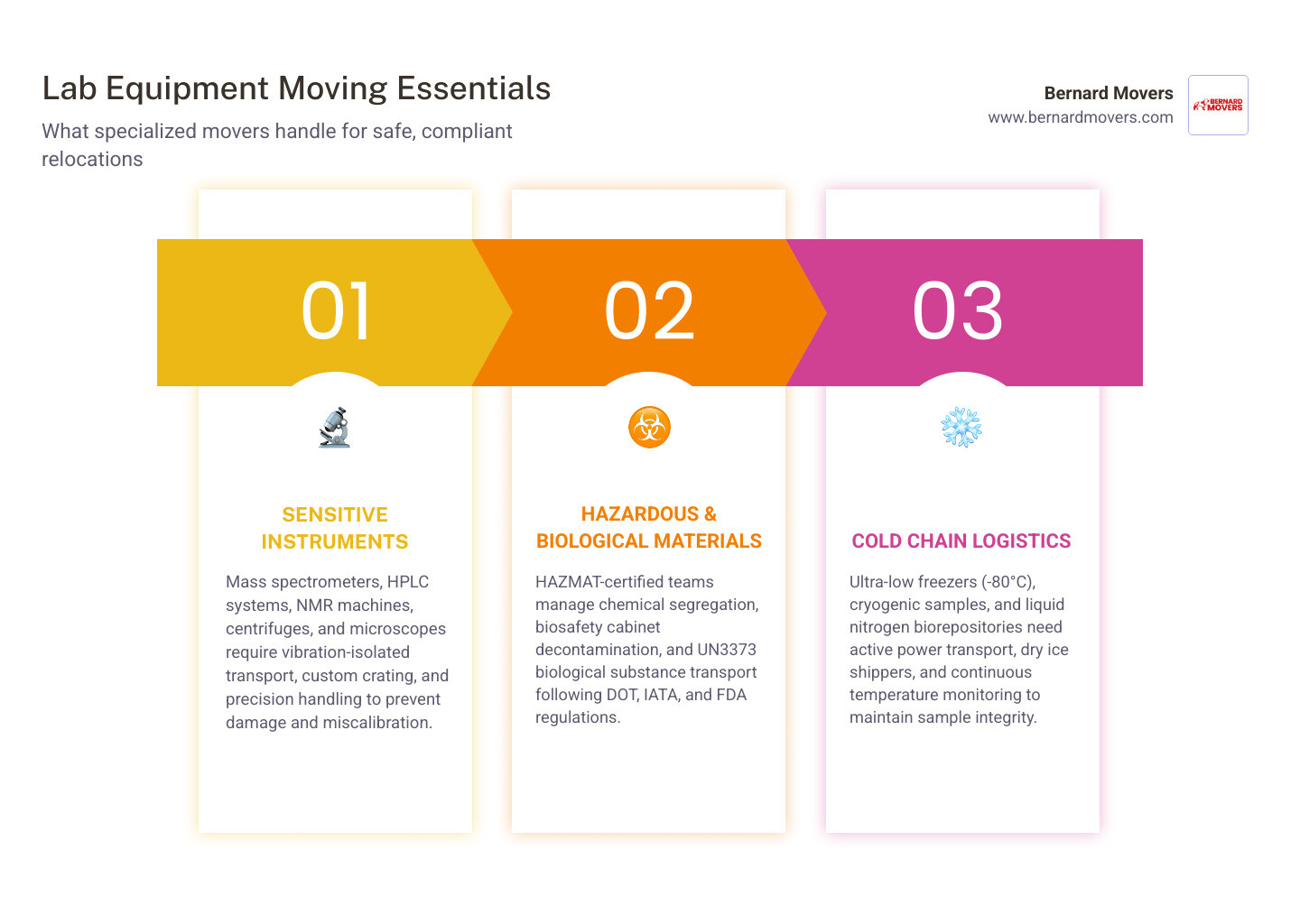
Quick laboratory equipment movers definitions:
Why You Need Specialized Laboratory Equipment Movers
Relocating a laboratory is not like packing up a standard office. You cannot simply bubble-wrap a mass spectrometer, throw it in the back of a standard box truck, and hope for the best. Scientific assets are incredibly fragile, highly calibrated, and often irreplaceable.
To ensure these sensitive instruments survive the journey across Chicago or Melrose Park, specialized movers utilize advanced transit solutions:
- Vibration-Isolated Transport: Road vibrations can easily ruin the alignment of optical systems, knock lasers out of phase, or loosen internal micro-connections. Lab movers use air-ride suspension vehicles specifically designed to absorb road shock, coupled with climate-controlled cargo areas to prevent thermal expansion or contraction of delicate components.
- Custom Crating and Foam-in-Place Packaging: Irregularly shaped, heavy, or highly fragile equipment is secured using custom-built wooden crates. Foam-in-place technology molds around the instrument, providing a perfect, form-fitting cushion that prevents any movement inside the crate during transit.
- Heavy Rigging: Moving multi-ton instruments like NMR systems, large autoclaves, or environmental chambers requires specialized crane, hoist, and rigging systems operated by certified professionals. This involves calculating load-bearing capacities of floors, navigating tight elevator shafts, and ensuring the structural integrity of the building is maintained.
Without these specialized protections, the risk of physical and calibration damage increases exponentially, potentially voiding manufacturer warranties.
The Difference Between General Movers and Laboratory Equipment Movers
If you hire general commercial movers, you are getting a team optimized for speed and bulk—moving desks, chairs, and filing cabinets. When you hire Specialty Movers who offer a dedicated Heavy Item Moving Service, you are partnering with technicians who understand the physics and chemistry of your assets.
For example, large optical tables utilize complex pneumatic isolation legs that must be carefully deflated, leveled, and adjusted during both disassembly and setup. Mass spectrometers and nuclear magnetic resonance (NMR) systems feature delicate magnet arrays and detector components that require strict environmental controls. A single mistake during disassembly can lead to a catastrophic quench of an NMR magnet, costing tens of thousands of dollars in helium refills and system repairs.
Furthermore, moving liquid handling automation, fume hoods, integrated lab casework, and cleanroom equipment requires clean-handling protocols to prevent electrostatic discharge (ESD) and physical damage. Standard commercial movers simply do not have the specialized training, cleanroom garments, or the equipment required to manage these high-value assets safely.
Compliance, Regulations, and Decontamination Standards
Operating a laboratory means adhering to strict regulatory frameworks. Your relocation must be handled in a way that keeps your facility fully compliant with FDA, GLP (Good Laboratory Practice), GMP (Good Manufacturing Practice), and CLIA standards.
A specialized lab mover provides serialized tracking and a complete audit trail to ensure compliance during and after the move. This includes:
- HAZMAT-Certified Teams: Transporting active chemical inventories requires strict adherence to DOT regulations regarding chemical segregation, packaging, and transport. This includes proper labeling, manifesting, and spill-response readiness.
- Biological Materials & IATA Standards: Moving biological specimens requires compliance with IATA and TDG standards, particularly UN3373 regulations for biological substances.
- Biosafety Cabinet (BSC) Decontamination: Before a BSC can be moved, it must undergo professional decontamination (typically using gaseous formaldehyde or vaporized hydrogen peroxide). Post-move, it requires certified face-velocity testing and HEPA integrity checks (such as ASHRAE 110 testing) before it can return to active service.
To protect your research and your team, every transport protocol must strictly adhere to FDA, DOT, and HIPAA compliance standards.
Cold Chain Logistics and Temperature-Sensitive Transport
Many laboratories house biological samples, reagents, and specimens that must remain frozen. A single hour of temperature deviation can ruin years of research, clinical trials, or patient samples.
To maintain strict cold chain logistics, specialized movers utilize several tactics:
- Active Power Transport: For short moves, ultra-low temperature (-80°C) freezers can sometimes remain loaded if they are pre-chilled with dry ice and transported in trailers equipped with active generators to keep them powered.
- Cryogenic and Liquid Nitrogen Shippers: For longer distances, samples are consolidated into specialized dry ice or liquid nitrogen (LN2) shippers.
- Continuous Temperature Monitoring: Logistics teams use data loggers to provide real-time temperature tracking throughout the journey, sending alerts if temperatures drift outside of acceptable parameters.
Experienced carriers integrate GDP (Good Distribution Practice) standards, utilizing shock and tilt data logging alongside continuous temperature monitoring to ensure absolute sample integrity.
Planning and Executing a Seamless Lab Relocation
A successful laboratory move is 90% planning and 10% physical execution. The typical timeline for a complete lab relocation runs three to six months from initial consultation to operational readiness.
To help budget your upcoming relocation in Chicago, Melrose Park, or the surrounding Illinois suburbs, here is a breakdown of average laboratory relocation costs:
| Facility Size | Typical Cost Range | Key Cost Factors |
|---|---|---|
| Small Lab (1-3 rooms) | $8,000 – $25,000 | Basic equipment, local transport, minimal cold chain |
| Mid-Size Biotech Lab | $50,000 – $150,000 | Calibration coordination, BSC certification, cold chain |
| Large Pharma / Multi-Floor | $500,000+ | Phased scheduling, heavy rigging, extensive compliance |
Planning also involves coordinating with your internal Environmental Health and Safety (EH&S) team to manage lab decommissioning, lease expiration requirements, and facility closure permits.
Coordinating with OEM Vendors and Calibrating Instruments
When moving high-value analytical instruments, physical transport is only half the battle. You must also preserve the instrument’s calibration.
As expert Commercial Equipment Movers, we know that Moving Mountains And Machinery Safely requires careful collaboration with Original Equipment Manufacturer (OEM) field technicians.
Before the move, OEM vendors must install specialized shipping locks on sensitive internal components (like the vacuum chambers in mass spectrometers or the mirrors in optical microscopes). Once our moving team completes the physical transport and post-move setup, the OEM technicians return to perform the necessary recalibration, re-certification, and IQ/OQ/PQ (Installation Qualification/Operational Qualification/Performance Qualification) validation.
Managing Phased Relocations and Multi-Story Challenges
For active laboratories, shutting down operations entirely is not an option. Specialized movers handle this by executing phased migrations. By moving your lab in waves, researchers can maintain rolling access to vital equipment, keeping operational downtime to an absolute minimum.
Additionally, urban environments like downtown Chicago present unique physical challenges. Moving heavy, sensitive equipment through multi-story buildings requires expert navigation of:
- Tight freight elevators
- Low-clearance loading docks
- Complex campus pathways
Whether you need specialized Packing Services Chicago Il or a comprehensive plan from our Commercial Moving Services Complete Guide, we ensure every physical barrier is mapped out long before move day.
How to Vet and Hire Laboratory Equipment Movers
When searching for Equipment Moving Companies Near Me or reading a Commercial Safe Movers Complete Guide, keep this vetting checklist in mind:
- Verify Insurance and Liability: Standard carrier cargo liability is limited to $0.60 per pound, which is entirely insufficient for a $200,000 microscope. Ensure your mover offers robust third-party valuation protection and can quickly provide a Certificate of Insurance (COI) with at least $10 million in general liability coverage to secure loading dock clearance.
- On-Site Project Management: Ensure the company assigns a dedicated project manager to oversee the entire process from start to finish.
- Regional Expertise: Choose a team that knows local regulations. Illinois laboratories require regional specialists who understand the local biotech corridors of Chicago and Melrose Park.
At Bernard Movers, we are proud to be the premier Commercial Movers serving Chicago, Melrose Park, and the wider Illinois area. We bring the specialized equipment, compliance knowledge, and white-glove care your research deserves.
Plus, if your laboratory is expanding, we offer a 20% additional discount on moves to Georgia and Florida booked for delivery by March 15, 2025.
Ready to plan a safe, compliant, and seamless transition for your laboratory? Contact us today to secure your specialized relocation team!