


Your Journey Across the Border Begins
Cross border moving is the process of relocating your household goods from one country to another. It requires specialized documentation, customs clearance, and compliance with international shipping regulations. Unlike a domestic move, it involves multiple government agencies, complex import/export laws, and much longer timelines.
Moving from Chicago to another country is a major logistical challenge. The stakes are high: a missing document can delay your shipment for weeks, while an improperly declared item can lead to fines or confiscation. The process is also longer, with ocean freight and customs clearance adding significant time.
Key elements for success include:
- Proper Documentation: Passports, visas, and customs forms.
- Customs Compliance: Declaring all goods and avoiding prohibited items.
- Logistics Planning: Choosing between air and ocean freight.
- Professional Expertise: Working with experienced international movers.
- Timeline & Budget: Planning 3-6 months ahead for costs that can exceed $10,000.
I’m Mina Georgalas, owner of Bernard Movers. With nearly 30 years of experience, I’ve helped countless families steer the complexities of cross border moving from the Chicago area. Understanding these challenges is the first step to a smooth relocation.
The Complete Guide to Cross Border Moving
Domestic vs. International: Understanding the Key Differences
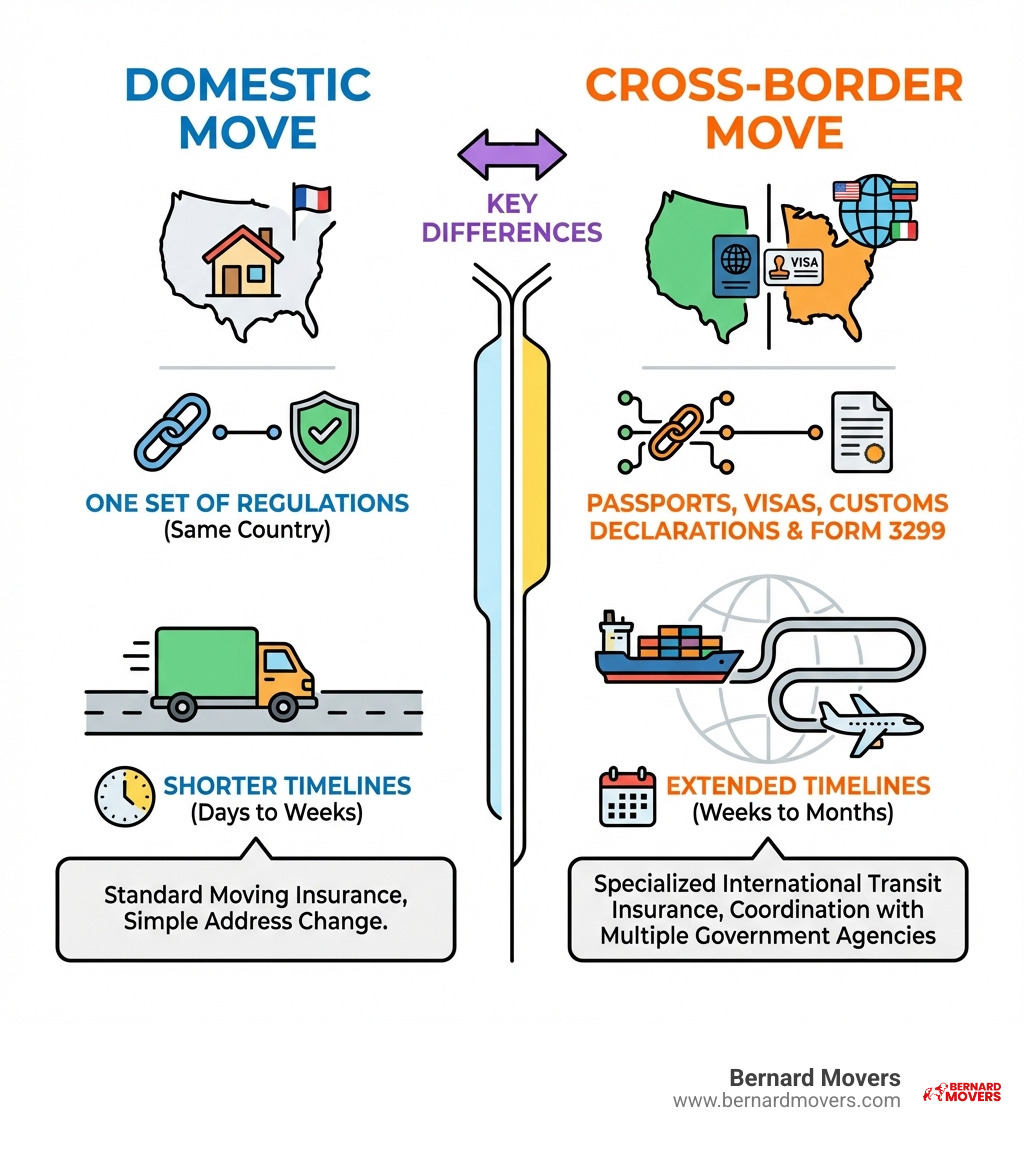
While a domestic move, like those covered in An Essential Guide to Out of State Moving Options, operates under one country’s laws, a cross border moving experience is far more complex. Here are the key distinctions:
- Legal Jurisdiction: An international move requires complying with the laws of at least two sovereign nations. Moving from the U.S. to the UK, for example, means adhering to both U.S. export regulations and UK import laws, which may have different rules for items like electronics, art, or antiques.
- Customs Clearance: Unlike domestic moves, every item you ship internationally must be declared and cleared through customs. This process can involve physical inspections, X-ray scans, and the payment of duties or taxes (like a Value-Added Tax or VAT) on new or high-value goods.
- Documentation: International moves demand extensive paperwork, including passports, visas, and specific customs forms, far beyond a simple inventory list. Each document must be meticulously accurate to avoid costly holds.
- Shipping Methods: Moves from Illinois overseas rely on ocean or air freight, which have different costs, timelines, and packing requirements than domestic ground transport. Ocean freight is more common for full households, while air freight is faster but significantly more expensive.
- Timelines: A cross-border move can take weeks or even months due to ocean transit times, port congestion, and customs processing. This is a stark contrast to the days it might take for a domestic relocation.
- Insurance: Your belongings face greater risks during international transit, such as shifting cargo at sea, water damage, and extensive handling at multiple ports. Standard moving insurance is insufficient; you’ll need specialized marine insurance to ensure adequate protection.
The Paperwork Trail: Essential Documents for a Cross Border Move
For cross border moving, proper paperwork is non-negotiable. A single missing document can halt your entire shipment, leading to costly delays and storage fees. Start gathering documents months in advance, keep digital and physical copies, and carry originals with you during your travel.

Here’s a checklist of essential documents:
- Passports and Visas: Ensure your passport is valid for at least six months beyond your arrival date. Secure the necessary visa (work, student, residency) for your destination country well in advance, as processing times can take several months and often require proof of employment or accommodation.
- Detailed Inventory List: Your mover will require a comprehensive, itemized inventory list with declared values for each item. This document is essential for both customs clearance and insurance purposes, so accuracy is paramount. It must be written in English and may need to be translated for some destinations.
- Birth and Marriage Certificates: Vital for proving identity and family relationships, especially when applying for residency or sponsoring family members. Keep these originals with you.
- U.S. Customs Form 3299: For moves into the U.S., this is a critical declaration for bringing in household goods duty-free. An incorrect or incomplete U.S. Customs Form 3299 can cause major delays and fees. An experienced mover can ensure it’s filled out correctly.
- I-94 Form for Non-Residents: If moving to the U.S. as a non-resident, you must enter the country before your shipment arrives and provide your mover with a copy of your I-94 arrival record to prove your legal entry.
- Other Key Records: Have copies of medical/dental records, school records for children, international driver’s licenses, and financial statements. U.S. citizens should review tax information for taxpayers living abroad to understand their filing obligations.
Our Moving Out of State Checklist offers more organizational tips.
Clearing Customs: Regulations, Duties, and Prohibited Items
Navigating customs is a critical part of cross border moving. You must declare every single item you ship on a detailed inventory. Failure to declare, or misrepresenting items, can result in fines, confiscation, and severe delays. Always check the official customs website for your destination country, like the Official U.S. Customs and Border Protection website for U.S. moves, for the most current rules.
Duty-Free Entry (U.S. Moves):
Most of your belongings can enter the U.S. duty-free if they are classified as ‘used household effects.’ This generally means you must have owned and used them for at least one year prior to your move. This ‘one-year rule’ is designed to prevent the tax-free importation of new goods for resale. Be prepared to provide proof of ownership if requested. For antiques, they must be 100 years or older (with a certificate of age) to be duty-free. New items, gifts, and items you’ve owned for less than a year will likely be subject to duties and taxes.
Restricted & Prohibited Items:
To avoid complications, know what you cannot ship. Moving companies do not transport alcohol, and firearms are highly regulated by agencies like the ATF and require complex permits. Other commonly prohibited or restricted items include:
- Live plants, seeds, and soil: Prohibited to prevent the introduction of invasive species and agricultural diseases.
- Perishable foods: Meats, fruits, and vegetables are restricted to protect against foreign pests and diseases.
- Hazardous materials: Items like paints, propane tanks, aerosols, and cleaning supplies are forbidden in household shipments due to the risk of fire or explosion.
- Illegal drugs and counterfeit goods: Strictly prohibited with severe legal penalties.
- Certain animal products: Furs, ivory, and other items from endangered species are illegal to import.
Moving Precious Cargo: Transporting Vehicles and Pets
Moving vehicles and pets across borders requires specialized planning that should begin months in advance. Early and thorough research is essential, as the rules are strict and non-negotiable.

Transporting Vehicles:
Importing a vehicle into the U.S. involves strict regulations. The ’25-year rule’ exempts cars 25 years or older from EPA and DOT standards, making it easier to import classic cars. However, vehicles under 25 years old must meet all U.S. safety and emission standards. This often requires a costly and complex process called ‘federalization,’ which can be prohibitive. You will need a compliance letter from the manufacturer and must complete specific forms.
- EPA Form 3520-1: See EPA vehicle importation forms.
- NHTSA Form HS-7: See NHTSA vehicle importation rules.
For container shipping, vehicles must be thoroughly cleaned (especially the undercarriage), have a nearly empty fuel tank (less than 1/4 full), and have the battery disconnected for safety.
Moving Your Pets:
Planning for pets is even more detailed and emotionally charged. For moves to the U.S., dogs and cats require proof of rabies vaccination and a recent veterinarian’s health certificate. Many countries also require an ISO-compliant microchip for identification. Some destinations, like the UK or Australia, have strict quarantine periods. Always check the regulations of your destination country well in advance. When flying, pets must travel in an IATA-approved crate, and you must be aware of breed restrictions and temperature embargoes imposed by airlines. Consider using a professional pet relocation service to manage these complexities.
Planning for Success: Timelines, Costs, and Avoiding Pitfalls
Successful cross border moving hinges on careful, long-range planning. Start at least 3-6 months in advance to manage document processing, shipping schedules, and other logistics. This buffer is crucial for navigating bureaucracy without stress.
Costs:
International moves often cost $10,000 or more. The final price is influenced by the volume of goods (which determines if you need a Full Container Load, FCL, or can use a shared Less than Container Load, LCL), distance, shipping method (air is much costlier than ocean), and additional services. Budget for the core shipping cost, comprehensive insurance, potential customs duties on new items, and ancillary costs like port fees, terminal handling, and vehicle transport. Our Long Distance Movers Cost Guide provides a baseline, but international moves are in a different league.
Here’s a simplified comparison for moves from Chicago:
| Aspect | Move to Toronto (Canada) | Move to London (UK) |
|---|---|---|
| Estimated Cost | $5,000 – $15,000+ | $8,000 – $20,000+ |
| Shipping Method | Ground (truck) or ocean freight | Primarily ocean freight; air for urgent items |
| Key Documents | Canadian customs forms, passports, permits | UK customs declarations, passports, visas |
| Customs/Duties | Duty-free for used goods (1-year rule) | Duty-free for used goods (1-year rule); VAT on new items |
| Timelines | 1-4 weeks + customs | 4-12 weeks + customs |
(Note: These are estimates and will vary.)
Avoiding Common Pitfalls:
- Documentation Errors: The #1 cause of delays. A single incorrect date or missing signature can hold your shipment in port for weeks. Triple-check everything and have your mover review it.
- Underestimating Costs: Your quote should be comprehensive, but you must also budget for the unexpected. Create a detailed budget that includes a 10-15% contingency fund for unforeseen fees or delays.
- Customs Issues: Be completely transparent. Declare everything, even if you think it’s insignificant. Attempting to hide items or ship prohibited goods can lead to confiscation and legal trouble.
- Improper Packing: International shipments endure significant vibration, temperature changes, and handling. Standard moving boxes are not enough. Professional export wrapping and crating are essential to prevent damage and ensure your insurance policy remains valid.
- Ignoring Destination Laws: Don’t assume what’s legal or common in the U.S. is the same abroad. Research your new country’s regulations on everything from electrical appliance compatibility to medication.
Why Hire Professionals for Your Cross Border Moving Needs?
Given the high stakes and complexities, hiring experts for your cross border moving from the Chicago area is a strategic advantage, not a luxury. Here’s why partnering with a professional international mover like Bernard Movers is essential:
- Customs Brokerage Expertise: Professional movers have in-house customs experts or long-standing relationships with customs brokers. They are fluent in tariff codes, port procedures, and the latest regulatory changes, ensuring forms like the U.S. Customs Form 3299 are completed accurately to prevent costly delays.
- End-to-End Logistics Management: We serve as your single point of contact, managing a complex web of partners including freight forwarders, shipping lines, port authorities, and destination agents. This integrated coordination covers everything from professional packing in Chicago to final delivery and unpacking in your new home country.
- Proper Insurance Coverage: We can guide you through the nuances of marine insurance, helping you select the right ‘All-Risk’ or ‘Total Loss’ policy. We also ensure your goods are packed to the required standard for the insurance to be valid, giving you true peace of mind.
- Stress and Time Savings: We handle the immense logistical and bureaucratic burdens of an international move. This frees you to focus on the human side of your relocation: securing housing, enrolling children in school, and emotionally preparing your family for the transition.
- Expert Packing and Loading: Our teams use specialized, heavy-duty materials and techniques like export wrapping and custom crating. They know how to properly load a container to minimize shifting and prevent damage during long-distance ocean or air transit.
Whether you need Professional Movers Long Distance or specific Chicago Long Distance Moving services that cross borders, our expertise is the key to a successful and smooth experience.
Your Smooth Move Starts Here
A cross border moving journey from Illinois is a significant undertaking, but it doesn’t have to be daunting. With the right preparation and professional guidance, your international relocation can be a seamless and exciting transition. Navigating complex customs, documentation, and logistics is where an expert partner like Bernard Movers makes all the difference.
We specialize in managing the unique challenges of moving from the Chicago area to a new country. Our team is committed to ensuring your belongings and peace of mind arrive safely. For a stress-free relocation that handles every international detail, trust the experts.
Contact us for your affordable moving needs today, and let’s start planning your new chapter!
