


The Weight and Complexity of Piano Moving
Moving a piano is one of the most challenging tasks in any relocation. It requires specialized knowledge, equipment, and strength.
Quick Answer: How to Move a Piano
- Assess the piano type – Uprights (300-800 lbs) vs. grands (500-1,400 lbs)
- Gather equipment – Piano dolly, moving blankets, lifting straps, and ramps
- Recruit help – At least 4 people for uprights, 5-6 for grand pianos
- Protect everything – Wrap the piano, protect floors and doorways
- Consider professionals – Costs range from $250-$1,200+ but prevent injury and damage
Why is moving a piano so difficult?
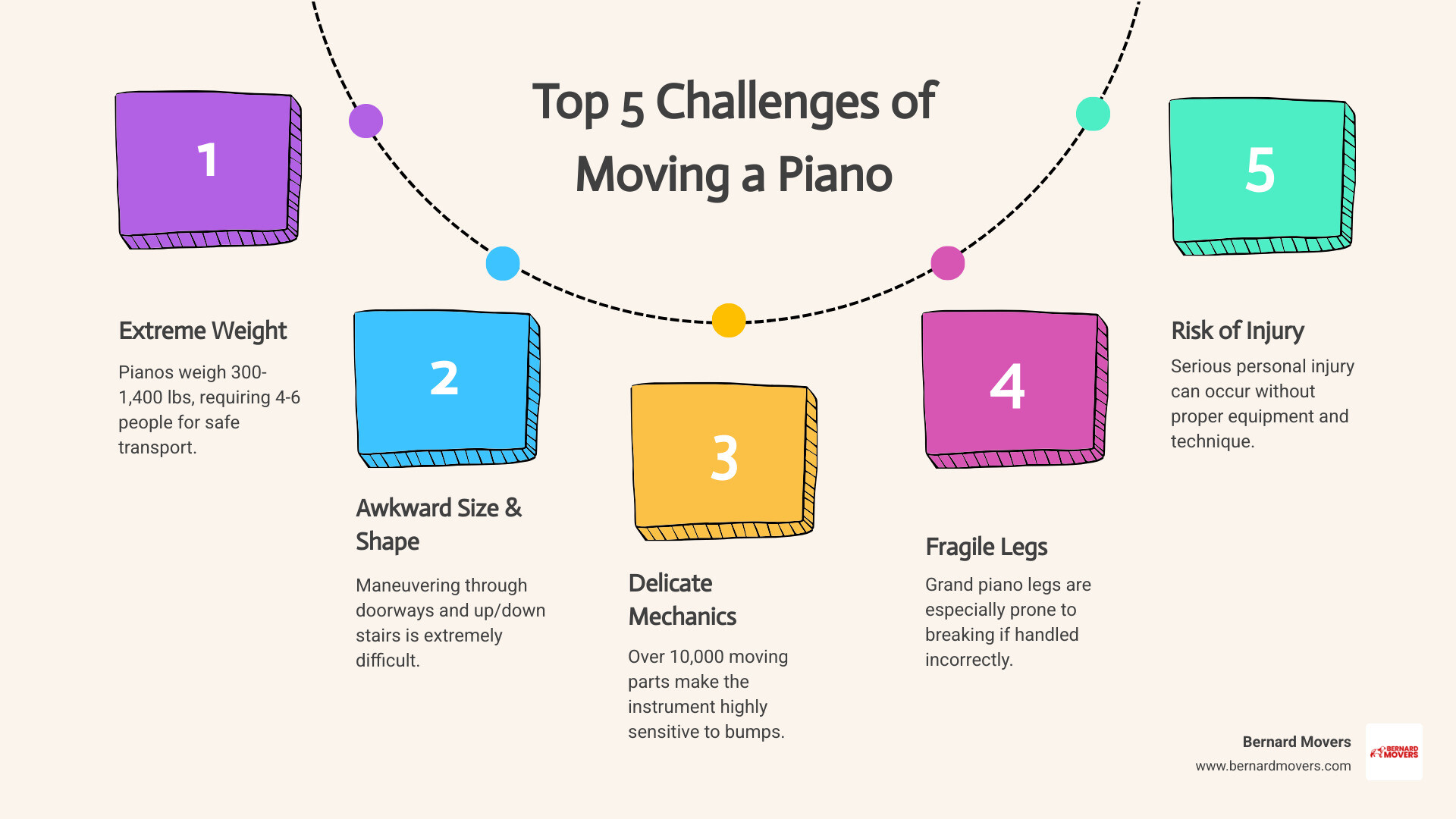
Pianos are a unique moving challenge due to their immense weight and delicate nature. Upright pianos weigh 300-800 pounds, while grand pianos can exceed 1,400 pounds. This weight is unevenly distributed, making them top-heavy and unstable. Inside, over 10,000 sensitive moving parts, a heavy cast-iron plate, and a fragile case mean that even small bumps can cause significant damage. The legs, especially on grand pianos, are often decorative and can easily break if handled incorrectly.
Attempting a DIY move without proper equipment or help risks serious personal injury, costly damage to the piano, and harm to your home’s floors and walls. Whether you’re relocating within Chicago, moving from Melrose Park to another Illinois city, or planning a long-distance move, careful planning is crucial.
I’m Mina Georgalas, owner and president of Bernard Movers. With nearly 30 years of experience in complex relocations, including countless piano moves throughout the Chicago area and Illinois, I’ll share the essential knowledge you need for moving a piano safely.
Find more about moving a piano:
The DIY Guide to Moving a Piano
While we strongly recommend professionals for moving a piano, a DIY move may be an option for lighter instruments over short, simple distances. If you proceed, meticulous preparation is non-negotiable.
Step 1: Preparation, Tools, and Safety
First, understand your piano and the path it will travel.
Piano Types and Weight
Pianos vary greatly. Uprights can weigh 300-800 pounds, while grand pianos range from 500 to over 1,400 pounds. The heavier and larger the piano, the riskier a DIY move becomes. For detailed weights, see Here are the weights of some popular piano brands and styles.
Essential Tools and Supplies
Gathering the right equipment is critical for safety and success. You will need:
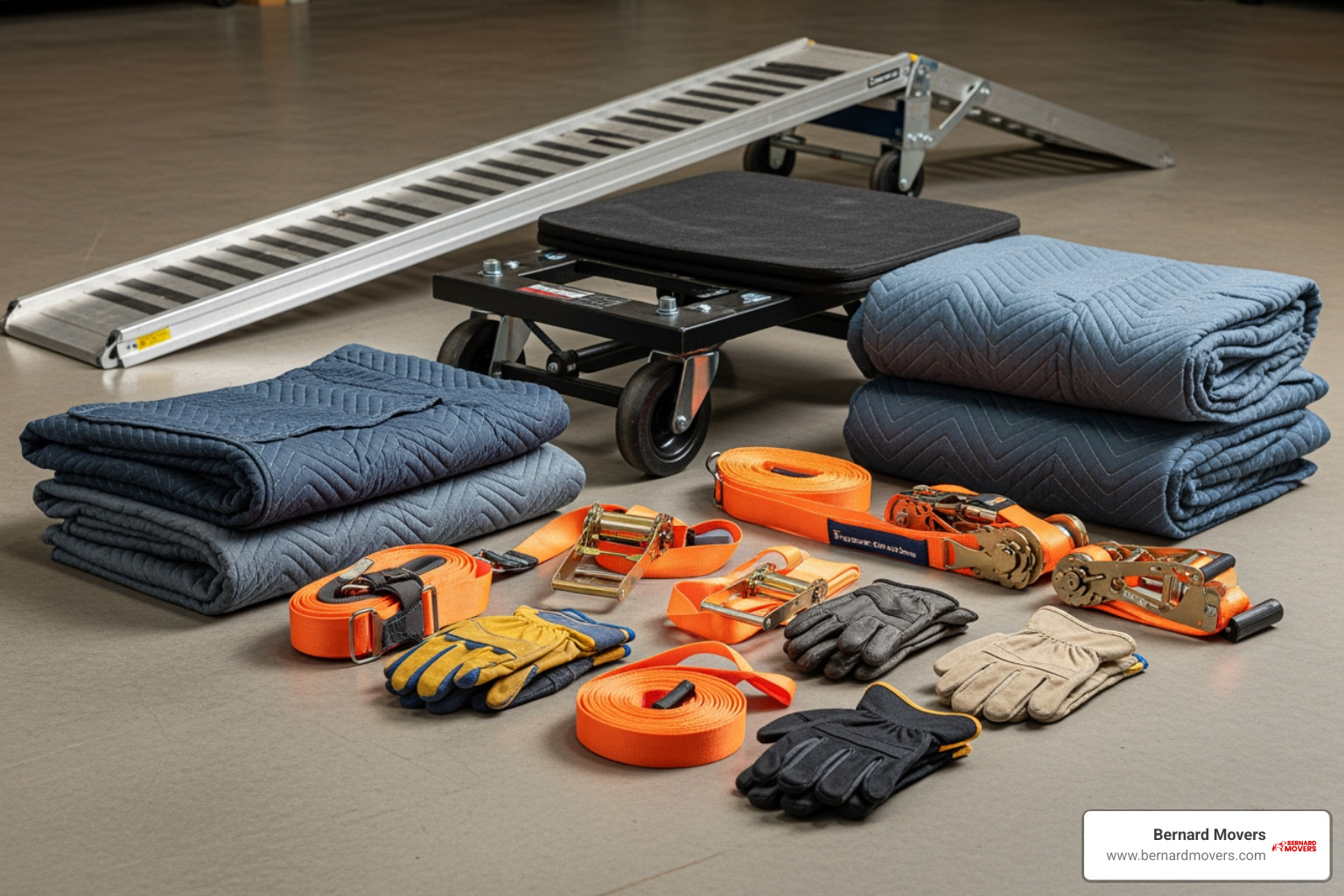
- Specialized Piano Dolly: Do not use a standard utility dolly. A piano dolly (or H-dolly) is wider, has a stronger frame, and features non-marring rubber wheels to support the immense, uneven weight without damaging floors.
- Moving Blankets/Pads: You’ll need at least 4-6 thick, quilted blankets. These are essential for protecting the piano’s delicate finish from scratches, gouges, and dings during the move.
- Lifting Straps/Shoulder Harness: Often called “forearm forklifts” or shoulder dollies, these straps use leverage to make lifting more manageable and significantly reduce the risk of back strain.
- Ratchet Straps: Have several heavy-duty straps on hand. These are non-negotiable for securing the piano to the dolly and, most importantly, anchoring it inside the moving truck to prevent any movement.
- Stretch Wrap & Packing Tape: To secure blankets.
- Work Gloves & Closed-Toe Shoes: For personal protection.
- Floor Protection: Cardboard or heavy-duty paper to prevent scratches.
- Ramp: Ensure the ramp is rated to handle at least 1,500 pounds. A shallow incline is safer than a steep one, so a longer ramp is often better.
- Tools for Disassembly: Screwdrivers/wrenches for grand pianos.
For more details, see our guide on Piano Moving Equipment.
Protecting Your Home
- Clear the Path: Measure the piano and your entire moving path. Remove all furniture, rugs, and obstacles.
- Protect Surfaces: Lay down cardboard or floor protection along the entire path. Tape padding to vulnerable wall corners.
Safety Precautions
- Recruit Help: This is the most critical step. You need at least four people for an upright and five to six for a grand piano.
- Communicate: Establish clear commands for lifting, lowering, and turning.
- Lift Correctly: Always lift with your legs, not your back. Keep your back straight.
- Move Slowly: Rushing leads to accidents. Take your time and pause if needed.
- Avoid Fragile Parts: Never lift or push a piano by its decorative legs.
The Process for Moving a Piano: Upright & Grand Pianos
The procedure differs significantly between piano types.
Moving an Upright Piano
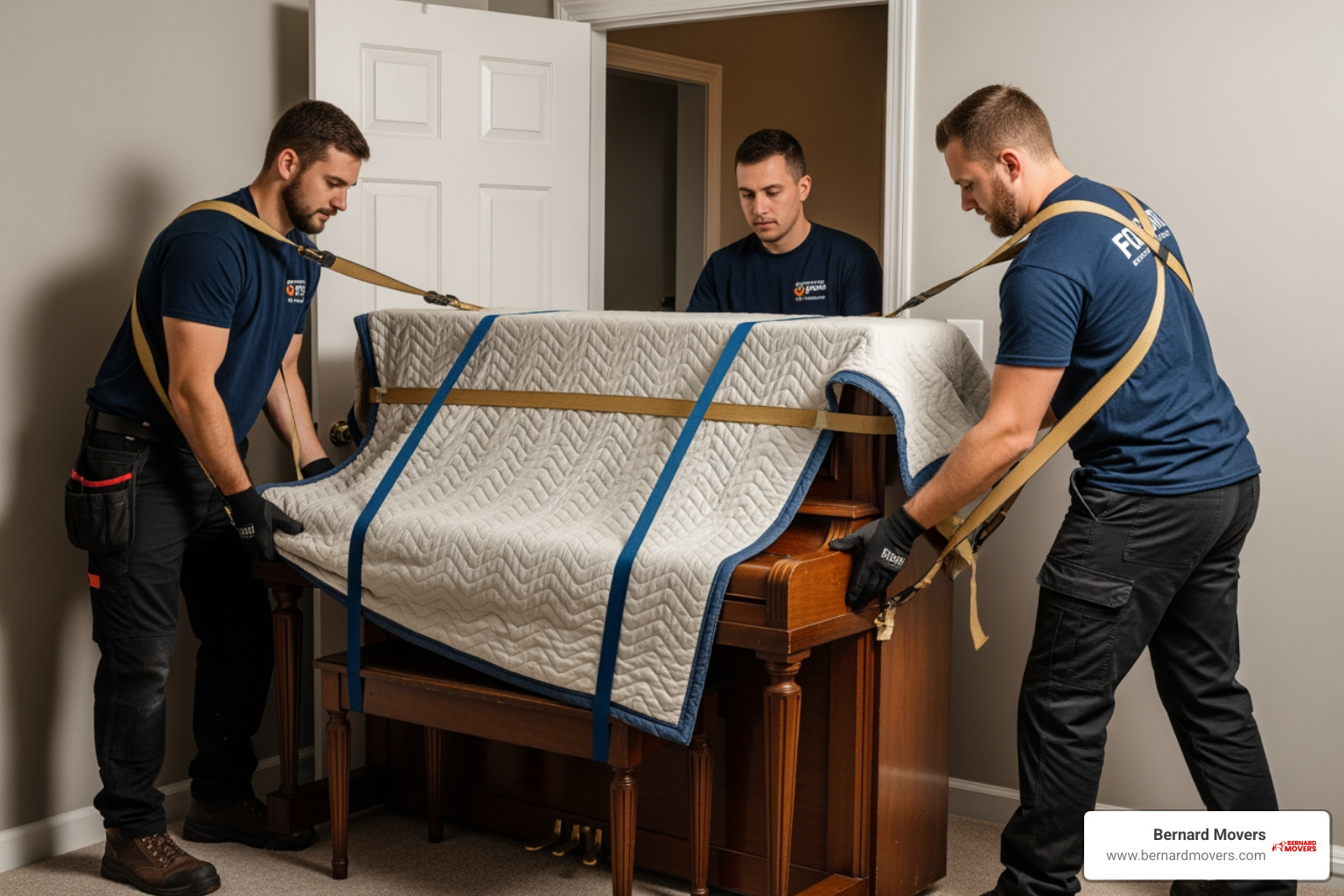
- Secure: Close and lock the keyboard lid.
- Wrap: Cover the piano completely with moving blankets, securing them with stretch wrap. Learn more at How to Pack an Upright Piano for Moving.
- Lift: With your team, use lifting straps to position the piano onto the center of a piano dolly.
- Strap: Use ratchet straps to firmly secure the piano to the dolly.
- Move: Carefully roll the piano along your cleared path. For stairs, it must be removed from the dolly and carried one step at a time using straps.
Moving a Grand Piano
Grand pianos require partial disassembly and a specialized piano board.
- Disassemble: Secure the lid. With helpers, tip the piano onto its flat side onto a padded piano board. Carefully remove the legs and pedal lyre, wrapping each part separately. The principles of careful disassembly are key: How to Disassemble an Upright Piano for Moving.
- Wrap & Secure: Secure the piano body to the board, then wrap the entire unit in moving blankets and stretch wrap.
- Move: With a large team, carefully slide or carry the piano on its board. Use a dolly only for flat surfaces.
Step 3: Transport and Post-Move Care
Proper transport and after-care are vital.
Securing a Piano in a Moving Truck
- Load First: The piano should be loaded first, against the front wall of the truck.
- Use a Ramp: Always use a sturdy ramp.
- Secure Tightly: Use multiple heavy-duty ratchet straps to anchor the piano to the truck’s tie-down points so it cannot shift, roll, or tip. Our guide on How to Secure a Piano in a Moving Truck has more tips.
Post-Move Care
- Unload & Reassemble: Carefully reverse the loading process. For grands, reattach the legs and pedals.
- Acclimate: Place the piano in its new spot, away from direct sunlight, vents, or drafty windows. The internal components, primarily made of wood and metal, need time to expand or contract to match the new environment’s temperature and humidity. This process is crucial for tuning stability.
- Wait to Tune: We strongly recommend waiting two to eight weeks before calling a tuner. A month is a good average. The piano’s pitch will fluctuate as it settles. Tuning it immediately after a move is a waste of money because it will quickly go out of tune again as the acclimation process continues. Patience is key to a lasting, quality tuning.
- Hire a Tuner: After the acclimation period, contact a qualified piano tuner to restore its pitch.
Hiring Professional Piano Movers
After reviewing the DIY guide, it’s clear that moving a piano is a major undertaking. This is why hiring professionals is often the wisest choice.
The Risks of DIY vs. The Benefits of a Pro
While a DIY move seems cheaper, the risks are immense. You could face severe personal injury, expensive damage to the piano’s delicate internal parts or fragile legs, and harm to your property. Professionals eliminate these risks.
We believe hiring professional piano movers is almost always the smarter, safer, and more cost-effective choice, especially in these situations:
- Complex Pianos: If you own a grand piano, a large upright, or an antique instrument.
- Stairs or Obstacles: If your move involves stairs, tight corners, or narrow hallways.
- Long Distances: To ensure the piano is properly secured for transport.
- Peace of Mind: Professionals are insured, so if an accident occurs, you’re covered. You can find reliable specialists through services like Moving Companies That Move Pianos.
| Feature | DIY Piano Moving | Professional Piano Moving |
|---|---|---|
| Cost | Appears lower initially (equipment rental, truck rental, food for helpers), but high risk of hidden costs (damages, injuries). | Higher upfront cost (typically $250-$1,200+), but covers specialized labor, equipment, and insurance, preventing unexpected expenses. |
| Risk of Injury | Very High. Significant potential for back injuries, crushed fingers, and falls. | Very Low. Trained professionals use proper techniques and equipment, minimizing risk to themselves and bystanders. |
| Risk of Damage | High. Significant potential for damage to the piano (internal, external, legs) and property (floors, walls, doorways). | Very Low. Professionals use specialized padding, wrapping, and securement methods. Insurance covers rare instances of damage. |
| Time | Can take many hours of planning, execution, and potential re-dos if something goes wrong. | Efficient. Professionals complete the move quickly and effectively due to experience and specialized tools. |
| Equipment | Relies on rented or purchased general moving equipment, often insufficient for piano-specific needs. | Access to specialized piano dollies, skid boards, heavy-duty straps, and appropriate moving trucks. |
| Insurance | Generally none, leaving you responsible for all damages and injuries. | Typically includes valuation coverage, protecting your piano and property against the move. |
Understanding the Cost of Moving a Piano
Professional piano moving costs typically range from $250 to $600 for local moves and can exceed $1,200 for more complex situations. For a closer look at pricing, consult our guide on Piano Moving Company Price.
Several key factors affect the final price:
- Type and Size of Piano: A small spinet or console piano is the least expensive to move. Larger uprights, baby grands, and concert grands cost progressively more due to their increased weight, bulk, and the need for careful disassembly and reassembly. See our Upright Piano Moving Cost guide for more.
- Distance of the Move: Local moves are often priced hourly or as a flat rate. Long-distance moves are typically priced based on weight and mileage, which can increase the cost significantly.
- Access and Obstacles: The moving path is a major cost factor. Expect to pay more for each flight of stairs (usually a per-stair or per-flight fee), tight 90-degree turns, and difficult terrain like grass, gravel, or steep driveways that prevent the use of a dolly.
- Special Handling: If the piano cannot be moved through doorways or stairs, it may require hoisting or craning through a window or over a balcony. This is a highly specialized service that adds considerable cost but is sometimes the only option.
To get an accurate quote, provide as much detail as possible about your piano and the locations.
How to Vet and Choose a Piano Mover
Not all moving companies are equipped to handle pianos. When you call for a quote, be prepared to ask specific questions to ensure you’re hiring a true specialist:
- Ask About Experience: Don’t just ask if they move pianos; ask how many they move per month and what types. Do they have experience with your specific model (e.g., a 9-foot concert grand vs. a 100-year-old upright)?
- Verify Insurance: A professional piano mover must have two types of insurance: General Liability (to cover your property) and Cargo Coverage (to cover the piano itself). Ask for a Certificate of Insurance. Standard “valuation” offered by general movers is often insufficient for the true value of a piano.
- Request a Detailed, Written Quote: The quote should be binding and itemize all potential charges, including fees for stairs, mileage, and any special handling. Avoid companies that give vague quotes over the phone without asking detailed questions about the piano and the moving path.
- Check Reviews and References: Look for reviews on platforms like Yelp and Google that specifically mention piano moving. A long track record of successful, damage-free piano moves is the best indicator of a reliable company.
Your Next Steps for a Chicago Piano Move
For a task as complex as moving a piano, entrusting it to professionals is the safest and most effective solution.
As local experts serving Chicago, Melrose Park, and all of Illinois, Bernard Movers has the training, equipment, and insurance to handle your instrument with the care it deserves. We understand the challenges of moving in our local neighborhoods, from historic brownstones in Evanston to suburban homes in Elmhurst.
If you’re planning a move and need assistance with moving a piano, don’t hesitate to reach out. We specialize in complex moves and are here to help make your relocation as smooth as possible. Plus, if you’re planning a move to Georgia or Florida, you can receive a 20% additional discount on moves booked for delivery by March 15, 2025.
Contact us for your professional piano moving needs today to get your personalized quote.
