

The Step-by-Step Budget Moving an Office Checklist for Businesses
A practical budget checklist for moving an office starts with four immediate actions: audit your current and future lease terms to quantify overlap costs, secure binding or not-to-exceed estimates from commercial movers, allocate a 10% to 15% contingency reserve, and schedule IT and telecom migration at least 60 days ahead. These steps keep relocation spending predictable while protecting operational continuity across your entire organization. Almost 50% of business executives state that company expansion drives their decision to relocate, but without a methodical framework, unexpected expenses can quickly mount and erode operational capital.
Managing corporate transition expenses requires a structured timeline, detailed vendor coordination, and strict line-item tracking across every department. Whether you are transitioning a boutique practice in downtown Chicago, an industrial facility in Melrose Park, or a regional corporate branch in Cook County, proactive fiscal governance is essential. For companies looking for structured administrative tools, reviewing a comprehensive office moving checklist helps establish baseline expectations early and aligns key internal stakeholders before physical work commences.
Phase 1: Planning and Initial Budget Moving an Office Checklist Milestones
The earliest phase of any relocation dictates whether the project stays within its financial boundaries. For an office of roughly 50 people, logistics require at least 12 weeks of structured preparation. Larger commercial facilities throughout Illinois with over 100 workstations frequently require 16 to 20 weeks of rigorous planning. Starting early allows management to align corporate lease requirements, conduct comprehensive site walkthroughs, establish vendor accountability, and implement an actionable commercial relocation project management guide.
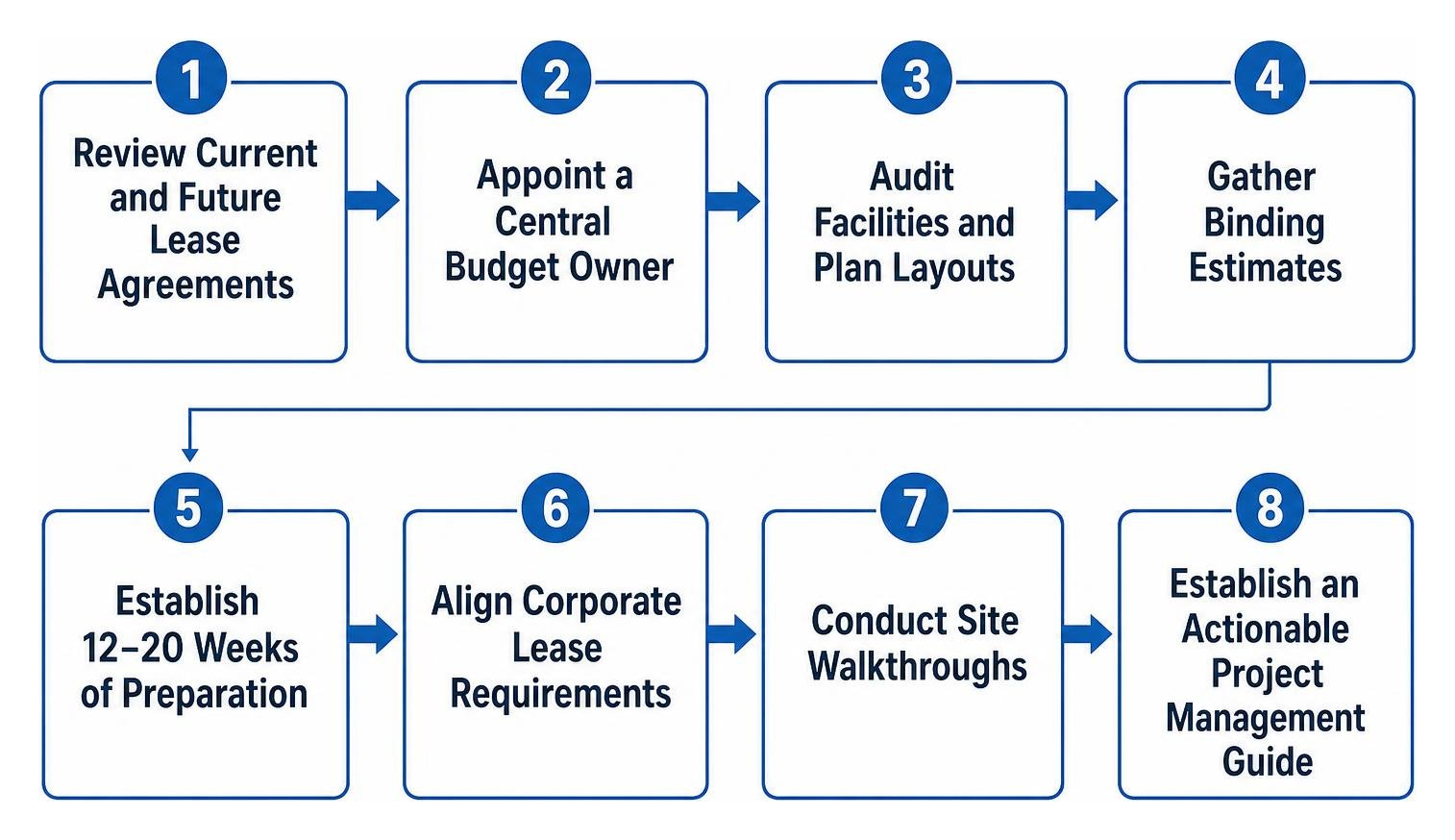
- Review Current and Future Lease Agreements: Examine your current commercial lease to determine mandatory notice periods (often 3 to 6 months) and identify tenant restoration or make-good clauses. Factor in potential lease overlap—paying rent on two corporate spaces simultaneously for 1 to 3 months is often the largest unbudgeted relocation expense for expanding companies.
- Appoint a Central Budget Owner: Designate a single project lead, facilities director, or steering committee to manage procurement, approve purchase orders, track vendor contracts, and monitor cost variances. Establishing strict internal spending thresholds prevents unapproved departmental purchases and keeps individual teams accountable to the master relocation balance sheet.
- Audit Facilities and Plan Layouts: Measure your target space in Chicago, Skokie, Evanston, or Melrose Park and verify physical dimensions against your current operational footprint. According to commercial real estate guidance from JLL, matching existing furniture assets to new architectural layouts early prevents redundant purchasing and eliminates unplanned storage expenses.
- Gather Binding Estimates: Commercial moving quotes vary significantly based on contract structure and carrier tariff rules. Non-binding estimates can shift dramatically when final weight, elevator wait times, and labor hours are calculated on move day.
| Estimate Type | Pricing Structure | Budget Predictability | Move-Day Cost Risk |
|---|---|---|---|
| Binding Estimate | Fixed price based on comprehensive inventory audit | High: Price remains set unless inventory changes | Low: Guarantees fixed operational spend |
| Non-Binding Estimate | Variable rate based on actual hourly labor and scale weight | Low: Subject to traffic, labor delays, and weight spikes | High: Costs can increase 15% to 25% on move day |
| Binding Not-to-Exceed | Capped maximum with downward adjustment for lower weight | Highest: Protects against unexpected cost overruns | Minimal: Best fit for strict corporate governance |
Phase 2: Technical Relocation and Protecting Critical IT Assets
Technology transitions present significant financial and operational risk during any corporate move. IT infrastructure is consistently underbudgeted in standard facility relocations, and unplanned network outages directly stall revenue generation. Minimizing downtime requires executing a dedicated IT office relocation plan for tech teams alongside general physical logistics.
- Order Telecom and ISP Services Early: Fiber internet circuits, dedicated phone routing, and static IP allocations require a carrier lead time of 60 to 90 days in Illinois commercial office buildings. Waiting until the final month can lead to costly expedited installation fees, construction surcharges, or operational blackouts on opening day.
- Coordinate Safe Equipment Transport: Servers, network switches, enterprise storage arrays, and precision electronics require specialized anti-static packaging and secure transport protocols. Utilizing professional procedures for moving office equipment prevents sensitive hardware damage during transit and avoids premature capital replacements.
- Execute Redundant Data Backups: Run full cloud synchronizations and localized off-site backups prior to disconnecting physical server racks or core workstation infrastructure.
- Audit Low-Voltage Cabling: Inspect the destination property to confirm sufficient Category 6 data drops, patch panel termination, and server room dedicated cooling circuits before delivery day.
- Schedule After-Hours Migration: Disconnect, transport, and reconnect primary server infrastructure over a weekend to ensure end-to-end network testing, firewall verification, and user access validation before staff return to work on Monday morning.
Phase 3: Cost Controls and Your Budget Moving an Office Checklist Items
Controlling total project expenditure requires distinguishing essential operational investments from avoidable logistical overhead. Research on capital allocation from Vector Installations underscores the importance of maintaining a dedicated 10% to 15% contingency reserve; moves without dedicated contingency allocations exceed their initial budget projections 90% of the time.
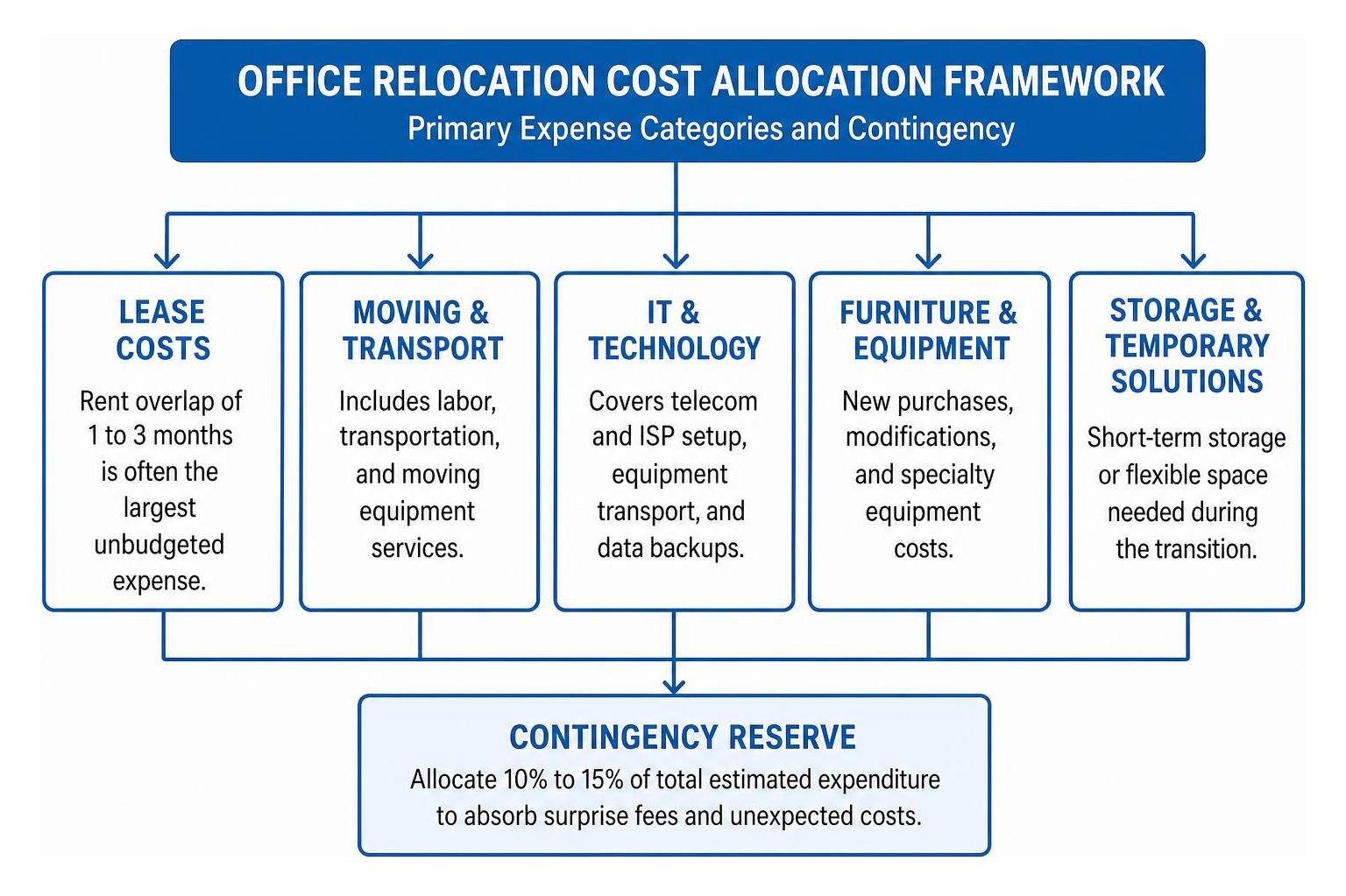
- Allocate Contingency Funds: Set aside 10% to 15% of your total estimated expenditure to absorb unexpected fees, including building overtime rates, union freight elevator engineer fees, building protection mandates, or emergency replacement of legacy hardware.
- Liquidate Surplus Assets: Commercial transportation costs are heavily influenced by total cargo weight, truck volume, and handling time. Selling, recycling, or donating redundant desks, modular cubicles, and filing cabinets reduces transport fees while clearing floor space in your new facility.
- Rent Reusable Packing Systems: Cardboard boxes require extensive taping, single-use material costs, and disposal labor. Transitioning to commercial plastic office moving crates streamlines the packing process, provides rigid structural protection for confidential paper files, and lowers packing supply overhead.
- Utilize Flexible Storage Units: If lease start dates do not align perfectly or space build-outs face construction delays, securing temporary business storage solutions prevents rushed delivery schedules, eliminates secondary relocation fees, and protects corporate assets during transitional phases.
- Standardize Workspace Packing Rules: Enforce clear packing policies for employees, specifying maximum individual container counts and personal item boundaries to streamline loading time and minimize moving labor charges.
Phase 4: Move-Day Execution, Facility Closeout, and Onboarding

Move day demands strict logistical coordination across both facilities to keep labor costs within contracted boundaries. Managing building access, property management documentation, and immediate workspace setup ensures your team resumes normal business operations without billing delays.
- Verify Vendor Compliance: Ensure commercial movers supply an accurate Certificate of Insurance (COI) that names both the departure and arrival property managers as additional insured parties well before trucks arrive on site.
- Secure Freight Elevators and Docks: Reserve dedicated loading bays and service elevators at both properties. Uncoordinated dock access or shared freight elevators can cause costly carrier standing time and extended crew hours.
- Complete Lease-End Sanitization: Arrange comprehensive office move out cleaning to fulfill commercial lease terms and support the return of your full security deposit (which often represents 2 to 6 months of base corporate rent).
- Conduct Immediate Workspace Audits: Follow a detailed new office setup plan to test network ports, verify power distribution, place department signage, check emergency exits, and orient returning staff on their first business day.
- Perform Final Facility Walkthrough: Conduct a signed joint inspection with the outgoing property manager to formally document the surrendered space condition and eliminate future property damage claims.
- Update Business Records and Vendor Accounts: Finalize all corporate regulatory filings with the Illinois Secretary of State, update banking institutions and merchant processors, adjust municipal business licenses, and revise local directory listings to reflect your new address.
Executing a Smooth Office Relocation While Protecting Your Bottom Line
Managing an office move on budget requires clear planning, proactive risk management, and reliable vendor execution. From calculating lease overlap to securing sensitive hardware and avoiding non-binding pricing spikes, every stage of the process directly impacts your balance sheet. When corporate leadership establishes strict budget ownership, schedules technical migrations early, and implements structured timeline controls, office transitions become predictable operational milestones rather than financial liabilities.
For expanding enterprises, medical centers, legal practices, and corporate facilities throughout Chicago, Melrose Park, and the surrounding Illinois business communities, Bernard Movers delivers experienced commercial logistics tailored to exacting corporate standards. Our dedicated commercial specialists manage structural move planning, heavy equipment handling, cubicle reassembly, and strategic transport to minimize operational downtime and safeguard corporate capital. Explore our comprehensive commercial office moving solutions to organize your next corporate relocation with total confidence, reliable scheduling, and cost clarity.