

Find Local Commercial Movers Without Disrupting Your Workday
To find local commercial movers in Chicago, Melrose Park, or elsewhere in Illinois, compare more than price. Ask each mover for a walkthrough, a written scope of work, proof of insurance, and references from businesses with similar moves. Check your building’s loading dock and elevator rules before you choose a date.
For Illinois businesses, the details that matter most are rarely the truck or the hourly rate. They are how the move fits around payroll deadlines, client appointments, deliveries, and the people who need a working desk on Monday morning. A mover who understands that rhythm will ask about your busiest days, your non-negotiable systems, and which departments must be operational first. A mover who does not ask those questions is likely planning a generic move and hoping it fits.
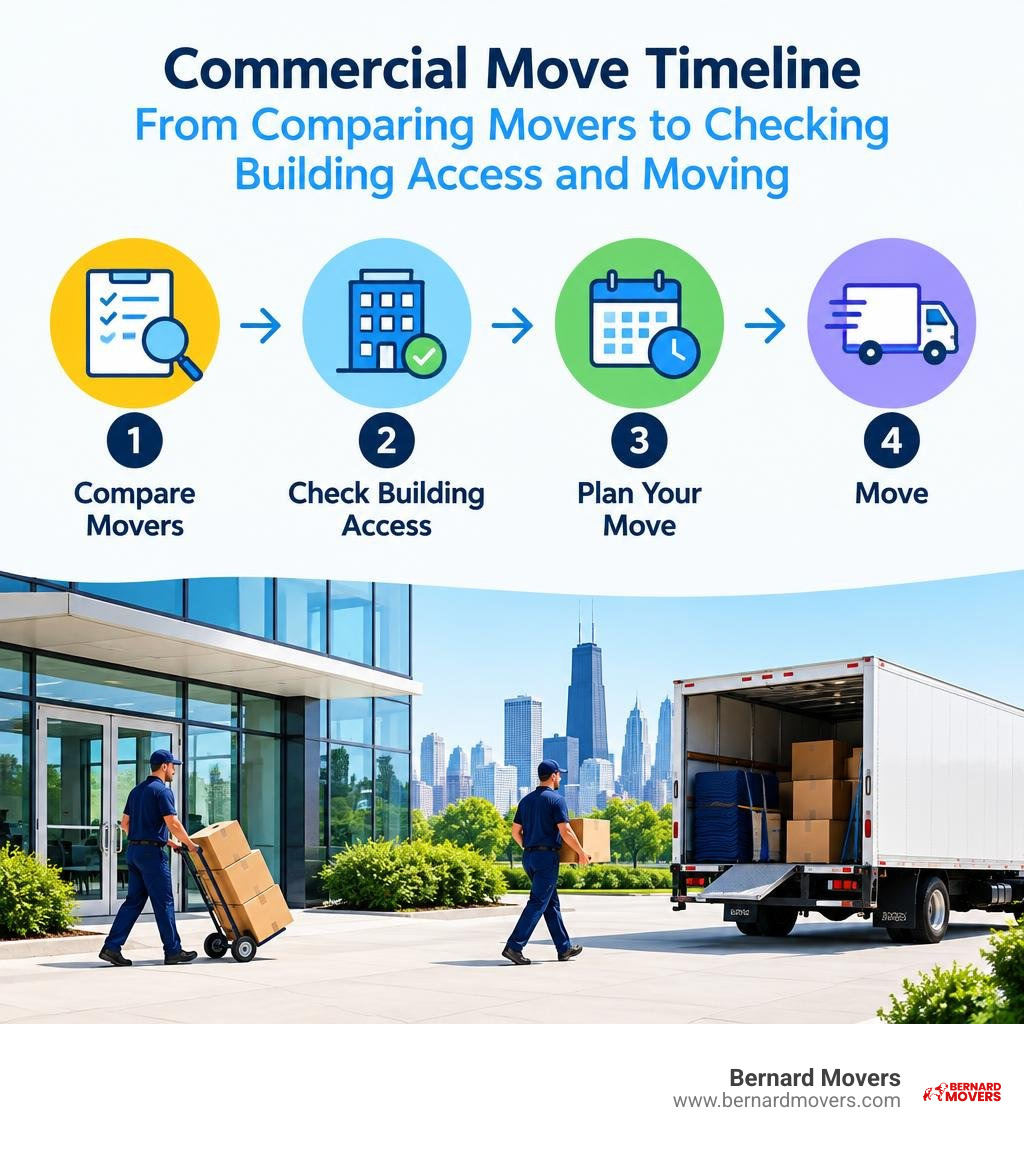
Start planning about eight weeks ahead for a typical office move. A large or multi-site move may need 10 to 12 weeks. That time gives you room to plan the move around your staff, customers, and workday.
Use those weeks to build a simple inventory of what is actually moving. Count workstations, files, storage, and specialized equipment, and flag anything that needs crating, climate protection, or a vendor disconnect. In Chicago high-rises, that inventory also has to line up with freight elevator reservations and dock windows. In Melrose Park and other suburban Illinois locations, it may line up with parking for multiple trucks and grade-level access. Either way, a clear inventory turns a vague estimate into a plan a mover can staff and schedule with confidence.
Local commercial movers terminology:
How to Choose Local Commercial Movers for an Illinois Business
Think of “best mover” as a score, not a feeling. A slick website tells you little. A mover’s track record on projects like yours tells you a lot.
Start with specialization. A commercial-only mover plans around payroll, phones, servers, and Monday-morning deadlines. A residential-first mover may be great with sofas, but office moves are a different sport. Offices have cubicle systems, IT equipment, shared floors, and building managers with strict rules. Local knowledge matters too. A crew that already knows how Chicago high-rises and suburban office parks handle docks and elevators won’t learn it on your dime.
Here is how the two types usually compare:
| What to compare | Commercial-only mover | Residential-first mover |
|---|---|---|
| Planning | Written project plan, move-day schedule, phased options | Often a single-day estimate |
| Staffing | Named project manager and trained crew leads | Crew assigned close to move day |
| IT coordination | Planned disconnect and reconnect, clear disclosure of who does it | Often left to your own IT team or a subcontractor |
| References | Recent business clients of similar size | Mostly household customers |
Whichever type you consider, look for one named project manager, from the first walkthrough through the post-move punch list, and a fixed-scope proposal. Our commercial moving services complete guide goes deeper on what a full project looks like.
You can also borrow a trick from procurement teams. Public bodies, such as the Village of Oak Lawn, Illinois, publish detailed bid requests so every vendor answers the same questions. Do the same at your company. Send each mover the same scope and compare the answers side by side.
One more opinion from us: the cheapest proposal in a stack is usually the least complete one. Missing line items do not disappear. They show up later as change orders.
During the walkthrough, listen for how a mover talks about the work you cannot see in a quote. Ask who will lead the crew on move day, how furniture will be protected in hallways and elevators, how labeled boxes will be sorted by department, and what happens if the freight elevator is unavailable or a department is not ready to pack. In Chicago, a mover should also ask about building management approval, dock scheduling, and any restrictions on weekend or after-hours work. In Melrose Park and across suburban Illinois, a mover should ask about truck access, staging space, and whether the new location can receive deliveries while the move is underway. Those questions reveal whether the company has planned similar Illinois moves before.
What local commercial movers should include in a written proposal
A good proposal follows an on-site walkthrough, not a phone guess. Expect an itemized scope that covers:
- Labor, with crew size and hours
- Materials, such as crates, wardrobe boxes, and protection supplies
- Equipment, including trucks, dollies, and lift gear
- Packing and unpacking responsibilities
- Furniture disassembly and installation
- IT disconnect and reconnect
- Storage, if any part of the move needs it
- Decommissioning of the old space
- Insurance coverage
- Exclusions, overtime terms, and the move window
An hourly-only quote with no scope document is a warning sign. So are surprise fuel charges and long-carry fees that were never mentioned. If you want to see how a commercial-focused team structures this work, start with our commercial movers page.
How to verify local commercial movers before signing
Verification takes about an hour and can save you months of regret. Work through this list:
- USDOT number. Look up the mover on the FMCSA SAFER website and confirm the company is registered and active.
- Certificate of insurance. Ask for commercial liability, cargo coverage, and workers’ compensation. Your building will likely want a COI naming the property manager as additional insured. A mover who can’t produce one within about a business day is a concern.
- Three references. Ask for recent commercial clients with similar square footage, then actually call them.
- Complaint history. Check the company’s Better Business Bureau record and read recent customer reviews, including reviews from the Melrose Park area if you are moving there.
Our practical guide to finding reliable commercial movers adds more detail on what to ask.
Which credentials and track record should local commercial movers show?
Credentials are not decoration. Many larger companies and public agencies ask suppliers for diversity certifications such as WBENC (women’s business enterprise), WOSB (woman-owned small business), and HUB (historically underutilized business). If your company has a supplier-diversity program, confirm that your mover’s certifications match your paperwork.
Beyond certificates, look for:
- A project portfolio you can verify, not just photos
- Years of leadership experience in commercial moves
- Background-checked and drug-tested crews, especially for healthcare, energy, and secure sites
- A named project manager, not a rotating dispatcher
For Illinois moves, also ask how the mover handles the paperwork that buildings and landlords require before move day. That includes certificates of insurance, elevator reservations, dock scheduling, and written approval from property management. A mover who has worked in Chicago and Melrose Park will know that these steps can take days or weeks, and will build them into the timeline instead of treating them as an afterthought. Ask for examples of recent projects in the Chicago area, including the size of the space, the number of phases, and whether the move was completed during a weekend or after hours. Specific answers are a stronger signal than general promises.
If your move is an office project, see how our office movers Chicago page lays out the process.
Plan a Low-Downtime Commercial Move Across Chicago and Illinois

Downtime is the real cost of an office move. Every hour your team can’t work is an hour of lost revenue, and no one wants to explain that to the boss. Good planning keeps the disruption close to zero. For a wider view, our business relocation Chicago complete guide covers the whole process.
How local commercial movers can reduce downtime
Look for movers who build the schedule around your business instead of theirs. The usual tools are:
- After-hours and weekend moves. Staff leave on Friday and sit down at working desks on Monday. Ask whether weekend work costs extra, because some movers add a premium and others do not. Put it in writing.
- Phased floors. Move one floor or department at a time so the whole company never goes dark at once.
- Department sequencing. Move the teams that depend on each other in the same wave.
- IT testing and workstation setup. Computers, phones, and servers should be disconnected, labeled, reconnected, and tested before people arrive. Ask who does this and whether it is subcontracted.
- Change communications. Tell staff, clients, and vendors the date and the new address early.
- Contingency plan. Know what happens if a freight elevator is down or a truck is late.
Our office relocation Chicago page shows how this sequencing works in practice.
What crew size and timeline fit your move?
Crew size and schedule are the clearest sign that a mover has scoped your project properly. Use these ranges as a sanity check:
| Office size | Typical crew | Typical timeline |
|---|---|---|
| Under 5,000 sq ft | 3 to 4 movers, one truck | One day or one weekend |
| 5,000 to 15,000 sq ft | 6 to 10 movers, two trucks | One to two weekends |
| 15,000 to 50,000 sq ft | 12 to 25 movers | Phased weekends |
| 50,000+ sq ft | Dedicated project team | 6 to 12 weeks, phased |
Warehouses are a special case. Pallet racking has to be torn down and reinstalled, and the type of racking changes the labor. Any warehouse move needs its own project-specific walkthrough rather than a square-foot guess.

Two identical offices can need very different crews. Building access is often the reason.
How Chicago-area building access changes move planning
The building can decide your schedule before the mover does. Ask your property manager about:
- Freight elevator. Is it reservable, and how far ahead? Chicago Loop high-rises often limit freight use to evenings and weekends, so book early.
- Loading dock. Dock slots can be tight, and truck height and length may matter.
- COI and additional insured. Most managed buildings want a certificate naming them before crews can enter.
- Move windows, parking, and service entrances. Know where trucks can legally stop and which door crews must use.
- Floor protection. Many buildings require protective coverings on floors and elevator walls.
- Building manager sign-off. Get approvals in writing.
Suburban settings like Melrose Park often have easier access, with grade-level docks and open parking, which can cut labor hours compared with a high-rise. Rules still vary by property across Illinois, so confirm before you pick a date.
Finish with a move plan built around your business
Timing ties everything together. Book about eight weeks ahead for a typical office. Allow 10 to 12 weeks for multi-floor or multi-site moves, since freight elevators and credentialing can take weeks to arrange.
Before you commit, make sure you have a written scope, a named project manager, current insurance paperwork, and a building-approved move window. Then talk with us. At Bernard Movers, we can walk through your space, review your building’s rules, and build a plan that keeps your people working. Our local moving services page is a good place to start.