

Plan Your Business Office Move Without Losing a Workday
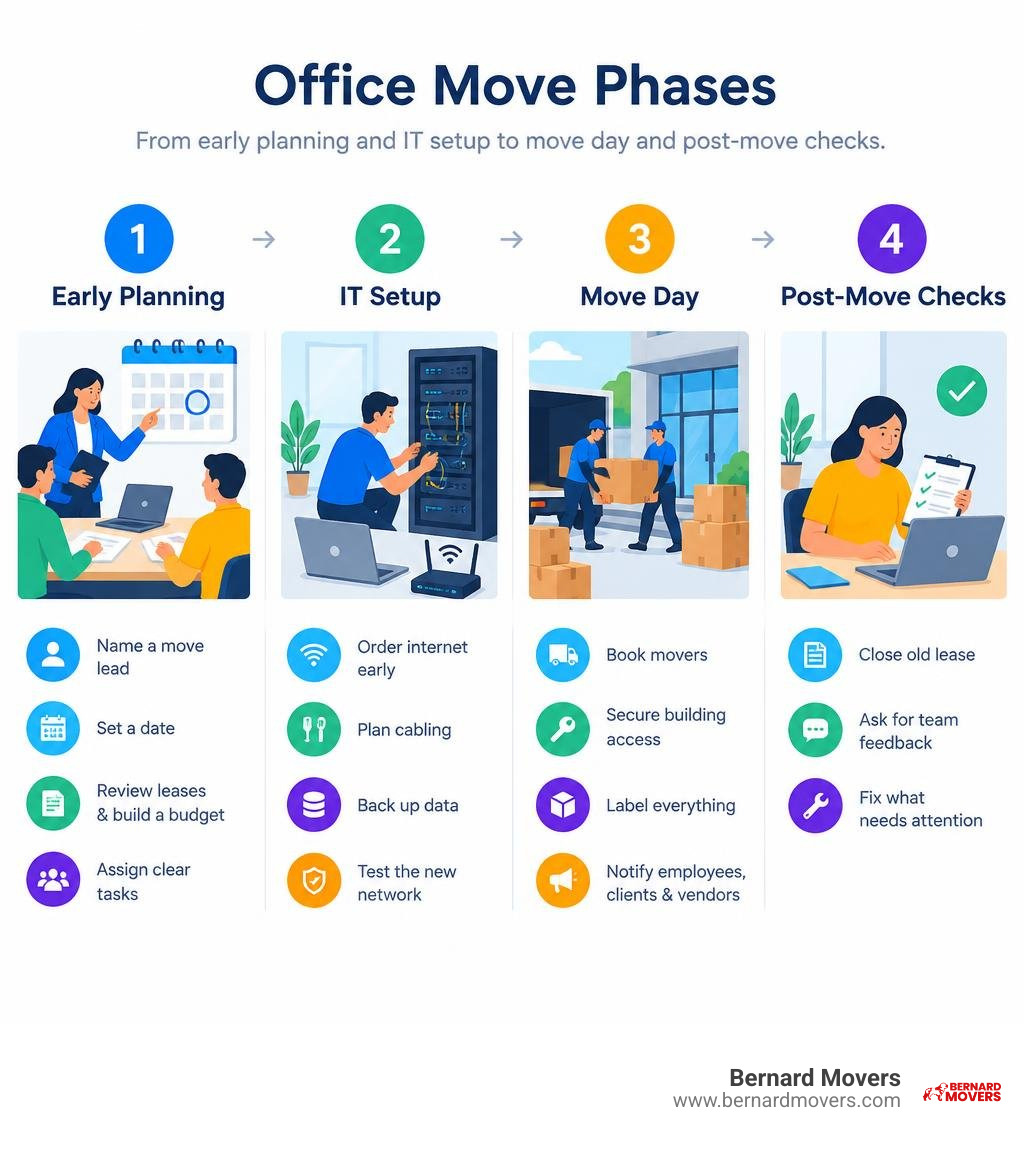
Relocating a workplace involves coordinating staff, sensitive equipment, vendor timelines, and property management rules. Start your office moving checklist by naming a move lead and setting a date. Then review both leases, build an itemized budget, and assign IT, facilities, human resources, and finance clear, measurable tasks. Order your internet service early, plan low-voltage cabling, back up all corporate data, and test the new network thoroughly before staff arrive.
For an office in Chicago, Melrose Park, or the surrounding Illinois suburbs, begin planning several months ahead to navigate local building requirements and commercial dock schedules. Keep a practical backup plan for temporary remote work if build-out delays occur in the new space. After moving, complete your lease closeout walkthrough, decommission redundant hardware, and gather team feedback to refine your workspace.
Key resources to guide your strategy include:
- Structured office move project management for cross-department coordination
- A specialized it office move project plan to prevent technology downtime
- A detailed office relocation plan covering milestone schedules and space transitions
The Master Checklist for Moving Business Offices by Timeline and Phase
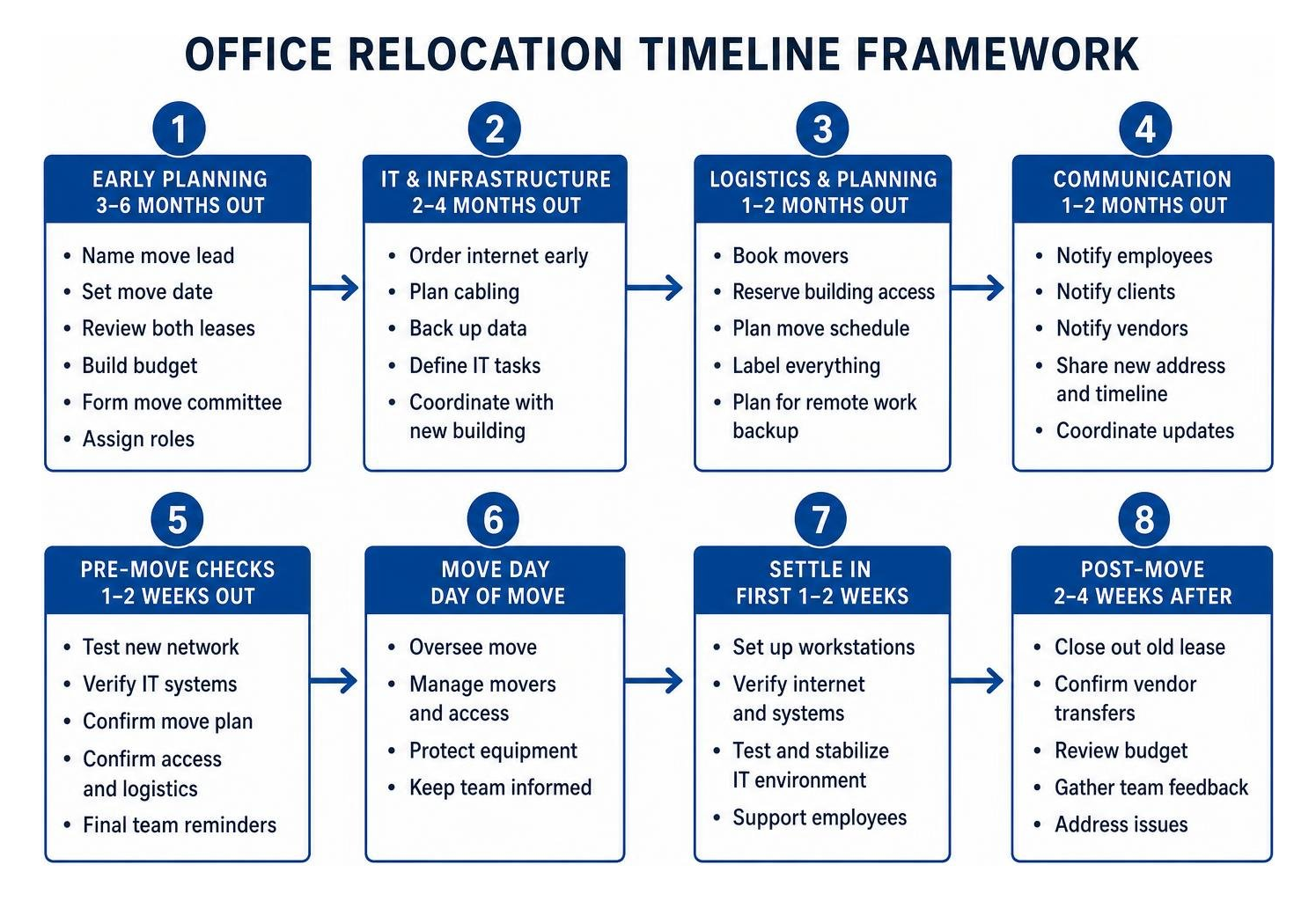
Relocating an entire organization is a major logistical undertaking. Without a clear framework, businesses face lost productivity, ballooning costs, and IT headaches. Managing an office relocation successfully requires breaking down months of work into structured phases, establishing clear ownership, and planning for every operational detail across your facility.
Move Committee Roles and Core Responsibilities
A smooth transition depends on cross-functional alignment. Form a dedicated relocation committee to distribute tasks effectively:
| Role | Primary Responsibilities | Key Milestones |
|---|---|---|
| Move Lead / PM | Overall project oversight, timeline management, budget tracking, vendor coordination | Month 12: Committee setup Month 1: Vendor lock-in |
| IT & Telecom | Data backups, internet circuits, server migration, cabling, hardware setup | Month 6: Circuit ordering Move Day: Network testing |
| Facilities & Ops | Floor plan design, mover coordination, site access, building permits, furniture disposal | Month 9: Space planning Move Week: Loading dock bookings |
| Human Resources | Employee communications, welcome packets, change management, remote work plans | Month 6: Initial announcement Day 1: Orientation |
| Finance & Legal | Budget audits, lease review, vendor contract review, insurance COIs | Month 12: Lease audit Month 3: Address updates |
12 to 6 Months Out: Project Governance and Early Planning

Long before packing tape touches a single box, strategic planning must begin:
- Review Existing Lease Agreements: Most commercial leases across Chicago and Illinois require a 60- to 90-day formal notice before vacating. Review your current agreement for termination penalties, make-good clauses, property restoration obligations, and security deposit surrender terms.
- Designate an office relocation project manager: Appoint an experienced internal lead or external consultant to manage daily operational timelines, track milestones, and maintain cross-departmental accountability.
- Establish a Comprehensive Budget: Factor in professional mover fees, IT infrastructure installation, new furnishings, local municipal permits, and site decommissioning. Add a 15% to 20% contingency budget to absorb unexpected architectural revisions or supply chain delays.
- Map Out the New Space: Collaborate with an architect or interior designer to finalize floor plans, meeting room layouts, acoustic zones, and department adjacencies to support ongoing business operations.
- Audit Existing Assets: Catalogue all workstations, ergonomic chairs, conference tables, and breakroom appliances to determine what will move, what should be liquidated, and what needs replacement.
6 to 3 Months Out: IT Infrastructure and Structured Cabling Setup
Technology issues represent the single largest risk for post-move downtime. Planning digital infrastructure months ahead keeps critical systems online:
- Order Internet Circuits Immediately: Telecom and dedicated internet circuit installations in major metropolitan centers like Chicago frequently carry lead times of 30 to 90 days. Place orders with your chosen ISP the day your lease is executed.
- Install Structured Cabling: Low-voltage data cabling is a major long-lead item. Ensure all network drops, server room racks, and patch panels are installed and certified before modular workstations arrive.
- Plan the IT office relocation: Audit all server units, switches, uninterrupted power supplies, desktop setups, printers, and peripherals. Schedule climate-controlled, secure transport for sensitive digital hardware.
- Execute Redundant Data Backups: Perform full, verified on-site and off-site cloud backups of all core business data, customer records, and server images before disconnecting any physical equipment.
- Test Power and Environmental Controls: Verify that server closets at the new facility feature dedicated climate control, adequate electrical breaker capacity, and enterprise-grade surge protection.
3 Months to 2 Weeks Out: Logistics and Operational Preparation

As move day approaches, shift your focus to operational readiness and third-party logistics:
- Follow a Dedicated corporate office moving checklist: Track every physical asset, department transition schedule, and vendor milestone in a shared management dashboard.
- Implement a Color-Coded Labeling System: Utilize commercial plastic crates and assign distinct color codes and numeric identifiers for each department, private office, and individual workstation.
- Reserve Building Access and Freight Elevators: Secure dedicated loading dock slots and freight elevator reservations at both your origin and destination properties in Chicago, Melrose Park, Skokie, or Elmhurst, ensuring all property managers receive Certificate of Insurance (COI) documents.
- Notify External Stakeholders: Update billing and physical address records with banking institutions, insurance carriers, the Illinois Department of Revenue, utility providers, and key clients.
- Hold an Employee Orientation: Brief your staff on packing expectations, personal belongings guidelines, clean-desk policies, and the precise schedule for move week.
Moving Week and Day-of Execution: Minimizing Operational Disruption
- Implement a Temporary Remote Work Protocol: Allow non-essential staff to work from home on the Friday before and Monday after the physical relocation to keep hallways and docks clear for crews.
- Stage a Central Command Hub: Establish an on-site command center with key team leaders to coordinate directly with professional commercial moving services.
- Safely Power Down and Disconnect Gear: Systematically disconnect servers, workstations, and network gear according to IT shutdown protocols, labeling every cord, cable bundle, and port location.
- Conduct Comprehensive System Dry Runs: Once hardware is positioned at the new facility, reconnect networks, verify internet throughput, test phone lines, and run sample print jobs across all departments before employees return to their desks.
Post-Move Execution: Settling In and Optimizing Your Workspace
The move is not finished when the last crate is unloaded. Transitioning smoothly into full productivity requires post-move diligence, space optimization, and attentive staff support across your organization.
Decommissioning the Old Space and Updating Public Records
Failing to properly restore an old space can result in forfeited security deposits and significant landlord penalties:
- Execute Lease Restoration: Decommissioning an office back to broom-clean or base-building condition often requires substantial effort if not budgeted early. Remove custom signage, obsolete cabling, partition walls, and temporary fixtures in accordance with your lease agreement.
- Schedule office move out cleaning: Coordinate commercial deep cleaning of carpets, hard floors, glass partitions, and restrooms to satisfy property manager inspection standards.
- Liquidate or Recycle Surplus Assets: Arrange responsible donation, commercial liquidation, or certified e-waste recycling for discarded office furniture and retired computer hardware.
- Update Public Presence and Legal Filings: Update your Google Business Profile, Apple Maps, industry directories, corporate stationery, email signatures, and state licensing registrations to reflect the new address.
Day 1 Through Day 90: Measuring Relocation Success and Space Utilization
- Provide Comprehensive Welcome Packets: Give employees everything they need on Day 1, including parking passes, building security badge instructions, public transit information, and emergency exit maps.
- Deploy Workplace Management Software: Implement desk-booking software and visitor registration systems to help hybrid teams coordinate in-office schedules effectively.
- Collect Feedback and Track Utilization: Use occupancy tracking and staff surveys over the first 60 to 90 days to evaluate conference room demand, acoustic levels, lighting adjustments, and departmental workflow bottlenecks.
When coordinating complex office moves across Chicago, Melrose Park, or the wider Illinois commercial corridor, partnering with experienced professionals ensures your business transitions efficiently and on schedule.