

Why Commercial Moving in Chicago Demands More Than a Moving Truck
Commercial moving Chicago is one of the most complex logistical challenges a business can face — and getting it wrong costs real money.
Here’s a quick overview of what you need to know:
| Topic | Quick Answer |
|---|---|
| Average cost | Small office from ~$898; mid-size from ~$1,198; full-floor from ~$1,499 |
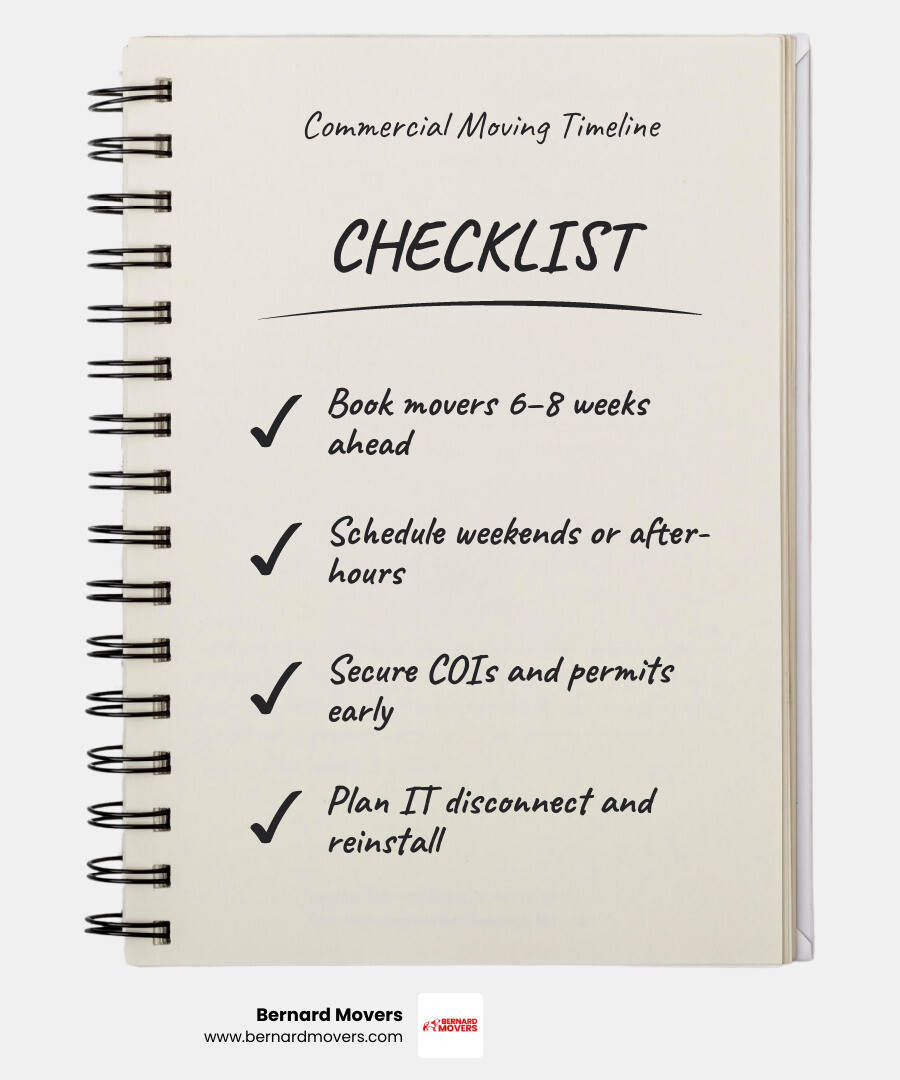
| Best time to move | Weekends or after-hours to minimize business disruption |
| How far in advance to book | 6–8 weeks before your move date |
| Key services to expect | Packing, furniture installation, IT disconnect, storage, COI handling |
| What makes Chicago moves unique | High-rise logistics, freight elevators, loading dock rules, city parking permits |
Chicago is not a simple city to move in. Between navigating freight elevators in Loop high-rises, securing certificates of insurance (COIs) from building management, and coordinating loading dock windows — a commercial move here has layers that most cities simply don’t.
Add to that the pressure of keeping your business operational during the transition, protecting sensitive IT equipment and confidential records, and managing a team of employees who still have work to do — and the stakes get even higher.
Whether you’re relocating a startup in River North, a corporate office in the West Loop, or a warehouse operation near Melrose Park, the decisions you make before, during, and after your move will directly impact your bottom line.
This guide breaks it all down — clearly and practically.
Navigating the Logistics of commercial moving chicago
When we talk about Office Relocation Chicago, we aren’t just talking about putting boxes on a truck. We are talking about a precision-engineered transition. In a city like ours, logistics are the difference between a Monday morning where your team is productive and a Monday morning where everyone is sitting on the floor waiting for their desks to be bolted together. A successful move requires a deep understanding of the city’s infrastructure, from the weight limits of historic elevators to the specific traffic patterns of the Kennedy Expressway.
The process begins with a comprehensive Commercial Moving Services Complete Guide. We focus on several critical pillars: packing, crating, furniture installation, and decommissioning. Each of these pillars must be executed with surgical precision to ensure that your business assets are protected and your downtime is minimized.

Packing and Crating Standard cardboard boxes are fine for your home kitchen, but for a business move, we often utilize specialized solutions. This includes heavy-duty corrugated boxes for electronics and reusable plastic moving crates. These crates are a favorite for Chicago businesses because they are stackable, eco-friendly, and provide superior protection for sensitive files and hardware. For high-value items like server racks or original artwork in executive suites, we provide custom timber crating. This ensures that even if a truck hits a pothole on Lake Shore Drive, your most valuable assets remain completely immobile and protected.
Furniture Installation and Decommissioning Most modern offices aren’t filled with simple desks; they are filled with complex cubicle systems, L-shaped modular workstations, and integrated conference room technology. Professional installers ensure that everything is dismantled correctly and, more importantly, put back together in your new space according to your floor plan. This includes managing the complex internal wiring of modern “smart” desks and ensuring that ergonomic settings are preserved where possible.
Furthermore, “decommissioning” is a term every Chicago business owner should know. Many commercial leases in the Loop and River North require you to return the space to its original condition. This means not just moving your stuff out, but removing data cables, taking down signage, and ensuring the suite is broom-clean to avoid heavy landlord penalties. We handle the disposal of unwanted furniture through liquidators or charitable donations, ensuring your old space is cleared according to your lease obligations.
Essential Services for a Seamless commercial moving chicago Experience
To achieve a successful Commercial Moving project, you need Full Service Office Movers who understand that your assets are more than just furniture. Your business relies on its infrastructure, and any break in that infrastructure is a break in your revenue stream.
- IT Disconnect and Reconnect: Your server room is the heart of your business. We coordinate with IT teams to ensure that servers, rack systems, and workstations are handled with extreme care. This isn’t just about moving the hardware; it’s about ensuring the infrastructure is ready for a “plug-and-play” start at the new location. We use anti-static bubble wrap and specialized IT carts to prevent any electrostatic discharge during transit.
- Specialized Equipment: Does your business involve more than just computers? Chicago is home to world-class medical facilities and labs. Moving sensitive lab equipment, clinical machinery, or industrial tools requires specialized rigging and climate-controlled transport. We understand the calibration requirements of high-end medical devices and the delicate nature of laboratory glassware.
- Asset Protection: Beyond physical damage, we protect your business from liability. This includes providing Certificates of Insurance (COIs) that meet the stringent requirements of Chicago’s premier property management firms. We also offer detailed inventory management, using digital tracking to ensure every single item that leaves your old office is accounted for at the new one.
Minimizing Downtime and Managing Costs
The biggest “hidden” cost of any move isn’t the mover’s bill—it’s the lost revenue from business downtime. Understanding How Moving Services Determine Pricing For Commercial Moves is the first step toward a budget-friendly Business Relocation.
Most commercial moves are billed on an hourly basis, which includes labor and the truck. However, for larger projects, we often provide binding estimates to give your CFO peace of mind. To keep costs down, we recommend the “90% Rule”—aim to have 90% of the packing done before the movers arrive so they can focus on the heavy lifting. We also suggest a “Phase Move” strategy for larger corporations, where departments are moved over several nights to ensure that the business never fully shuts down.
The Timing Strategy When you schedule your move can drastically change the impact on your operations. While a Tuesday move might seem cheaper, the disruption to your work week could cost you thousands in productivity. In Chicago, you also have to account for “bridge lifts” on the Chicago River and major sporting events at Soldier Field or United Center that can paralyze city traffic.
| Move Timing | Pros | Cons |
|---|---|---|
| Weekday (Business Hours) | Lower mover rates, building staff available | Maximum disruption to staff, traffic congestion |
| After-Hours (Evening) | Less traffic, staff can finish their day | Higher labor costs, lighting/security issues |
| Weekend (Sat/Sun) | Zero weekday downtime, empty elevators | Premium labor rates, requires early building booking |
Tax Considerations Don’t forget that for many Chicago businesses, office relocation expenses are tax-deductible as a necessary business expense. This can include the cost of the movers, packing supplies, and even the cost of disconnecting and reconnecting utilities. If you are upgrading your equipment during the move, there may be additional depreciation benefits. Always consult with your CPA to ensure you are maximizing these deductions and keeping the necessary documentation from your moving partner.
Specialized Equipment and High-Rise Logistics
Moving in a suburban office park is a walk in the park compared to a high-rise in the Loop. High-rise logistics are a specialized discipline that requires constant communication with building engineers and security teams.
- Freight Elevators and Loading Docks: You can’t just show up with a truck. Most Chicago buildings require you to reserve a loading dock and a freight elevator weeks in advance. These windows are often strictly enforced—if you miss your slot, you might be waiting another week. We manage these reservations for you, ensuring our team arrives exactly when the dock is clear.
- Building Approvals and COIs: Most Class A office buildings in Chicago require a minimum of $2 million to $5 million in liability insurance from the moving company. We handle the paperwork to ensure your building manager has everything they need before the first box moves. This includes naming the building owner and management company as “additionally insured.”
- Rigging and Machinery: For businesses moving heavy machinery or oversized items that won’t fit in a standard elevator, we employ specialized rigging. This might involve hoisting equipment through a window or using heavy-duty dollies to distribute weight across sensitive flooring like marble or historic hardwood.
Planning Your Relocation Strategy in Illinois
A successful move starts months before the truck arrives. Our Business Relocation Chicago Complete Guide suggests a 6-to-8-week planning window. This allows you to audit your Corporate Relocation Services and ensure every detail, from parking permits to asset monitoring, is covered. During this time, you should also be communicating with your employees, providing them with “Move Kits” that explain how to pack their personal items and what to expect on day one at the new office.
In areas like Melrose Park or Franklin Park, logistics might involve more warehouse-scale planning, including pallet jacks and forklift coordination. In the city center, it’s all about navigating the “Dan Ryan” rush hour, tight alleyways, and the unique challenges of the Chicago Pedway system if your building is connected to it.
Choosing the Right commercial moving chicago Partner
With so many options, how do you choose? Our A Practical Guide To Finding Reliable Commercial Movers highlights a few non-negotiables. You should always consult a Commercial Movers Near Me Guide to verify local credentials and ensure the company has a physical presence in the Chicagoland area.
- Licensing: Ensure the company holds a valid Illinois Commerce Commission (IL C.C.) number. For Chicago, look for the IL C.C. MC 216511 designation or similar state-authorized licensing. This license ensures the mover follows state-mandated safety and pricing regulations.
- BBB Ratings: A high rating with the Better Business Bureau (especially an A+ rating) is a strong indicator of reliability. Check for recent reviews specifically regarding commercial projects, as office moving requires a different skill set than residential moving.
- Valuation Options: Standard liability is usually $0.60 per pound per article. For high-value office assets, we recommend looking into upgraded valuation coverage. This ensures that if a $5,000 server is damaged, you aren’t just reimbursed based on its weight. Full Value Protection is the gold standard for corporate relocations.
Preparation Checklist and Neighborhood Insights
Preparation is the antidote to chaos. Follow this Office Moving Checklist and consider your Office Moving And Storage Solutions if your new space isn’t quite ready. Many businesses find that a move is the perfect time to put old records into long-term climate-controlled storage rather than taking up valuable square footage in a new, expensive Loop office.
The Preparation Steps:
- Audit Your Inventory: Decide what stays, what goes, and what gets recycled. Use this as an opportunity to digitize old paper records.
- Assign a Move Coordinator: One point of contact within your company makes communication seamless. This person should have the authority to make quick decisions on move day.
- Tag Everything: Use a systematic numbering or color-coding system. We provide specialized labels that don’t leave residue on furniture but stay attached during the move.
- Notify Vendors: Update your address with the post office, banks, and clients at least 3 weeks out. Don’t forget to update your Google Business Profile and Yelp listings.
- Secure Permits: If your building doesn’t have a private dock, we coordinate with the City of Chicago for residential or commercial street parking permits. This is critical in neighborhoods like Lakeview or Lincoln Park where street parking is non-existent.
Chicago Neighborhood Insights:
- The Loop: Expect strict elevator times and zero street parking. Planning is everything here. Most moves must happen after 6:00 PM or on weekends.
- River North/West Loop: These areas are booming but have narrow streets and heavy pedestrian traffic. We often recommend early morning moves to avoid the lunch rush and the heavy evening social scene.
- Fulton Market: A mix of old industrial buildings and new glass towers. Loading docks can be tricky, often requiring smaller “shuttle” trucks to navigate tight alleys that weren’t designed for modern semi-trailers.
- South Loop: Rapidly developing with many new high-rises. Access is generally better than the North Loop, but traffic near Museum Campus can be a factor during summer festivals.
- Melrose Park & Suburbs: More space for large trucks and easier staging, but longer travel times to the city core. We factor in the “reverse commute” traffic when planning these routes.
Conclusion and Next Steps
At Bernard Movers, we’ve spent years perfecting the art of the Chicago business move. From the tight corridors of the Gold Coast to the expansive industrial parks of Wood Dale and Elmhurst, we understand the local landscape because we live and work here too.
Whether you are looking for Commercial Movers to handle a simple internal floor shuffle or a massive multi-state corporate relocation, we have the expertise to get it done without the stress.
Special Offer for Your Expansion: Are you moving beyond Illinois? Bernard Movers offers a unique advantage for businesses heading south. We provide a 20% additional discount on moves to Georgia and Florida booked for delivery by March 15, 2025. While we are currently in April 2026, keep an eye out for our seasonal corporate specials that help Chicago businesses grow into new markets.
We serve a wide range of locations including Melrose Park, Des Plaines, Franklin Park, Park Ridge, Elmhurst, Wood Dale, Wilmette, Skokie, Morton Grove, Glenview, Mount Prospect, Evanston, Winnetka, Glencoe, Northfield, and Northbrook.
Ready to plan your next move? Let’s get your business where it needs to be. Contact us today to start your customized relocation strategy.