

Why Every Business Needs a Solid Office Relocation Plan
A well-structured office relocation plan is the difference between a smooth move and weeks of costly chaos. Whether you’re moving a 10-person team across Chicago or relocating a 200-person operation in Illinois, the stakes are high — and the margin for error is slim. When a business relocates, it is not merely moving physical assets from point A to point B; it is transitioning its entire operational hub, culture, and daily workflow. Without a comprehensive blueprint, the risk of extended downtime, lost productivity, and fractured client relationships increases exponentially.
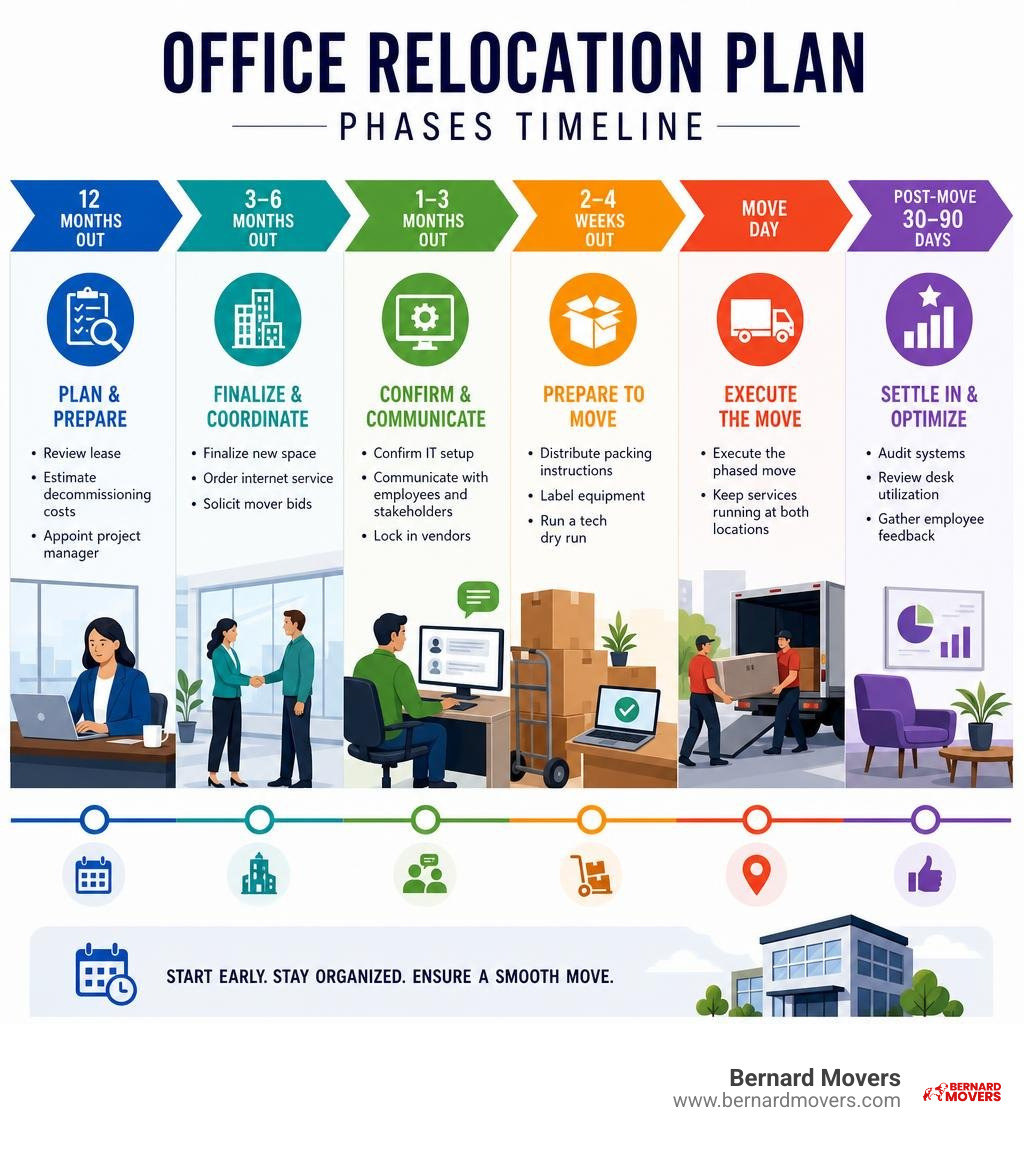
Here’s a quick overview of what an effective office relocation plan covers:
- Start 6-12 months out — review your lease, estimate decommissioning costs, and appoint a project manager
- 3-6 months out — finalize your new space, order internet service, and solicit mover bids
- 1-3 months out — confirm IT setup, communicate with employees and stakeholders, and lock in vendors
- 2-4 weeks out — distribute packing instructions, label equipment, and run a tech dry run
- Move day — execute the phased move, keep services running at both locations
- Post-move (30-90 days) — audit systems, review desk utilization, and gather employee feedback
The numbers make it clear why planning ahead matters. For a 200-person company in a 15,000 square foot space, total move costs can run anywhere from $150,000 to over $720,000 — not counting fit-out. And decommissioning your old office alone can cost 3 to 5 times the physical move cost. This is because commercial landlords typically require tenants to return the space to its original “broom-clean” shell condition, which involves removing all custom cabling, partitions, and branding elements.
Most companies underestimate how long things take. Internet provisioning at a new location can take 30 to 120 days. Construction build-outs run 12 to 16 weeks. Start too late, and you’re paying overlap rent on two leases while your team sits in a half-functional office. By establishing a clear timeline early, you can align your lease termination dates with your new move-in date, minimizing double-rent exposure and ensuring a seamless transition.
This guide walks you through every phase — from signing the lease to your first 90 days in the new space.
Office relocation plan helpful reading:
Designing a Phased Office Relocation Plan

A successful commercial move is not a weekend DIY project. It is a highly complex, multi-stakeholder initiative that requires dedicated leadership. To prevent operations from grinding to a halt, we always recommend appointing a single, empowered Office Relocation Project Manager to champion the transition. This leader will coordinate with facilities, IT, HR, and finance to keep the project on track and under budget. They will serve as the central point of contact for all external vendors, ensuring that communication remains streamlined and that no critical details slip through the cracks.
Timeline and Phases of an Office Relocation Plan
To execute a seamless office move, you must break the process down into manageable phases. Here is the ideal timeline we use to guide businesses in Chicago, Melrose Park, and across Illinois:
- Phase 1: Planning (6–12 Months Out): This is when you review your current lease, analyze your spatial needs, and start scouting locations. For instance, you might look at flexible Office space for rent in Park Ridge – Regus to accommodate a hybrid workforce. During this phase, you should also establish a steering committee to define the primary goals of the move, such as cost reduction, talent attraction, or geographic expansion.
- Phase 2: Preparation (3–6 Months Out): Once the lease is signed, the real work begins. You will hire your moving company, select your workspace technology, and finalize your architectural floor plans. This is also the time to engage with interior designers and space planners to ensure your new layout maximizes productivity and collaboration.
- Phase 3: Final Preparations (1–3 Months Out): This is the window for tech coordination, utility transfers, and detailed inventory audits. You must catalog every piece of furniture, IT asset, and document archive that will make the journey to the new facility.
- Phase 4: Packing & Move Week (2–4 Weeks Out): Employees pack their personal items, and IT systems undergo final cutover rehearsals. This phase requires precise coordination to ensure that critical business systems remain online during peak operational hours.
For a deeper dive into managing these distinct phases, check out our comprehensive From Chaos to Cubicles: Your Office Relocation Project Management Guide.
Budgeting and Managing Hidden Relocation Costs
One of the biggest mistakes Illinois businesses make is budgeting solely for the physical moving trucks. In reality, the logistics of moving furniture is only a fraction of the total cost. Decommissioning your old space—restoring it to the original condition required by your landlord—frequently costs 3 to 5 times more than the physical move itself. This process often involves repairing drywall, replacing worn carpeting, painting walls back to neutral colors, and removing specialized electrical installations.
To avoid nasty surprises, always build a 15% to 20% contingency buffer into your budget. This covers unexpected delays, building access fees, or last-minute IT modifications. Additionally, consider the cost of double rent if your construction schedule slips and you are forced to hold onto your old space longer than anticipated.
| Cost Category | Estimated Percentage of Budget | Key Expenses Included |
|---|---|---|
| Physical Moving Services | 15% – 25% | Loading, transport, and unloading |
| Workspace Fit-Out & Design | 40% – 50% | Construction, painting, and new furniture |
| IT & Telecommunications | 15% – 20% | Network cabling, internet setup, and hardware |
| Old Office Decommissioning | 10% – 15% | Repairs, deep cleaning, and lease restoration |
| Contingency Buffer | 15% – 20% | Unexpected fees and emergency delays |
Our team specializes in managing these complex variables through our dedicated Corporate Relocation Services, ensuring you maintain cost certainty from start to finish.
IT, Telecom, and Workspace Technology Setup

A beautiful new office is useless if your employees cannot connect to the internet on day one. In the Chicago commercial real estate landscape, fiber internet provisioning takes 30 to 90 days for on-net buildings and up to 60 to 120 days for off-net buildings. You must order your internet circuits the very day you sign your new lease. Waiting until the final weeks of the move to coordinate with telecom providers is one of the most common causes of post-move operational downtime.
Additionally, modern Illinois offices must be optimized for hybrid work. With hybrid employees in the office an average of 2.3 to 2.9 days per week, you do not need a 1:1 desk-to-employee ratio. Instead, aim for a 0.6:1 or 0.8:1 ratio and implement desk booking, room scheduling, and visitor management software during your New Office Setup. This approach not only reduces your real estate footprint but also creates a more dynamic, collaborative environment for your team.
Coordinating Vendors and Stakeholder Communication
Movers, IT specialists, and furniture installers must work in perfect harmony. We recommend submitting Requests for Proposals (RFPs) and securing binding, itemized mover bids at least 2 to 3 months prior to your target move date. This allows you to compare services, verify insurance credentials, and lock in competitive rates before peak moving seasons.
Equally important is clear communication. Notify external stakeholders—including clients, suppliers, and municipal offices like the Village of Franklin Park: Home Page—of your address change well in advance. Keep your employees engaged with weekly updates and clear packing guidelines. For practical advice on managing team morale during this transition, read our guide on Moving the Team Without the Tears.
Your Essential Office Relocation Plan Checklist
To keep your sanity intact, we have distilled the most critical tasks into a high-level timeline checklist:
- 6 Months Out: Review current lease terms and restoration requirements; establish your relocation budget; appoint your internal project manager.
- 3 Months Out: Order internet circuits; hire your moving company; design the new floor plan; finalize furniture orders.
- 1 Month Out: Begin purging unnecessary files and e-waste; notify utilities and service providers; update marketing materials and business listings.
- 2 Weeks Out: Distribute color-coded labels and packing bins to employees; back up all critical company data; finalize building access permits.
- Move Week: Conduct a tech dry run; complete a final walkthrough of both spaces; execute the physical move; test all security systems.
For a printable, step-by-step checklist, refer to our master Office Moving Checklist.
Executing Your Move and Post-Relocation Optimization
When moving day finally arrives, having a team of seasoned, local commercial movers makes all the difference. In Chicago and Melrose Park, building managers are incredibly strict about Certificate of Insurance (COI) requirements and freight elevator time slots. Working with specialists who know these local regulations inside and out ensures you avoid costly delays or building access denials. Discover how we streamline this process in our guide to Office Relocation Made Easy: A Guide to Full-Service Commercial Moving.
Settling In: Post-Move Tasks and Minimizing Disruption
Once the boxes are delivered, the work of optimizing your new space begins. Run a post-move audit to resolve any “snag list” items with your contractors. Over the first 30 to 90 days, monitor your desk booking and occupancy sensor data to see how your team actually utilizes the space. You may find you need to convert underused desk zones into casual collaborative areas.
At Bernard Movers, we are committed to making your transition seamless. If your business is planning a long-distance expansion, we are proud to offer a unique promotion: a 20% additional discount on moves to Georgia and Florida booked for delivery by March 15, 2025.
Ready to take the stress out of your upcoming transition? Visit Bernard Movers Office Moves to request your custom commercial moving plan today.