
What Is Residential Long Distance — and Why It Matters When You Move
Residential long distance service is how your home phone connects you to people outside your local calling area — and choosing the wrong plan can quietly cost you hundreds of dollars a year.
Here’s a quick breakdown of what you need to know:
| Topic | Quick Answer |
|---|---|
| What is residential long distance? | Phone calls made from a home line that go beyond your local calling area — typically more than 15–40 miles away |
| Main service types | Traditional landline, VoIP, cellular, prepaid calling cards |
| Typical plan structures | Per-minute rates or flat unlimited monthly fees |
| Key cost factors | Monthly recurring charges, usage caps, regulatory fees, paper billing fees |
| Who regulates it? | State public service commissions (intrastate) and the FCC (interstate) |
| Best for heavy callers | Unlimited monthly plans (watch for usage caps around 2,500 min/month) |
| Best for light callers | Per-minute plans with low or no monthly fee |
For Illinois households — especially those in Chicago or Melrose Park who are planning an out-of-state move — understanding your residential long distance setup matters twice. You need to know what you’re paying now, and you need a plan for what happens to your phone service when you relocate.
This guide walks you through every major option, the real costs behind the plans, and how to manage the transition smartly.
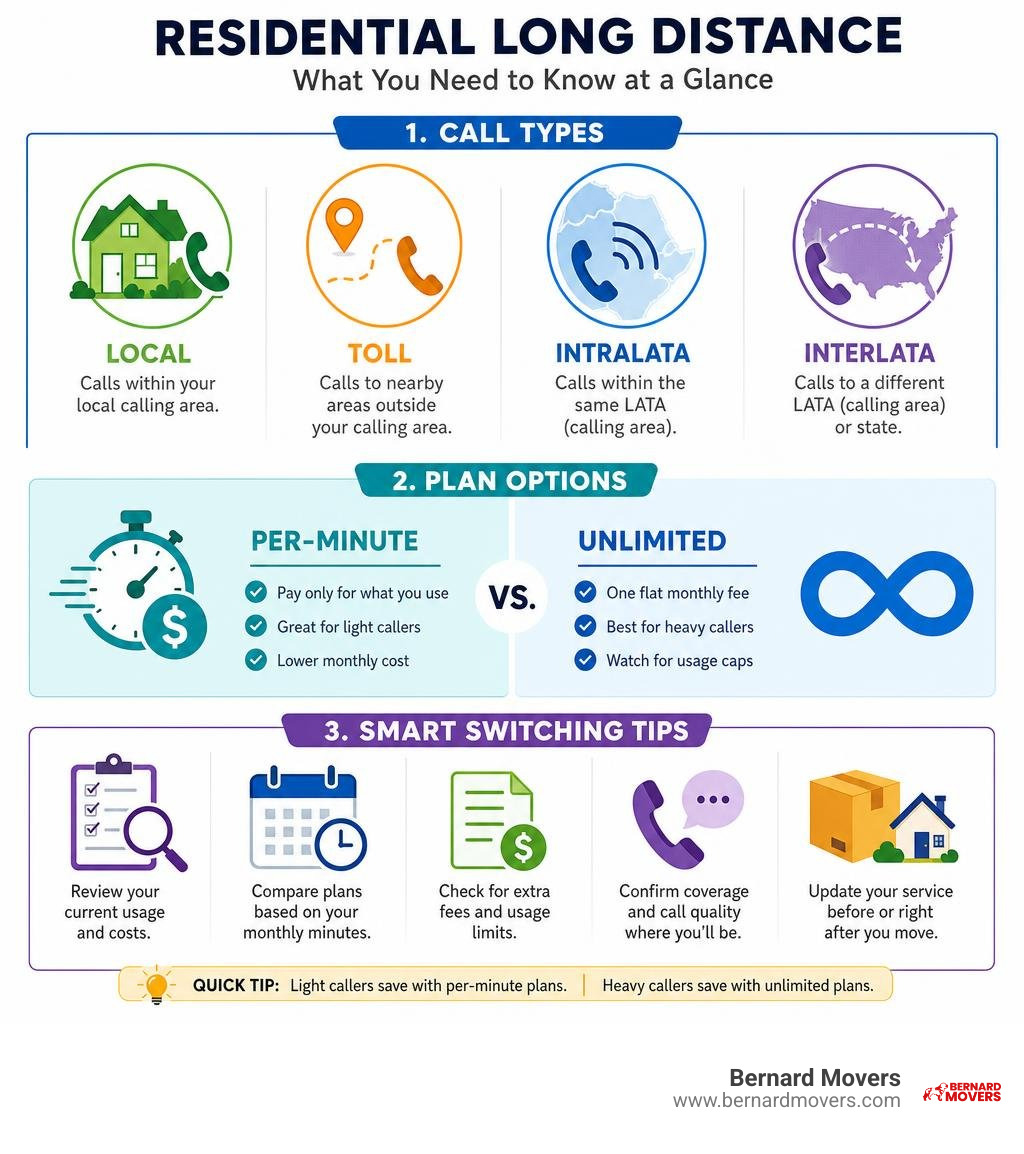
Simple guide to residential long distance terms:
Understanding Residential Long Distance Service Options and Plans
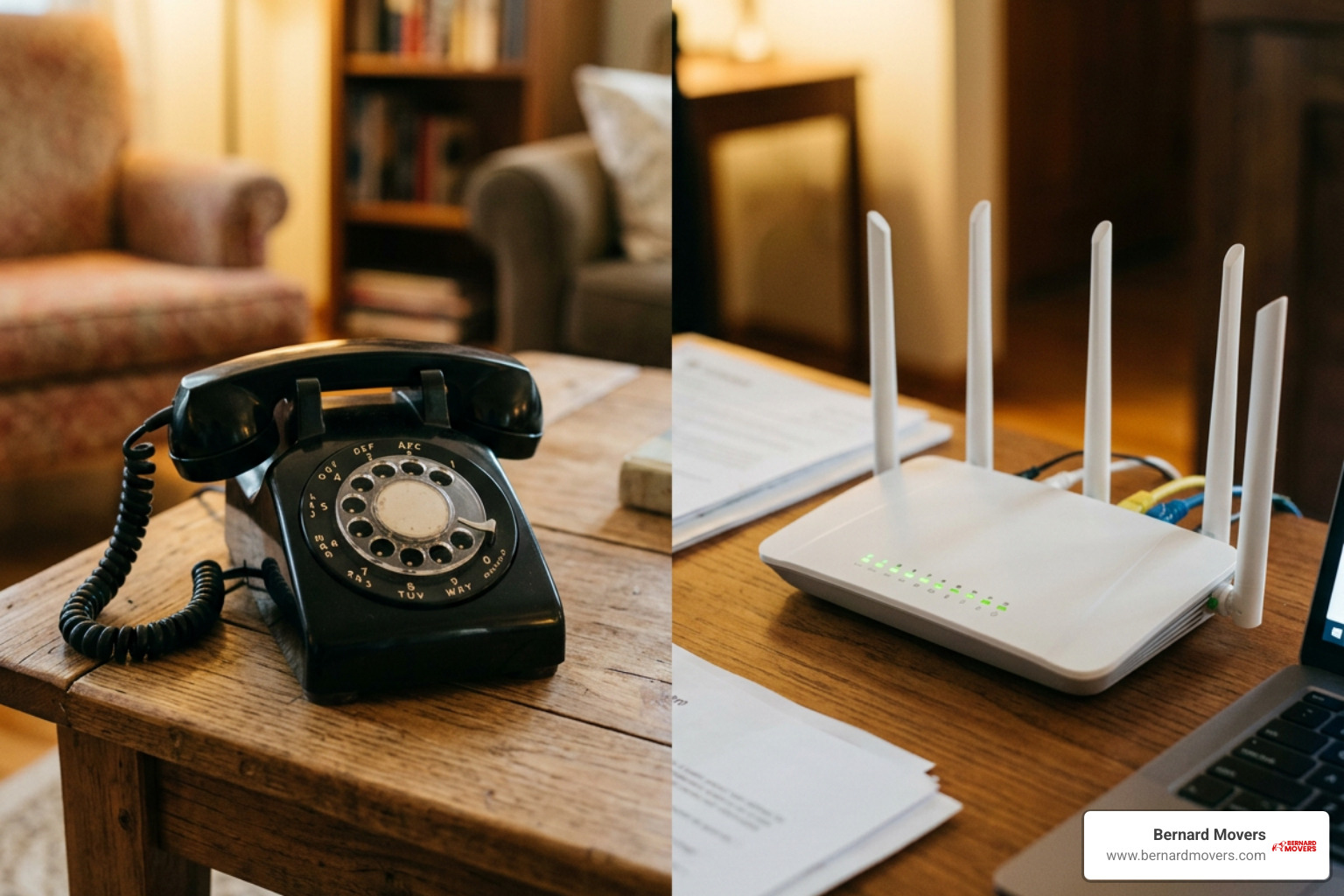
When evaluating residential long distance, it helps to realize how quickly the telecommunications landscape has shifted. For decades, traditional copper-wire telephone lines managed by regional landline monopolies were the only way to reach relatives across the country. Today, carrier tariffs and legacy pricing models are being phased out in favor of internet-based solutions and mobile plans.
For example, major legacy telecommunications carriers have officially grandfathered traditional landline plans like AT&T Unlimited Nationwide Calling and ONE RATE Nationwide Advantage as of October 15, 2025. Subscribers who had these packages can keep them, but new orders are no longer accepted, pushing modern households toward newer digital alternatives. Detailed documentation regarding these legacy tariff changes can be reviewed through SBC Long Distance, LLC 2nd Revised Page 1 d/b/a AT&T Long Distance Effective: October 15, 2025.
Classifying Calling Boundaries: Local, Local Toll, IntraLATA, and InterLATA
Understanding how phone carriers bill your calls requires understanding calling geography. Telecommunications companies categorize calls using specific distance bands and regulatory boundaries originally established following the 1982 breakup of the Bell System:
- Local Calls: Calls made to destinations within roughly 0 to 15 miles of your home exchange. These are almost always included free in basic monthly landline packages.
- Local Toll Calls (IntraLATA): Calls covering destinations between 16 and 40+ miles away. These fall within your local geographic market—known as a Local Access and Transport Area (LATA)—but cross standard local exchange lines. For example, calling from Chicago to a nearby outer suburb might trigger intraLATA rates. Charges can reach up to $0.17 per minute if you do not have an inclusive plan.
- Long Distance Calls (InterLATA): Calls made outside your home LATA to another region in the state or across state borders, such as placing a call from Illinois to Wisconsin or Indiana.
Jurisdictional oversight also changes based on these lines. Toll calls made within a single state are subject to state public service commission rules, whereas interstate calls spanning multiple states fall under Federal Communications Commission (FCC) regulation. Regulatory filings for regional telecommunications providers can be examined via the UTC Company Detail Page | UTC.
Comparing Per-Minute and Unlimited Residential Long Distance Calling Plans
When selecting a residential long distance phone package, consumers generally choose between per-minute billing structures and flat-rate unlimited monthly plans.
- Per-Minute Plans: Basic pay-as-you-go calling tiers charge standard usage fees ranging from $0.05 to $0.42 per minute. Some carriers add a Monthly Minimum Usage Charge (MUC) of around $8.99 if your outbound activity stays under a specific monthly threshold. Light callers placing only a few calls a month benefit from standalone low per-minute options.
- Unlimited Monthly Plans: Ranging from $23.00 to $28.99 per month for traditional landlines, these packages provide flat-rate nationwide calling across all 50 states.
However, “unlimited” plans frequently contain hidden fine print. Carriers enforce fair usage policies to prevent commercial autodialing, telemarketing, or internet dial-up usage on residential lines. Many providers cap residential unlimited calling at a fair usage threshold of 2,500 minutes per month. Exceeding these limits can trigger account reassignment or per-minute penalties. Budgeting for household operational expenses follows similar principles to estimating moving budgets; learn more by checking our Long Distance Movers Cost Guide.
Comparing Traditional Landline, VoIP, Cellular, and Calling Card Technologies
Choosing the right calling technology directly dictates your monthly bills, call quality, and reliability during power grid interruptions.
| Feature / Tech | PSTN Traditional Landline | VoIP (Voice over IP) | Cellular Voice | Prepaid Calling Cards |
|---|---|---|---|---|
| Primary Connection | Copper wires / PSTN network | High-speed fiber/cable internet | Wireless cellular towers | PSTN or IP via 800-access numbers |
| Typical Monthly Cost | $25.00 – $45.00+ | $5.00 – $15.00 | Included in mobile plan | Pay per card ($10 – $50) |
| International Rates | Expensive ($0.25 to $3.00+/min) | Very cheap ($0.01 to $0.10/min) | Varies by carrier pass | Flat per-minute rates |
| Power Dependency | Works during power outages | Requires battery backup/router power | Requires device battery | Dependent on phone used |
| Hardware Required | Standard telephone jack | Analog Telephone Adaptor (ATA) | Smartphone | Any physical phone line |
Modern fiber providers often include crystal-clear digital voice features along with broadband packages. While digital voice and VoIP offer immense cost savings over legacy copper lines, home owners should remember to maintain an Uninterruptible Power Supply (UPS) or battery backup unit for their modem router to preserve Emergency 911 access during unexpected power outages. Services like Unlimited Calling with Residential Phone Service – Sonic give consumers nationwide domestic calling and free international reach to dozens of countries using standard phones attached to an Analog Telephone Adaptor (ATA).
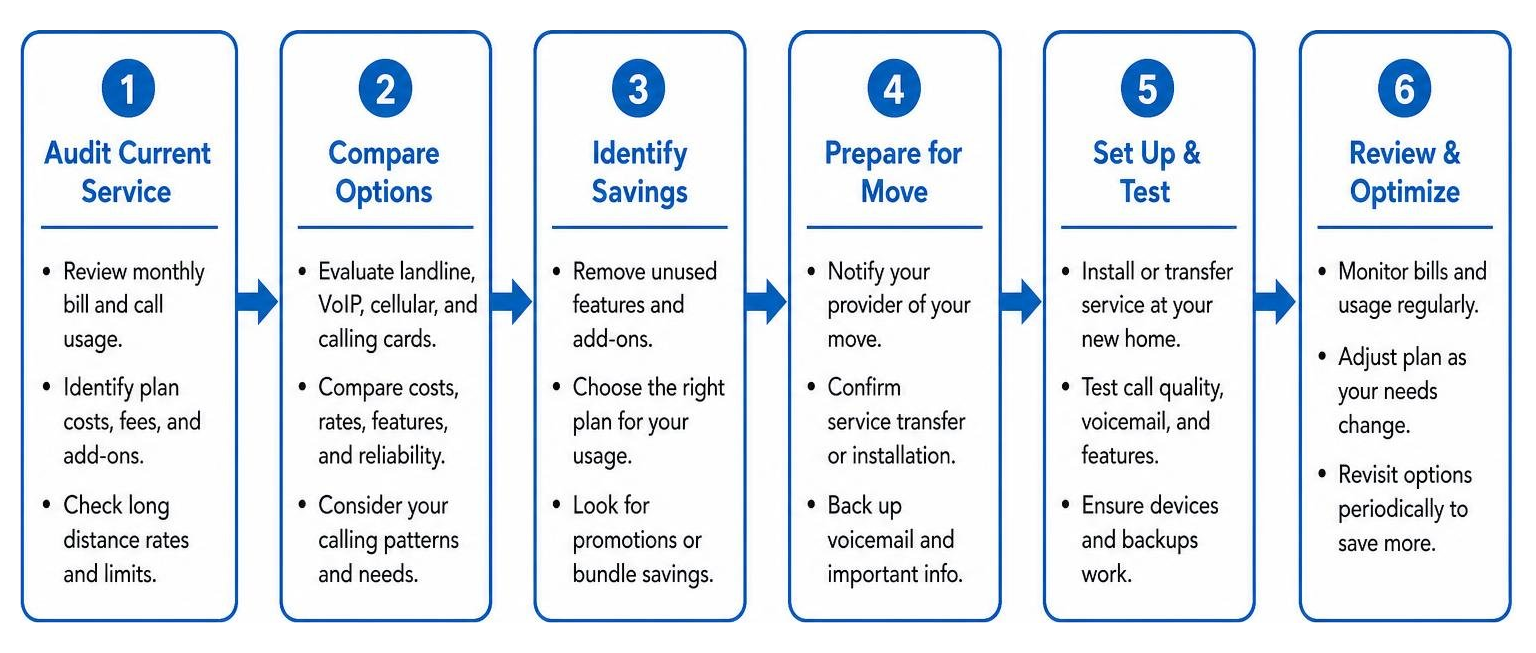
Strategic Cost Savings for Illinois Households and Relocation Transitions
Optimizing household utilities is an essential part of preparing for a household move in Chicagoland. Whether you are living in a single-family house in Melrose Park or relocating from a high-rise in downtown Chicago, auditing monthly telecommunication expenses often reveals immediate savings opportunities. Take time to explore local real estate context like Melrose Park IL Real Estate & Homes For Sale when planning your upcoming neighborhood shift.
Navigating Carrier Switching, Consumer Rights, and Avoiding Hidden Fees
When switching residential long distance service providers, hidden billing surcharges can quickly diminish advertised promotional discounts. Common administrative add-ons to review on your bill include:
- Paper Bill Fees: Carriers routinely charge $1.99 per month simply to print and mail physical paper invoices. Opting into e-billing avoids this expense.
- Statement & Regulatory Fees: Line-item charges like administrative statement fees ($1.99/mo) or state regulatory fees (often $2.49/mo) are frequently added on top of base calling rates.
- Carrier Switching Charges & Slamming Protection: Unscrupulous companies sometimes switch a consumer’s designated long-distance landline carrier without explicit permission—an illegal practice known as “slamming.” To prevent unauthorized transfers, contact your local landline carrier to place a freeze on your long-distance provider choice.
When shopping for service providers, utilize this checklist:
- Verify if local toll (intraLATA) calls are billed under long-distance or local rates.
- Confirm whether international country rates apply to both landlines and mobile phones.
- Check if there are strict usage limits (e.g., 2,500 minutes) on unlimited home phone plans.
- Ask if the new provider covers switching fees charged by your legacy carrier.
For deeper insights into long-distance logistics during home relocations, review our resources on Going the Distance with Residential Moving and the comprehensive Residential Moving Services Complete Guide.
Managing Residential Long Distance Costs During Relocation and Moving
Relocating across state lines requires careful coordination of household utilities, phone service transfers, and physical moving logistics. At Bernard Movers, we have spent years helping families transition seamlessly throughout Chicago, Melrose Park, Des Plaines, Elmhurst, Skokie, and surrounding suburbs.
When transferring phone services during a cross-country move:
- Audit Your Calling Patterns: Determine if you still need a dedicated copper landline at your new residence or if switching to an internet VoIP bundle or mobile line fits your routine better.
- Port Your Existing Number: If you rely on a long-standing landline phone number, port it to a digital voice or mobile service before canceling your landline account. Services like Google Voice can port landline numbers for a one-time fee around $20.
- Schedule Transfer Dates: Align utility shut-off dates at your old location with activation dates at your destination to prevent double-billing during move week.
If your upcoming journey involves an interstate move, working with experienced movers simplifies the process. Our team at Bernard Movers provides tailored relocation solutions across Chicagoland. Check our specialized services for Professional Long Distance Movers, explore options with Chicago Cross Country Movers, or prepare your timeline with our dedicated guide to Out of State Moving.
Planning a move down south? We offer an exclusive 20% additional discount on long-distance moves to Georgia and Florida booked for delivery by March 15, 2025. Contact our team today for affordable moving local and long distance moving services to get your relocation started smoothly!