

Moving a Piano Near Me: What You Need to Know Before Moving Day
If you’re searching for help moving a piano near me in Chicago, Melrose Park, or anywhere across Illinois, here’s the short answer:
You need a specialized piano mover — not a general moving crew, and definitely not a DIY approach.
Here’s a quick overview of what to expect:
| What You Need to Know | Quick Answer |
|---|---|
| Who should move it? | A licensed, specialized piano moving company |
| Why not DIY? | Pianos weigh 300–1,200+ lbs and can cause serious injury or property damage |
| How much does it cost? | Typically $200–$1,000 locally, plus $50–$200 per flight of stairs |
| How far in advance to book? | 2–4 weeks, especially May through September |
| Does it need tuning after? | Yes — wait 2–6 weeks after the move before scheduling a tuning |
Pianos are one of the heaviest, most structurally complex items you’ll ever need to relocate. A standard upright can weigh anywhere from 300 to 800 pounds. A concert grand can top 1,200 pounds. And the weight is only part of the challenge — the delicate internal mechanisms (strings, hammers, soundboard) are sensitive to every bump, tilt, and shift along the way.
For families relocating within Chicago or across Illinois, getting this wrong isn’t just expensive. It can be dangerous.
This guide walks you through everything you need to know — from choosing the right local piano movers to preparing your home and caring for your instrument after the move.
Moving a piano near me terms at a glance:
The Realities of Moving a Piano Near Me: DIY vs. Professional Movers
When faced with the task of relocating a heavy instrument, it is incredibly tempting to call up a few friends, rent a truck, and attempt to tackle the job yourself. However, the realities of moving a piano are far more complex than simply lifting a heavy piece of furniture.
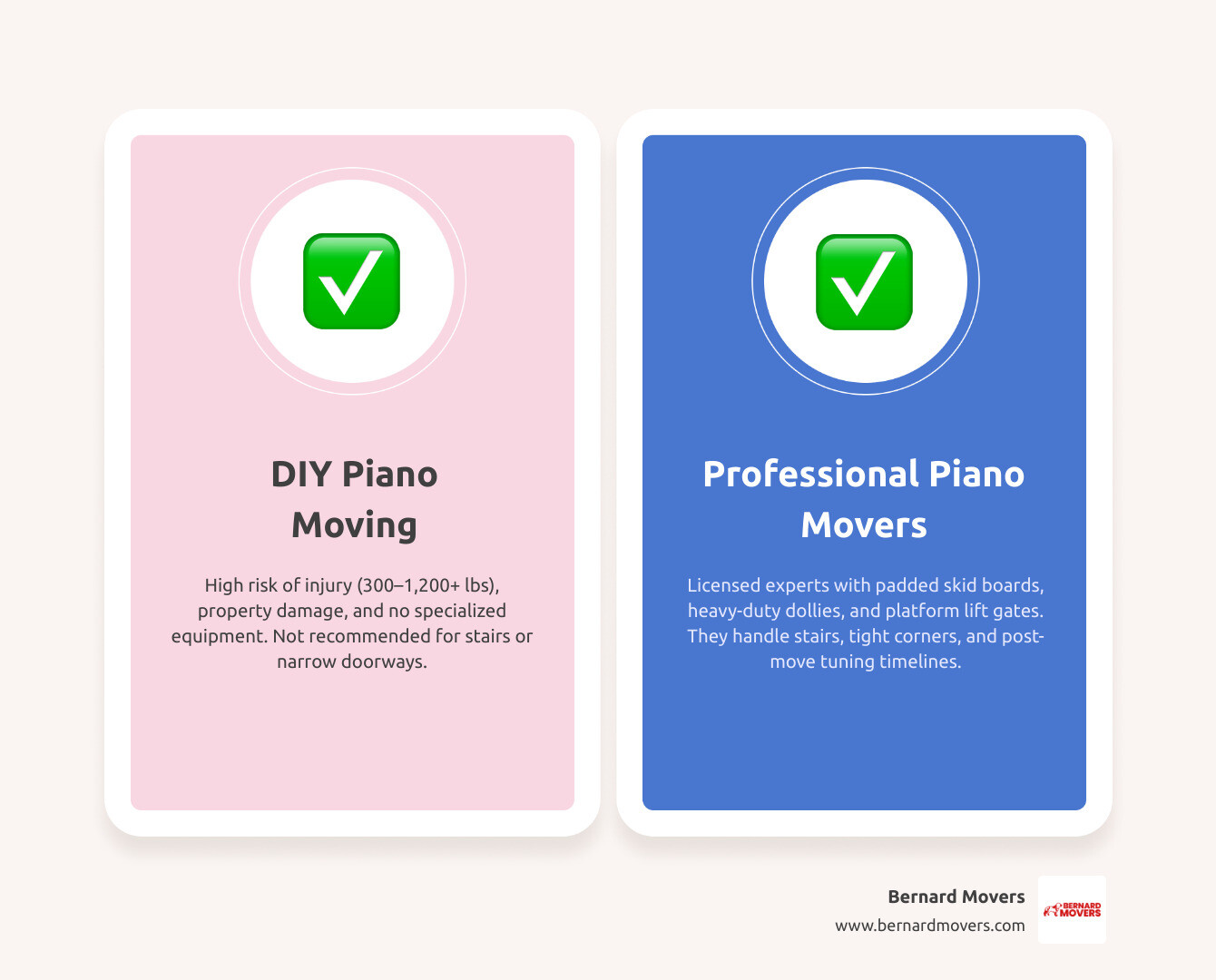
To help put things into perspective, let’s look at how a DIY move stacks up against hiring a professional service:
| Feature/Risk | DIY Piano Moving | Professional Piano Moving |
|---|---|---|
| Risk of Personal Injury | Extremely high (herniated discs, crushed fingers, sprains) | Negligible (handled by trained professionals) |
| Risk of Property Damage | High (gouged hardwood floors, broken drywall, chipped doorframes) | Covered by comprehensive cargo and property insurance |
| Specialized Equipment | Must rent or buy (often utilizing inadequate standard dollies) | Included (heavy-duty dollies, skid boards, custom straps, ramps) |
| Instrument Safety | High risk of knocking keys out of alignment or cracking the soundboard | Safely wrapped, secured, and balanced during transit |
| Time & Stress | High stress, physical exhaustion, and potential scheduling delays | Fast, efficient, and completely hands-off for you |
One of the biggest mistakes DIY movers make is using standard moving dollies. Pianos require heavy-duty dollies with specialized rubber wheels that can support hundreds of pounds without buckling or scratching your floors. Without knowing how to pack a piano for moving, you risk damaging the delicate internal action, scratching the polished exterior finish, or worse, dropping the instrument entirely.
By working with experienced local piano movers, you eliminate these physical risks and gain peace of mind knowing that every step of the journey is handled with absolute precision.
Why Hiring a Professional for Moving a Piano Near Me is Essential
If the sheer weight of a piano isn’t enough to make you hesitate, its physical construction should. Upright pianos pose a unique structural challenge because they are top-heavy. They have a very high center of gravity, which means they present a severe tipping hazard if they are tilted even slightly on an uneven surface or ramp.
Navigating obstacles like stairs, tight corners, and narrow doorways requires a deep understanding of physics, balance, and leverage. A single misstep on a flight of stairs can lead to catastrophic consequences for both the movers and the instrument. Professional crews know exactly how to distribute the weight, secure the keyboard lid, and safely guide the piano through tight spaces. Plus, when you consider that stairs can add anywhere from $50 to $200 per flight to your total upright piano moving cost, you quickly realize that the expertise required to handle these obstacles safely is worth every penny.
Upright vs. Grand Pianos: Different Instruments, Different Methods
It is a common misconception that all pianos are moved using the same general methods. In reality, moving an upright piano is completely different from moving a grand piano.
- Upright Pianos: These instruments are moved in their fully assembled state. They are carefully wrapped in heavy-duty moving blankets, secured with industrial straps, and placed upright onto specialized dollies. The main challenge here is managing the high center of gravity and protecting the delicate legs and casters from snapping during transit.
- Grand Pianos: A grand piano cannot simply be rolled out of a room on a dolly. Moving a grand piano requires partial disassembly. The legs and the lyre (pedal assembly) must be carefully removed. The body of the piano is then tilted onto its straight side and secured to a heavily padded skid board (also known as a piano board). This entire assembly is then carefully strapped down to prevent any movement.
Because of these drastic differences in handling, moving a grand piano requires a larger crew and highly specialized training. If you own a baby grand or a concert grand, securing a team that specializes in grand piano moving Chicago is non-negotiable for keeping your investment safe.
Preparing Your Home and Instrument for the Move
Before our professional crew arrives at your doorstep, there are several steps you can take to ensure the moving process goes as smoothly as possible. Proper preparation saves time and helps prevent accidental property damage.
- Measure Every Pathway: Measure the width and height of all doorways, hallways, stairwells, and tight corners the piano must pass through. Compare these to your piano’s dimensions to ensure a clear path.
- Clear the Runway: Remove all rugs, toys, shoes, and decorative items from the path. Keep the pathway entirely clear both inside your home and outside leading to the driveway.
- Secure the Keyboard Lid: Lock the keyboard lid if it has a built-in lock. If it doesn’t, do not use packing tape directly on the wood, as this can ruin the finish. Our team will secure it safely using professional-grade moving blankets and non-adhesive wraps.
- Protect Your Floors: While professional movers use specialized rubber-wheeled dollies, it is always a great idea to lay down protective floor runners or cardboard sheets over hardwood and tile floors.
- Learn the Basics: If you want to understand the packing process in detail, you can read up on how to pack an upright piano for moving to see exactly how we shield your instrument’s delicate exterior.
Choosing the Right Local Piano Moving Service
When searching for the best company for moving a piano near me, you should look for specific credentials that set specialized piano movers apart from standard household moving companies.
First and foremost, verify that the company is fully licensed and insured. Standard moving insurance often only covers items by the pound, which is completely inadequate for a valuable musical instrument. Ensure the company carries cargo insurance specifically tailored to high-value specialty items.
Additionally, ask about their equipment. A dedicated piano moving service will utilize custom-built trucks equipped with platform lift gates rather than steep, narrow ramps. Lift gates allow the heavy instrument to be raised and lowered completely flat, eliminating the risk of slipping on a ramp.
At Bernard Movers, we proudly serve the entire Chicago metropolitan area and surrounding suburbs, including:
- Chicago
- Melrose Park
- Des Plaines
- Franklin Park
- Park Ridge
- Elmhurst
- Wood Dale
- Wilmette
- Skokie
- Morton Grove
- Glenview
- Mount Prospect
- Evanston
- Winnetka
- Glencoe
- Northfield
- Northbrook
Whether you need a piano moving service in Chicago or are relocating an heirloom instrument in Melrose Park, our local teams have the regional expertise and specialized equipment to get the job done right.
What to Expect from a Specialized Service for Moving a Piano Near Me
When you contact us for a moving quote, we calculate your estimate based on several key factors to ensure there are no surprises on moving day. These factors include:
- The Type and Size of the Piano: Upright pianos are generally less complex to move than grand pianos, which require disassembly and specialized skid boards.
- Stairs and Obstacles: Flights of stairs, steep driveways, tight landings, or elevators require extra labor and equipment. Stairs typically add an additional fee of $50 to $200 per flight.
- Distance: The mileage between the pickup and delivery locations.
In addition to standard relocation, many clients require specialized services. For example, if you are remodeling your home and need to store your instrument temporarily, we offer secure, climate-controlled piano storage solutions. Chicago’s extreme weather—with freezing winters and humid summers—can be devastating to a piano’s wooden soundboard and delicate felt hammers. Our climate-controlled facilities maintain a stable temperature and humidity level year-round to prevent warping, cracking, or tuning instability. Pianos in storage are kept wrapped in protective blankets on carpeted boards to prevent dust and moisture from entering the cabinet.
If you have an old, unplayable instrument that you need to retire, we also provide professional disposal services. You can learn more about these specific options by reviewing our guides on piano removal cost and general moving a piano cost.
Post-Move Care: When to Tune Your Piano
Once your piano is safely positioned in its new room, you might be tempted to call a piano technician immediately. However, patience is key here.
Pianos go out of tune after a move not because of the physical vibrations of the truck, but because of environmental changes. The wood of the soundboard and bridge is highly sensitive to relative humidity and temperature. When a piano enters a new home, the wood needs time to expand or contract as it acclimates to the new climate.
Piano technicians recommend waiting at least two to three weeks (and ideally up to six weeks during major seasonal shifts) before scheduling a tuning. This waiting period allows the instrument’s tension to stabilize. If you tune it too early, the soundboard will continue to adjust, and the piano will quickly drift out of tune again. If the keys feel slightly stiff or the action feels sluggish after the move, give it a few weeks; if the issue persists past a month, a technician can easily adjust the key action.
Let Bernard Movers Handle Your Next Relocation
Moving a piano is a highly specialized craft. At Bernard Movers, our experienced teams treat your instrument with the respect, care, and precision it deserves. From historic uprights in Evanston to concert grands in downtown Chicago, we are your trusted local experts.
Planning a larger move? We also specialize in long-distance relocations! We are currently offering a 20% additional discount on moves to Georgia and Florida booked for delivery by March 15, 2025.
Whether you need local piano moving services or a full-service household relocation, we are here to help. Contact us today to discuss your upcoming move and secure your booking with our expert team!