

Why Heavy Equipment Moving Is More Complex Than You Think
Heavy equipment moving is a specialized service that involves far more than loading a machine onto a truck and driving to a new location.
Quick answer: What does heavy equipment moving involve?
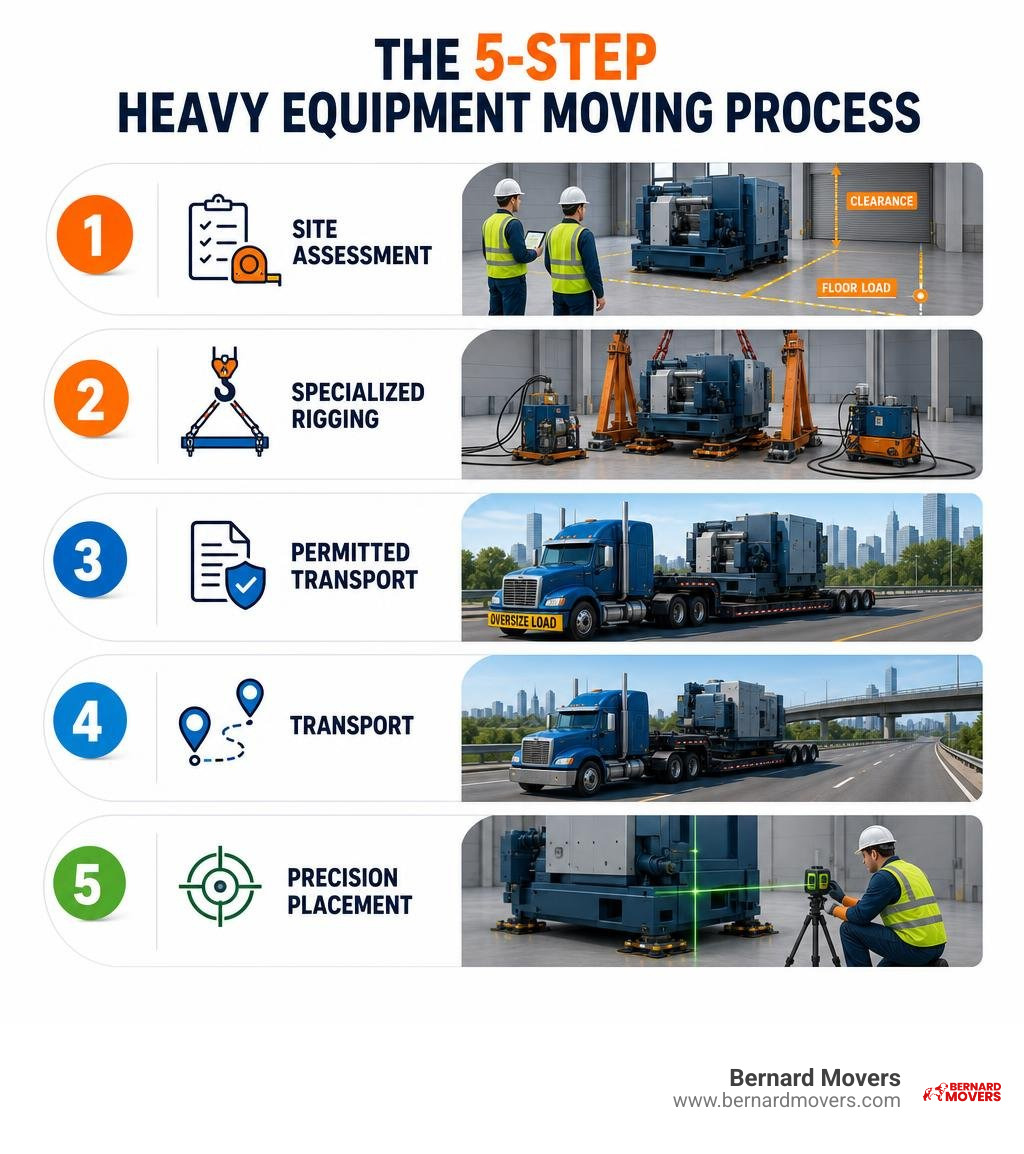
- Site assessment — Measuring clearances, floor load limits, and access points before anything moves
- Specialized rigging — Using tools like hydraulic gantries, toe jacks, and air skates to lift and position machinery safely
- Permitted transport — Securing oversize and overweight permits, especially for loads exceeding 80,000 lbs or 8’6″ wide
- Precision placement — Laser and optical alignment at the destination to ensure machinery runs correctly
- Safety and insurance — OSHA-compliant protocols and cargo insurance to protect high-value assets throughout the move
Industrial machinery is heavy, fragile in ways you wouldn’t expect, and extremely expensive to repair or replace. A single mistake — an improper lift, a missed permit, or even a few millimeters of misalignment during reinstallation — can mean days of costly downtime or permanent equipment damage.
For businesses in Chicago, Melrose Park, and across Illinois, the stakes are especially high. Urban job sites, congested roads, and strict Illinois DOT regulations add layers of complexity that standard movers simply aren’t equipped to handle.
That’s why companies rely on professional heavy equipment movers who combine rigging expertise, the right tools, and careful planning to get the job done safely.
Basic heavy equipment moving glossary:
The Logistics and Challenges of Heavy Equipment Moving
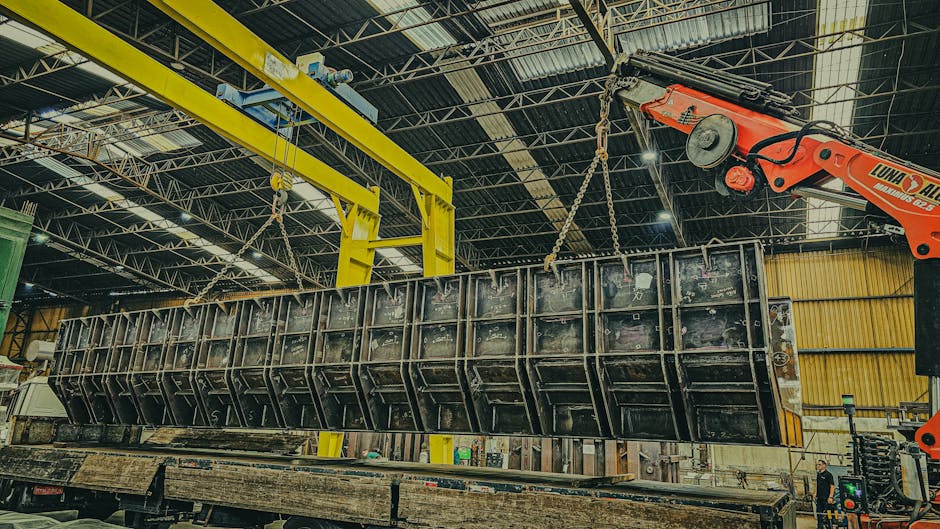
Relocating an entire production line or moving a single multi-ton stamping press is a masterclass in applied physics. Standard commercial moving handles boxes, desks, and electronics, but industrial machinery requires a deep understanding of structural engineering, weight distribution, and rigging safety.
When we handle a heavy haul, we aren’t just thinking about the physical weight. We must map out the center of gravity, calculate the exact pressure exerted on the floor, and plan for tight overhead clearances. A machine that is top-heavy or has an irregular shape cannot be lifted with a standard forklift. It requires custom rigging configurations and specialized millwrighting to ensure that no internal components are warped or damaged during transit.
To give you an idea of how specialized these moves are, here is a quick comparison of the common tools used during the rigging and positioning phases:
| Equipment Type | Best Used For | Weight Capacity | Surface Requirement |
|---|---|---|---|
| Transport Skates | Moving heavy loads across flat, smooth concrete floors | Up to 24+ tons | Level, debris-free surfaces |
| Toe Jacks | Lifting heavy machinery with extremely low ground clearance | Up to 10-20 tons | Solid, non-yielding ground |
| Hydraulic Gantries | Lifting and placing oversized loads where cranes cannot fit | Up to 250+ tons | Reinforced indoor or outdoor flooring |
What is Heavy Equipment Moving and Why Does It Require Specialists?
Heavy machinery functions through the mechanical advantage of simple machines that multiply input force. However, when these massive systems need to be relocated, that same mechanical scale makes them highly volatile if handled incorrectly.
The global heavy equipment market is projected to reach $278.9 billion by 2030, growing at a CAGR of 4.8% from 2023 to 2030. Industry giants like Caterpillar lead the heavy equipment manufacturing space with $37.8 billion in sales, representing 15.9% of the global market share. Because these machines represent massive capital investments, companies cannot afford to trust their transport to standard logistics providers.
Specialized services are required to safely disassemble, lift, transport, and reinstall these assets. Professional millwrights and riggers utilize specialized engineering formulas to calculate load-bearing capacities and ensure that the delicate internal calibrations of precision machinery remain completely intact. If you want to learn more about how these specialized services protect your high-value assets, check out our More info about heavy item moving services.
Key Challenges in Heavy Equipment Moving and Rigging
Safety is the absolute priority when moving heavy machinery. The physical risks are immense: dropped loads can crush building structures, destroy adjacent machinery, or cause severe injuries to personnel. Rigging crews must account for dynamic forces during lifting, ensuring that slings, shackles, and spreader bars are rated for the specific load configuration.
Beyond structural damage, businesses face significant financial risks. For instance, heavy equipment theft costs the construction industry an estimated $1 billion annually in the United States. During a relocation, machinery is particularly vulnerable, making secure transport, GPS tracking, and secure storage protocols essential to mitigate these risks.
Another major challenge is precision calibration. Modern industrial machinery—such as CNC machines, injection molding presses, and medical equipment—is built to operate within tolerances measured in fractions of a millimeter. Standard transport vibrations can throw these systems out of alignment. If a machine is reinstalled even slightly off-level, it can lead to immediate mechanical failure and catastrophic operational downtime. For a deeper look into the safety protocols that prevent these issues, read our More info about heavy item movers.
Specialized Rigging Tools and Transport Vehicles
To move multi-ton assets safely, we rely on an arsenal of heavy-duty transport and rigging equipment. Standard flatbed trucks are rarely sufficient. Instead, we utilize specialized lowboy trailers, which sit lower to the ground to accommodate tall machinery and maintain a low center of gravity. This design is crucial for navigating under low-clearance bridges and utility lines safely.
For indoor maneuvering, we use air skates (which float heavy loads on a thin cushion of compressed air, protecting sensitive factory floors) and heavy-duty hydraulic jacks. When securing these massive loads, cheap straps won’t cut it. We use Grade-70 transport chains and heavy-duty binders to guarantee the machinery does not shift even a fraction of an inch during transit. For more details on the heavy-duty fleet required for these operations, see our More info about commercial equipment movers.
Planning and Executing a Seamless Machinery Relocation in Illinois
Moving heavy machinery through the Chicago metropolitan area requires meticulous planning. Navigating the tight streets of Melrose Park, the industrial corridors of Des Plaines, or the congested highways of Chicago demands local expertise and flawless logistical coordination.
Step-by-Step Execution: From Site Assessment to Final Placement
A successful heavy move is executed in distinct, carefully planned phases:
- Pre-Move Site Survey & Risk Assessment: We inspect the origin and destination sites, analyzing floor load capacities, door clearances, overhead obstructions, and utility connections.
- Engineering & Lift Planning: We calculate load weights, select the appropriate rigging tackle, and draft an engineered lift plan.
- Rigging & Loading: Using hydraulic gantries, crane services, or specialized forklifts, our certified riggers lift and secure the machinery onto lowboys or flatbeds.
- Secure Transit: The load is transported along a pre-planned route, with real-time tracking to monitor progress.
- Offloading & Precision Placement: At the destination, we position the machinery and use laser and optical alignment tools to level and secure it.
For businesses looking for reliable local partners to execute these steps, explore our directory of More info about equipment moving companies near me.
Navigating Local, Long-Distance, and Oversized Load Regulations
Transporting oversized or overweight machinery in Illinois requires strict adherence to state and municipal laws. The Illinois Department of Transportation (IDOT) mandates special oversize permits for any load exceeding standard legal limits: 8 feet 6 inches wide, 13 feet 6 inches high, or 80,000 pounds gross weight.
In congested urban environments like Chicago, Melrose Park, and Elmhurst, local restrictions are even tighter. Moves may be restricted to specific daylight hours, and certain routes may require police escorts or utility bucket trucks to temporarily lift low-hanging power lines.
We work closely with local authorities across our primary service areas to secure all necessary permits and escort services. Whether you are moving machinery near Melrose Park, IL, coordinating industrial logistics in Elmhurst, IL, or planning rigging services in Chicago, we have the regional expertise to keep your move fully compliant. We also regularly serve surrounding communities, coordinating seamless transports through Des Plaines, Franklin Park, Park Ridge, and Wood Dale.
For a comprehensive guide on managing commercial relocations under these strict regulatory frameworks, consult our More info about commercial moving services.
Minimizing Downtime and Ensuring Safety Compliance
For any industrial business, time is money. Every hour your production line is offline represents lost revenue. Minimizing operational downtime requires a moving partner who treats your timeline as a critical business metric.
At Bernard Movers, we coordinate our heavy lifts around your shift schedules and planned power shutdowns to ensure minimal disruption to your daily operations. We maintain a strict safety-first culture, adhering to all OSHA standards and conducting pre-job safety briefings before every lift.
Furthermore, we provide comprehensive cargo insurance and liability coverage to protect your high-value assets. When you partner with us, you aren’t just hiring muscle; you are partnering with a licensed, insured logistics team dedicated to executing your move flawlessly.
As a premier commercial relocation specialist, we are proud to offer a unique selling proposition: a 20% additional discount on moves to Georgia and Florida booked for delivery by March 15, 2025. Even as we look back on that successful seasonal promotion from our current standpoint in June 2026, our commitment to providing cost-effective, high-quality industrial transport remains unchanged.
Ready to plan your next machinery relocation? Let us handle the heavy lifting. Learn more by visiting our More info about Bernard Movers commercial moving services.
Get Your Heavy Moving Quote Today
Don’t risk your valuable industrial equipment with standard commercial movers. Trust the experienced team at Bernard Movers to plan, rig, transport, and align your heavy machinery safely and efficiently.