

Why Office Move Project Management Determines Whether Your Relocation Succeeds or Fails
Office move project management is the structured process of planning, coordinating, and executing a business relocation — covering everything from assembling the right team and setting a realistic budget, to moving IT equipment safely and getting employees productive from day one.
Here’s a quick overview of what effective office move project management involves:
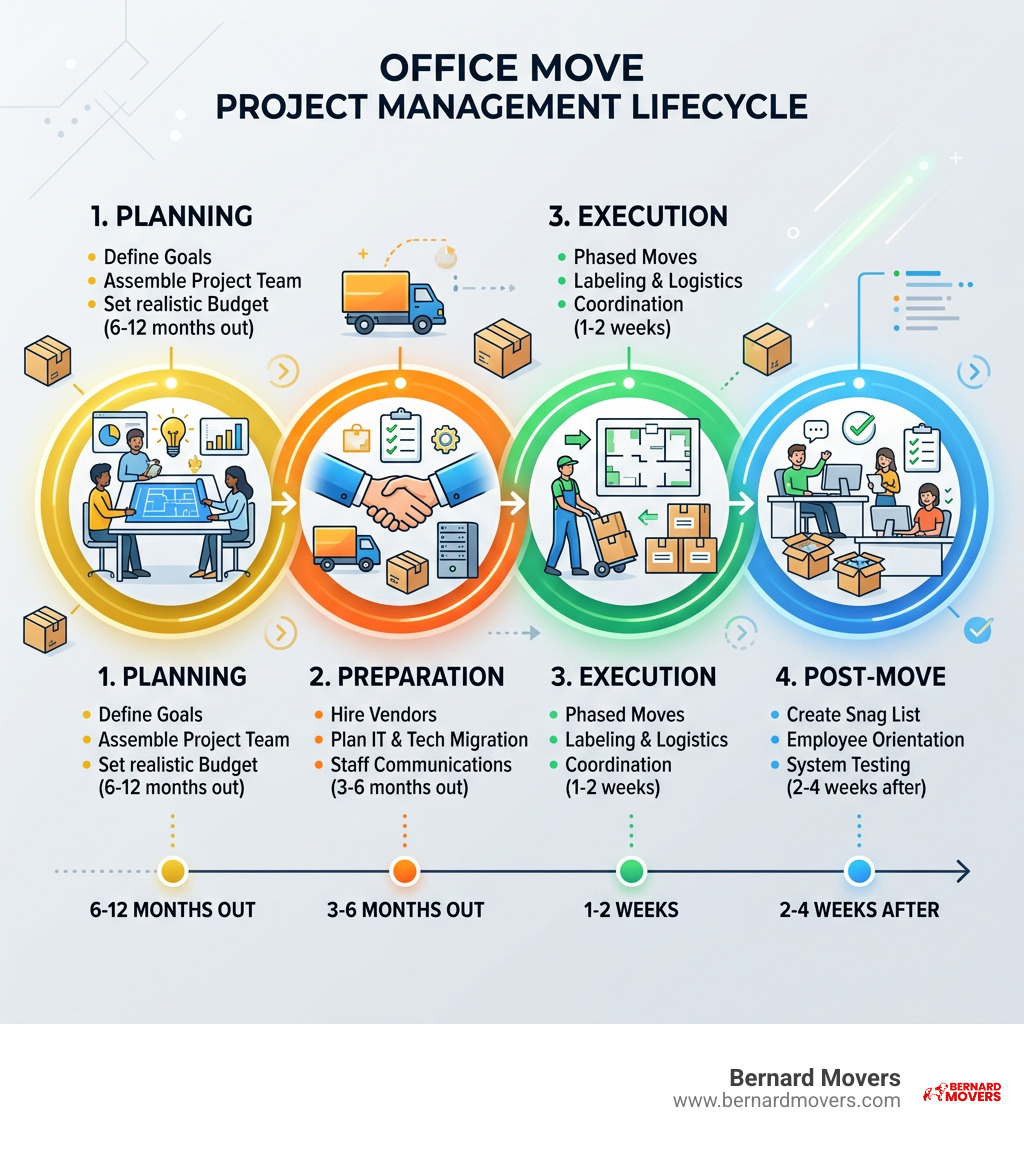
| Phase | Key Actions | Timeframe |
|---|---|---|
| Planning | Define goals, assemble team, set budget | 6-12 months out |
| Preparation | Hire vendors, plan IT migration, communicate with staff | 3-6 months out |
| Execution | Phased moves, labeling, logistics coordination | 1-2 weeks |
| Post-Move | Snag list, employee orientation, system testing | 2-4 weeks after |
Without a clear plan, even a short-distance move inside Chicago or the greater Illinois area can spiral into mislabeled boxes, offline IT systems, and days of lost productivity. The cost of that downtime almost always exceeds the cost of managing the move properly in the first place.
Relocating an entire business isn’t just a logistics challenge — it’s a change management project with real consequences for your people, your operations, and your bottom line.
I’m Mina Georgalas, owner and president of Bernard Movers, a Chicago-based commercial moving company with over 50 years of experience helping Illinois businesses navigate the complexities of office move project management. In this guide, I’ll walk you through exactly how to manage your relocation from start to finish — with minimal disruption and maximum control.
Explore more about office move project management:
The Fundamentals of office move project management
At its core, office move project management is about risk mitigation. Whether you are moving from a high-rise in the Loop to a sprawling facility in Melrose Park or consolidating offices in Des Plaines, the goal remains the same: “disruption insurance.” You want your employees to be fully functional in their new space from the moment they swipe their badges on Monday morning.

A successful move isn’t just about hauling desks; it’s about strategic logistics. This involves aligning your business goals—whether that’s reducing costs, supporting hybrid work, or increasing space efficiency—with the physical reality of moving assets.
| Feature | Internal Team Responsibility | Professional Moving Partner Role |
|---|---|---|
| Strategy | Defining business goals and KPIs | Providing logistical feasibility and timelines |
| Inventory | Categorizing proprietary data/files | Barcoding and tracking physical assets |
| IT Setup | Software migration and data backups | Specialized hardware transport and cabling |
| Communication | Internal employee communication | Vendor coordination and site management |
Professional move management strategies often include the use of a “single source of truth,” such as a digital dashboard, to ensure that everyone from the CEO to the loading dock crew is on the same page. In cities like Chicago, where freight elevator access is a precious commodity and traffic patterns are unpredictable, this level of precision is non-negotiable.
Building Your office move project management Team
You cannot manage a relocation alone. It is a multi-disciplinary effort that requires a “dream team” with clearly defined roles. The Project Leader acts as the “Chief Relocation Officer,” holding the authority to make quick decisions when unexpected hurdles arise.
- Project Leader: This should be a senior staff member with excellent organizational skills. They serve as the primary point of contact for us and other vendors, ensuring that the master timeline is strictly followed.
- IT Specialist: Perhaps the most critical role. They manage the optimize CPU settings, server shutdowns, and the “snake pit” of cabling that needs to be uninstalled and reinstalled. They must also oversee the transition from physical servers to cloud-based environments if applicable.
- HR Manager: Relocations are stressful for employees. HR handles the “people” side, managing change management and ensuring staff feel heard throughout the process. They are responsible for maintaining morale during the transition.
- Facilities Coordinator: This person knows the current building’s quirks—like that one service elevator in Skokie that always sticks—and coordinates with the new building management in places like Evanston or Glenview.
Effective employee communication is the glue that holds this team together. We recommend hosting town halls or creating a central digital hub where staff can find FAQs and floor plans. Transparency keeps morale high and panic low.
Establishing a Realistic Timeline and Budget
How far in advance should you start planning? While a small office with 10 employees might manage with three months of prep, larger corporations in Chicago often require a full 12-month master timeline. This allows for the procurement of long-lead items like custom furniture or specialized IT infrastructure.
A realistic budget must go beyond the cost of the moving truck. You need to account for:
- Lease-related fees: Restoration of your old space to its original condition (broom-clean status).
- New Furniture/IT: Upgrading tech or ergonomic seating to fit the new floor plan.
- Contingency: Research suggests you should build in a 10–15% contingency for unexpected expenses like elevator repairs or last-minute permit fees.
- The Cost of Downtime: If your team can’t work for two days, how much revenue is lost? Professional relocation project managers focus on minimizing this specific “hidden” cost.
For those looking ahead, following essential steps for a smooth office relocation can help you stay ahead of market trends and construction shifts.
Seamless IT Equipment Relocation
Your IT infrastructure is the nervous system of your business. Treat IT migration as a parallel project with its own dedicated master timeline.
Before the move, conduct a full IT audit. This is the perfect time to purge old hardware and optimize CPU usage on remaining machines. During the move, ensure your data is backed up off-site or in the cloud. We use specialized, anti-static packing materials and climate-controlled transport for servers and high-value electronics.
Once at the new site—whether it’s in Park Ridge or Northbrook—your IT team should be the first ones in. Testing connectivity, Wi-Fi “dead zones,” and phone systems before the general staff arrives is a hallmark of a successful office move. This “Day Zero” testing ensures that when the rest of the team arrives, they can hit the ground running without technical friction.
Executing the Relocation Strategy in Chicago and Beyond
Moving day in Illinois requires navigating specific local hurdles. In downtown Chicago, you aren’t just moving boxes; you’re managing “air traffic control” for vendors. This includes coordinating between the moving crew, IT installers, furniture assemblers, and building security.
To ensure a smooth execution, you must:
- Secure Permits: Downtown parking and sidewalk permits are essential to avoid hefty fines from the city.
- Schedule Freight Elevators: Most Chicago high-rises restrict freight use to after-hours or weekends. Booking these slots months in advance is critical.
- Obtain Accurate Price Estimates: Always get price estimates from at least three commercial movers to compare scope, not just the bottom line. Ensure they include insurance coverage and valuation options.
A detailed visual plan is your best friend here. We recommend a color-coded system where labels on boxes match a “destination map” posted at the entrance of the new office. This allows movers to place items in the correct room without needing to ask a single question, significantly speeding up the unloading process.
Streamlining Logistics with office move project management Tools
Modern office move project management has moved far beyond simple spreadsheets. Today, we utilize Office Move Management software to automate task assignments and tracking.
One of the most exciting advancements is the use of digital twins. These are 3D virtual models of your new office space. They allow your team to:
- Virtually “walk through” the layout to check for spatial flow and potential bottlenecks.
- Tag specific assets (like printers or server racks) to their exact future locations.
- Prevent “snake pits” by planning where cabling and power outlets will go before a single desk is moved.
Combine these tech tools with contingency plans for things like elevator breakdowns or inclement Chicago weather, and you have a recipe for success. Risk management also involves verifying Certificates of Insurance (COIs) for every vendor entering the property.
Minimizing Disruption through Phased Relocations
For many Illinois businesses, shutting down for a full Friday is not an option. This is where phased relocations and after-hours moves become essential.
By inform your team of a staggered schedule, you can move departments one at a time. For example, your accounting team in Mount Prospect might move on a Tuesday night, while the sales team in Wilmette moves Thursday evening. This ensures that at least part of your business is always “live” and serving customers.
If you are moving to Georgia or Florida, Bernard Movers offers a unique advantage: a 20% additional discount on moves booked for delivery by March 15, 2025. This can significantly offset the costs of long-distance logistics while maintaining our high standards of Illinois-based service.
Post-Move Audits and Employee Orientation
The move isn’t over when the last box is dropped. The post-move phase is where you resolve “snag lists”—those small issues like a missing desk key, a flickering light in the new Northfield office, or a misconfigured printer.
Crucially, you must adhere to record retention policies. A move is a great time to declutter, but you must ensure that legal and financial documents are handled according to IRS guidelines before shredding anything. Secure document destruction should be part of your project plan.
Once settled, inform your staff about the new office features. Hold a welcome meeting to explain the new amenities, desk-booking systems for hybrid work, and local perks in the neighborhood, whether you’ve moved to Glencoe or Winnetka. The human element is the final piece of the puzzle; a move is a cultural shift, and a positive “Day One” experience can boost long-term employee retention.
At Bernard Movers, we pride ourselves on being more than just muscle; we are your partners in office move project management. From the first start planning session to the final post-move audit, we ensure your Chicago business transition is seamless.