

When Your Business Safe Needs to Move, Don’t Wing It
Commercial safe movers are specialized professionals who relocate heavy, high-security safes for businesses — without damaging your property, your safe, or your team.
If you need a quick answer on what to look for, here’s the short version:
What commercial safe movers do:
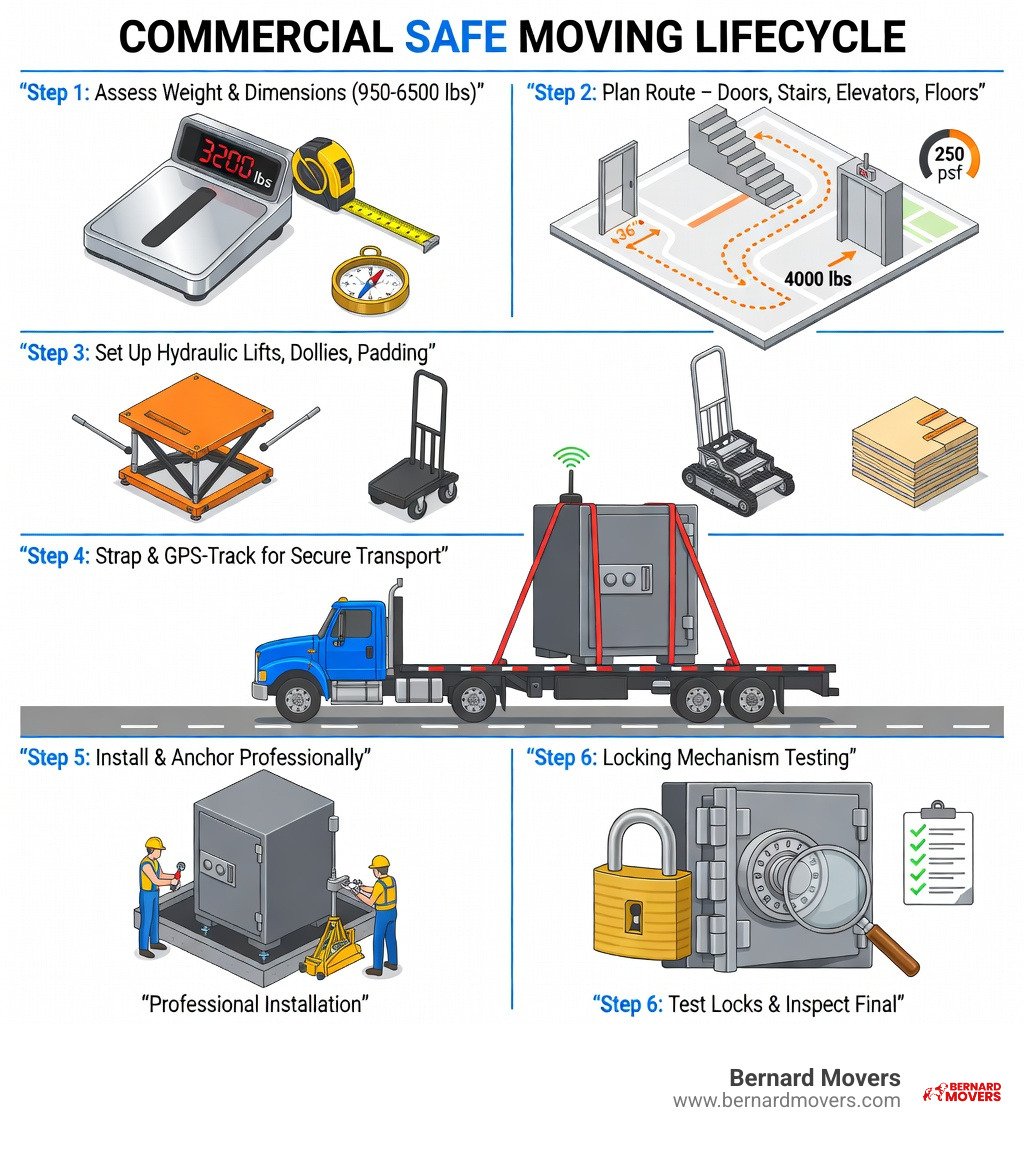
- Assess the safe’s weight, dimensions, and location before anything moves
- Plan the route — accounting for doorways, stairs, elevators, and floor load limits
- Use specialized equipment like hydraulic lifts, electric dollies, and stair-climbing tools
- Transport securely with the safe strapped and stabilized in a proper vehicle
- Install and anchor the safe at its new location and test all locking mechanisms
Safes are not like furniture. Commercial safes can weigh anywhere from 950 to over 6,500 pounds. One wrong move — literally — can mean a back injury, a cracked floor, a scratched vault, or worse. Industry experts note that many safe repairs exist because someone used the wrong movers. Understanding the mechanics of a security safe is crucial before attempting any relocation.
This isn’t a job for a general moving crew. It’s a job for people who do this every day, with the right tools and training.
I’m Mina Georgalas, owner and president of Bernard Movers — a family-owned Chicago company with over 50 years of experience handling complex commercial relocations, including commercial safe movers services for businesses across Illinois. If you’re in Chicago or Melrose Park and need a safe moved the right way, this guide is built for you.
Commercial safe movers terms to remember:
Why Hiring Professional Commercial Safe Movers is Essential
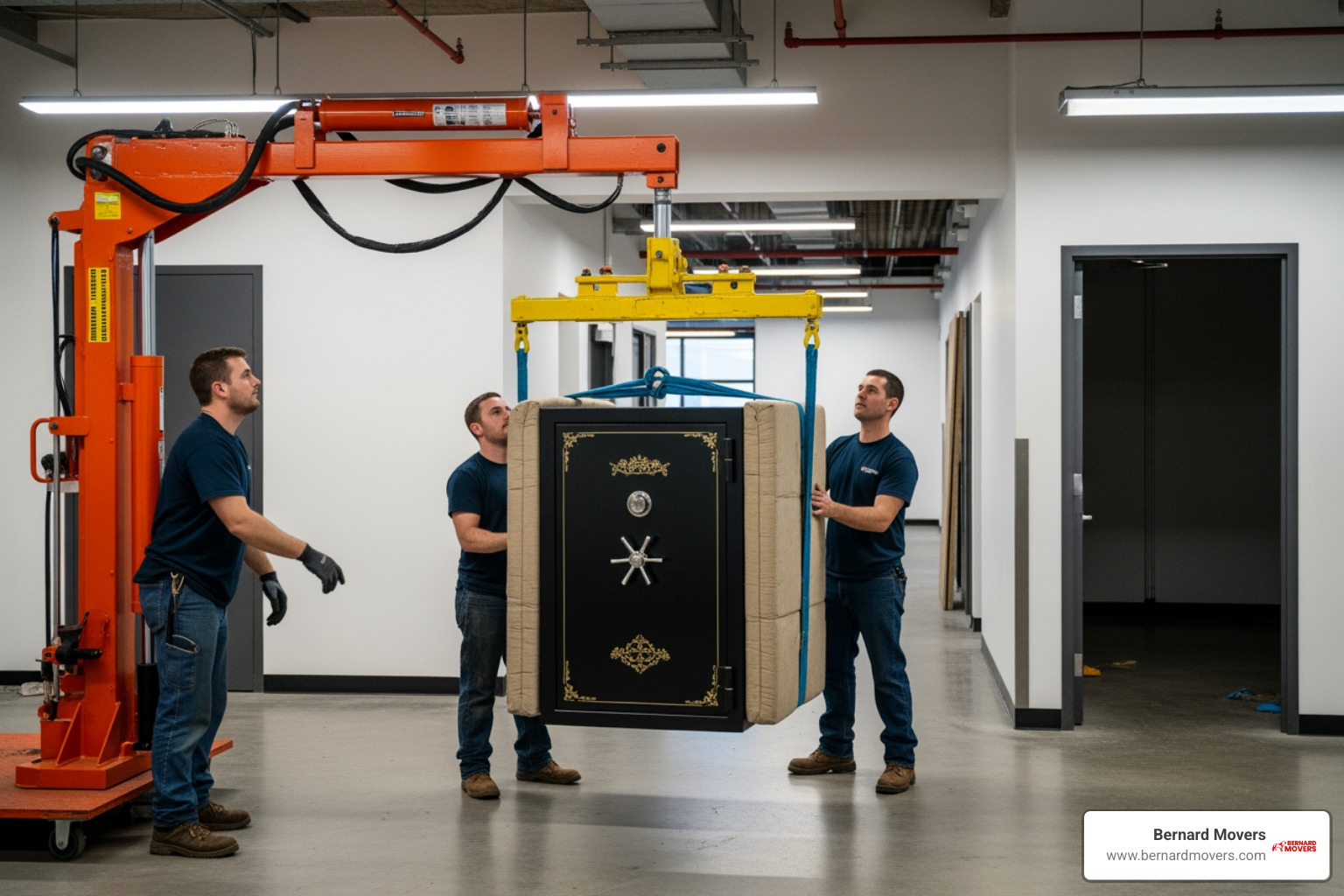
In logistics, moving a two-ton block of steel is a specialized discipline. When businesses in Chicago or Melrose Park attempt to move their own safes, they often underestimate the physics involved. A commercial safe exerts massive pressure on a small surface area, requiring professional intervention to mitigate risk. If a safe starts to tip, it cannot be stopped manually; professionals maintain the center of gravity to ensure total control.
Risk Mitigation and Property Protection
DIY safe moving risks are catastrophic, ranging from life-altering injuries to severe property damage. Amateur attempts often result in cracked marble tiles, collapsed floor joists, or destroyed drywall. Professional heavy item moving services utilize specialized high-density Masonite or steel plating to distribute weight and protect office floors.
Weight Classes: From 950 to 6,500 lbs
Understanding weight classes is vital for safety. While residential safes are lighter, commercial units are in a different league:
- Light Commercial (950 – 1,500 lbs): Requires specialized dollies.
- Medium Commercial (1,500 – 3,500 lbs): Requires hydraulic assistance.
- Heavy Industrial/Vaults (3,500 – 6,500+ lbs): Requires a team of five or more experts.
Liability and Insurance
Professional commercial safe movers carry specialized insurance covering the safe, the building, and the technicians. Standard business insurance may not cover “gross negligence” if an amateur move results in structural damage.
| Feature | DIY Safe Move | Professional Safe Movers |
|---|---|---|
| Equipment | Rental dollies | Hydraulic lifts, Cranes |
| Safety | High risk | Strict protocols |
| Property Damage | Likely | Minimized |
| Insurance | Limited | Full coverage |
Specialized Equipment Used by Commercial Safe Movers
Moving a TL-30 safe requires professional tools:
- Rol-A-Lift: Hydraulic jacks that allow precision rolling.
- Pry Bar Dolly: Used to get rollers under the safe edge.
- Electric Stair-Climbers: Battery-powered motors that “walk” safes up stairs.
- Hydraulic Trailers: Lower the entire bed to the ground for safe loading.
- Air Shims: For moving safes over delicate surfaces.
Assessing Complex Relocations in Chicago and Melrose Park
Every move starts with a site survey to address unique challenges:
- Floor Load Capacity: We ensure the path from the loading dock is reinforced.
- Narrow Corridors: We measure every inch, often removing doors to create a path.
- Elevator Limits: If a safe exceeds elevator capacity, we utilize freight elevators or cranes.
- Building Codes: We ensure placement doesn’t block fire egress.
Handling High-Security and Fireproof Commercial Safes
We handle various specialized units, including TL-30 and TL-60 rated safes tested by Underwriters Laboratories (UL). These are incredibly dense, often lined with composite materials. We also move TRTL (Torch and Tool Resistant) units, fireproof data safes, and vault doors. Each requires a specific touch to maintain its security rating. Learn more about the safes and vaults we handle.
The Step-by-Step Process for Commercial Safe Movers
Bernard Movers follows a disciplined process to ensure a successful relocation.
Step 1: Pre-Move Assessment
We verify the safe’s make and model to determine exact weight and walk the route at both locations to identify potential hazards like soft spots or low-hanging pipes.
Step 2: Preparation and Disassembly
We remove anchors and any removable interior components. The safe is then wrapped in heavy-duty blankets and shrink-wrap to protect the finish.
Step 3: The “Lift and Shift”
Using hydraulic lifts, we elevate the safe and move it slowly over protective plating. If stairs are involved, we deploy electric stair-climbers to maintain balance.
Step 4: Secure Transportation
The safe is loaded via a heavy-duty liftgate and secured using industrial-grade ratcheting tie-downs. We provide GPS tracking for real-time monitoring across Illinois.
Step 5: Final Positioning and Leveling
We position the safe exactly as requested, ensuring it is perfectly level. This prevents the heavy door from swinging unexpectedly or failing to lock properly.
Critical Importance of Professional Installation and Anchoring
An unanchored safe is a target for thieves who may roll the unit out to a secondary location. Professional installation includes concrete anchoring using heavy-duty wedge anchors and strategic placement to minimize prying leverage. We also perform mechanism testing to ensure “relockers” haven’t triggered during the move. This detail makes us the preferred office movers in Chicago for high-security industries.
Factors Influencing the Cost of Hiring Commercial Safe Movers
Safe moving costs vary based on several factors:
- Weight and Dimensions: Heavier units require more manpower.
- Staircase Navigation: Multi-story moves are more labor-intensive.
- Distance: Pricing depends on the travel distance between locations.
- Specialized Rigging: Use of cranes or forklifts adds complexity.
- Timing: After-hours moves may have different rates.
We provide competitive, detailed estimates. For more information, see our commercial movers near me guide.
Conclusion: Securing Your Business Future with Bernard Movers
Moving a commercial safe is one of the most challenging tasks in the relocation industry. It requires a blend of brute strength, mechanical engineering, and meticulous planning. Whether you are moving a jewelry safe in Northfield, a cash vault in Elmhurst, or a high-security document safe in the heart of Chicago, Bernard Movers has the local expertise and specialized equipment to get the job done right.
We serve a wide range of locations including Melrose Park, Des Plaines, Franklin Park, Park Ridge, Elmhurst, Wood Dale, Wilmette, Skokie, Morton Grove, Glenview, Mount Prospect, Evanston, Winnetka, Glencoe, Northfield, and Northbrook.
Special Offer for Your Expansion: Are you moving your business operations down south? Bernard Movers is currently offering a 20% additional discount on moves to Georgia and Florida booked for delivery by March 15, 2025. Whether you’re taking your safe with you or relocating your entire office, we can help you bridge the gap between Illinois and the Southeast with significant savings.
Don’t risk your floors, your safe, or your employees’ safety. Trust the professionals who have been moving Chicago’s heaviest burdens for over half a century.
Secure your commercial move today and let us handle the heavy lifting.