

Why Moving Company Estimates Matter for Your Illinois Relocation
Moving company estimates are far more than just a price tag; they are detailed cost projections and legal frameworks that help you budget for your relocation while protecting your rights as a consumer. In the state of Illinois, where moving regulations are strictly overseen by the Illinois Commerce Commission (ILCC), understanding these documents is the first step toward a successful transition. Whether you are navigating the tight streets of Lincoln Park or moving to a sprawling estate in Barrington, the estimate serves as your roadmap.
Key Components of a Moving Estimate:
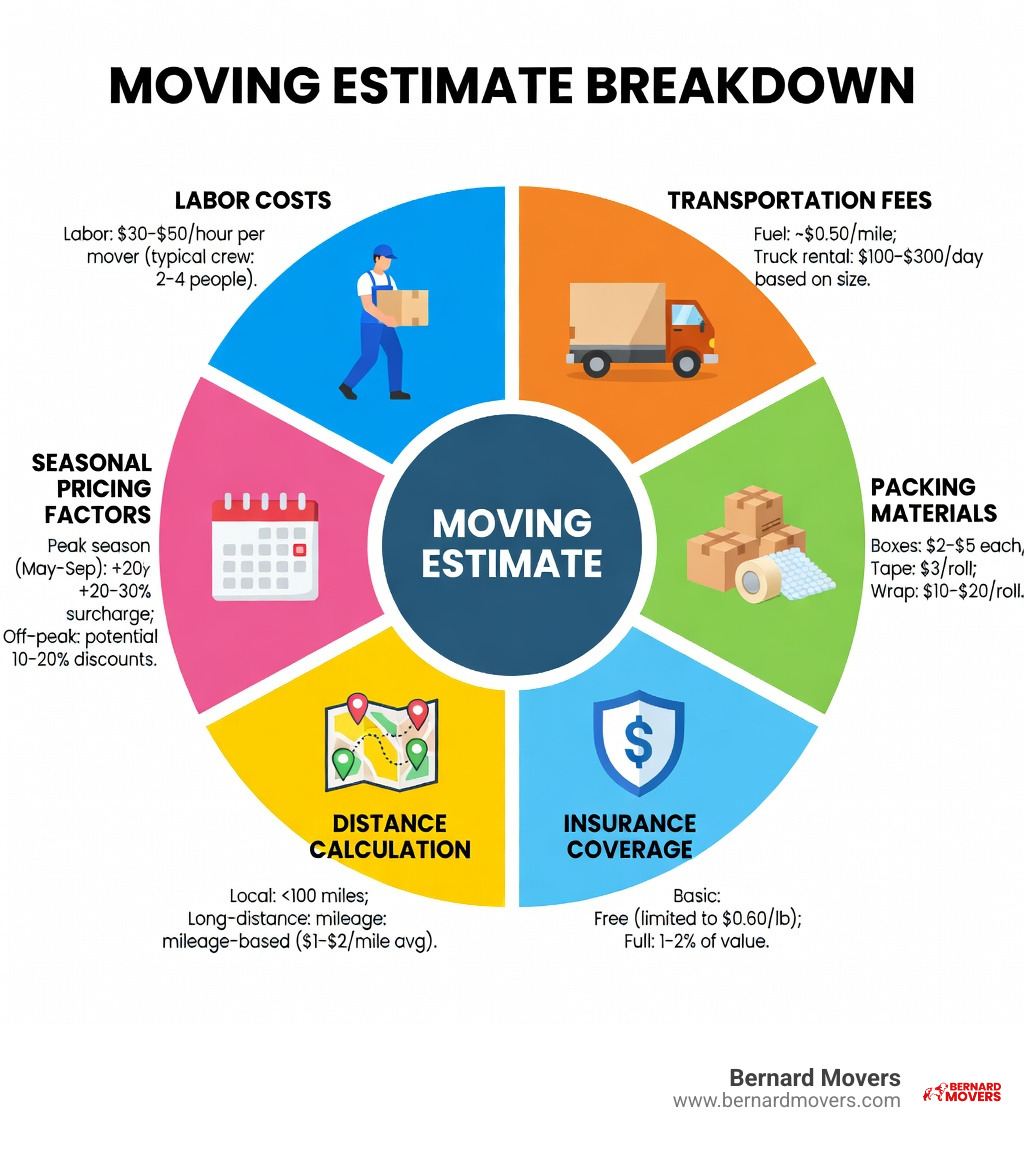
- Distance and Geography – Local moves (typically under 100 miles) are often billed hourly, with costs ranging from $1,250–$3,000. Long-distance moves, which cross state lines or exceed 100 miles, average $4,890–$6,550 and are based on weight and mileage.
- Weight and Volume – For interstate relocations, your belongings’ total weight is the primary driver of cost. For local moves, the volume determines how many movers and what size truck are required.
- Accessorial Services – These include packing, unpacking, crating of specialty items (like fine art or pianos), and temporary storage solutions. These services add layers of convenience but also increase the final price.
- Timing and Seasonality – The moving industry is highly seasonal. Peak season (May–September) can see price hikes of 20–30% due to high demand. Even the time of the month matters, as the first and last days of the month are the busiest.
- Quote Type and Legal Protections – Binding, non-binding, or binding not-to-exceed agreements dictate how much flexibility the mover has to change the price on moving day.
Most Illinois homeowners receive estimates ranging from $2,300 for local Chicago moves to $14,000+ for complex cross-country relocations. Industry experts universally recommend getting at least three written quotes from different providers. This practice allows you to identify outliers and avoid overpaying by 30% or more. It also helps you spot “low-ball” offers that might indicate a lack of insurance or hidden fees.
The difference between a smooth, affordable move and a budget-busting nightmare often comes down to understanding how movers calculate their estimates. Whether you’re relocating from Chicago to Melrose Park or moving your family from Illinois to Florida, knowing what goes into those numbers gives you serious negotiating power.
I’m Mina Georgalas, and I’ve spent nearly 30 years helping families and businesses navigate moving company estimates throughout the Chicagoland area and across 45 states. At Bernard Movers, we’ve refined our estimation process to eliminate surprises and deliver transparent, competitive pricing for every Illinois relocation. We believe that an informed customer is a happy customer, which is why we prioritize education alongside our moving services.
Similar topics to moving company estimates:
Mastering Moving Company Estimates with 5 Comparison Hacks

Navigating moving company estimates can feel like trying to solve a puzzle where the pieces keep changing size. In the Chicagoland area, costs vary wildly based on whether you are moving a studio in Skokie or a five-bedroom estate in Winnetka. On average, a local move for a 2-3 bedroom home (roughly 7,500 pounds) sits around $1,250, but for long-distance hauls of 1,000 miles or more, that figure jumps to an average of $4,890. To truly master your budget, you need to look past the bottom-line number and understand the mechanics of the quote.
For instance, the average cost to move a 3 bedroom house long distance is heavily influenced by the weight of your goods, whereas a moving estimate for 1 bedroom apartment in Melrose Park might be calculated primarily on hourly labor. When you look at Chicago moving company estimates, you’ll notice that local movers typically charge between $25 and $100 per hour, per crew member. For a two-bedroom home with three movers, you might see an average rate of $270 per hour, which includes the truck and basic equipment.
Hack 1: Decoding Moving Company Estimates and Quote Types
Not all quotes are created equal. If you don’t know the difference between the three main types of agreements, you might find yourself facing a bill that is much higher than you expected on moving day. Each type offers a different level of price certainty.
- Binding Estimates: This is a written agreement that guarantees the total cost of the move based on the inventory listed. If you have 50 boxes and two sofas, and that’s what’s on the list, the price won’t change—even if the items weigh more than expected. However, this is a double-edged sword; if you have fewer items on moving day, the price usually stays the same. Furthermore, if you add a treadmill on moving day, the mover can void the estimate or charge extra.
- Non-Binding Estimates: These are “ballpark” figures. They are not a guarantee of the final cost. Instead, they are an educated guess based on the mover’s assessment. The final price will be determined by the actual weight of your shipment and the services provided. By law, movers cannot charge more than 110% of a non-binding estimate at the time of delivery, but you’ll still owe the remaining balance 30 days later.
- Binding Not-to-Exceed Estimates: This is the “Goldilocks” of quotes. It’s also known as a “Guaranteed Price.” If your shipment weighs less than the estimate, you pay less. If it weighs more, you only pay the agreed-upon maximum. This is the most consumer-friendly option and the one we recommend for most long-distance relocations.
Understanding what goes into a moving estimate is vital for transparency. We always recommend getting a full service moving cost estimate in writing to ensure all parties are on the same page regarding labor, fuel, and materials.
Hack 2: How to Compare Moving Company Estimates for Illinois Moves
Comparing moving company estimates in Illinois requires a local eye. Logistics in Chicago are vastly different from logistics in Mount Prospect. You have to account for narrow alleys, parking permits, and the dreaded “elevator wait times” in high-rise buildings. If a mover doesn’t ask about your building’s Certificate of Insurance (COI) requirements or parking restrictions, they aren’t giving you an accurate estimate.
To get an accurate comparison:
- Insist on Visual Surveys: Never trust a quote given over the phone without a visual inspection. Whether it is an in-home visit or a detailed video walkthrough, the estimator needs to see the size of your furniture and the complexity of the move. Phone estimates are notorious for missing “hidden” items in basements or attics.
- Check the “Extra” Lines: Look for travel fees, fuel surcharges, and “long carry” fees. A long carry fee is applied if the truck cannot park within a certain distance (usually 75 feet) of your entrance.
- Verify Credentials: Ensure the company is licensed by the ILCC for local moves and the FMCSA for interstate moves. Check their USDOT number for safety records.
Our moving companies Chicago prices guide highlights that local moves are often calculated by multiplying the hourly rate by the estimated time. If you’re wondering how much do movers cost in Chicago, a studio apartment might cost as little as $501, while a large 4-5 bedroom house can easily exceed $2,988 for labor alone.
Hack 3: The Pre-Move Purge and Inventory Accuracy
The most effective way to slash your moving company estimates is also the simplest: move less stuff. Since long-distance moves are priced primarily on weight, every heavy book or old exercise bike you leave behind puts money back in your pocket. For local moves, less stuff means fewer hours on the clock.
We suggest following a step-by-step guide to the pre-move purge at least eight weeks before your move date. Start by cleaning out closets and the attic. Donate furniture you haven’t used in a year and host a garage sale for smaller items. For those moving shorter distances, check out our short distance movers cost tips to see how reducing your box count can lower the number of hours required for the job.
Inventory accuracy is the backbone of a reliable quote. If you tell an estimator you have “a few boxes” but show up with 80, your estimate will be worthless. Be honest about what’s in the basement and the crawl space! A detailed inventory list, often called a “cube sheet,” should be provided with your estimate so you can verify every item was accounted for.
Hack 4: Timing Your Relocation for Maximum Savings
In the moving industry, timing is everything. About 70% of moves take place during the “peak season” between Memorial Day and Labor Day. During these months, demand is sky-high, and so are the prices. In Illinois, the winter months (October through April) often offer the best rates, though you must contend with the potential for snow and ice.
To save money:
- Move Off-Peak: If possible, schedule your move during the winter or early spring.
- Avoid Weekends: Mid-week moves (Tuesday or Wednesday) are often cheaper than Friday or Saturday moves because crews are in lower demand.
- Mid-Month is Best: Most leases end on the 1st or the 31st, making those days the busiest for movers. Aim for the 15th of the month to secure better rates and your preferred time slot.
Consulting an apartment movers cost guide 2026 can help you see how these seasonal shifts impact pricing. When you decide when you move, you are making one of the biggest financial decisions of the entire relocation process.
Hack 5: Evaluating Full-Service Moving Options and Valuation
While a DIY move might seem cheaper at first glance, the “hidden costs” add up fast. Between truck rentals, fuel, insurance, equipment like dollies, and the literal physical toll on your body, the “savings” often vanish. A cost for full service movers includes professional packing, loading, and expert logistics.
One critical part of the estimate often overlooked is Valuation Coverage. This is not technically insurance, but it determines the mover’s liability for your belongings:
- Released Value Protection: This is the basic coverage required by law at no extra cost. However, it only pays up to 60 cents per pound per article. If your $2,000 LED TV weighs 50 pounds and gets broken, you only get $30.
- Full Value Protection: This is an add-on cost but is highly recommended. If an item is lost or damaged, the mover must either repair it, replace it with a similar item, or offer a cash settlement for the current market value.
Red Flags to Watch for in Moving Company Estimates
When reviewing your moving company estimates, be alert for these warning signs of a potential scam:
- The “Over-the-Phone” Only Quote: If they refuse to do a visual inspection, they are likely to hit you with massive fees on moving day.
- Cash-Only Deposits: Reputable movers accept credit cards or checks. A demand for a large cash deposit upfront is a major red flag.
- Generic Phone Greetings: If they answer the phone as “Moving Company” instead of a specific business name, they may be a broker rather than a carrier.
- No Physical Address: Verify that the company has a physical office and warehouse in Illinois.
Understanding Additional Fees and Tipping Etiquette
Keep a sharp eye out for “add-on” fees that can sneak up on you. These aren’t necessarily scams—they are charges for extra labor or resources. Common fees include Stair/Elevator Fees for multi-story buildings, Specialty Item Fees for pianos or safes, and Shuttle Fees if a large semi-truck cannot reach your front door and a smaller van is required to shuttle goods.
Tipping: While not mandatory, it is customary to tip your movers for a job well done. A standard tip is about $20 per mover for a half-day (4 hours) or $40-$50 per mover for a full day. If they are handling heavy items up multiple flights of stairs in the Chicago summer heat, a little extra is always appreciated.
Taxes: You might be wondering, “Are moving costs tax-deductible?” For most taxpayers, the answer is no through 2025. However, there is an exception: Military personnel moving due to a permanent change of station can often still deduct unreimbursed expenses. The IRS has a tool to determine if you can deduct your moving expenses if you fall into this category.
Conclusion
At the end of the day, getting accurate moving company estimates is about more than just numbers—it’s about trust. By using these five hacks, you can approach your Illinois relocation with confidence, knowing exactly what you are paying for and where you can save.
Whether you are moving within Des Plaines, Elmhurst, or Evanston, we at Bernard Movers are here to make the process seamless. For those looking to head south, we have a special offer: Get a 20% additional discount on moves to Georgia and Florida booked for delivery by March 15, 2025.
Ready to see how we stack up? Get your personalized moving estimate today and let us handle the heavy lifting while you focus on starting your new chapter in your new home. From Skokie to Wilmette and everywhere in between, we are proud to be your local Illinois moving experts.