

Understanding How Commercial Moving Costs Are Calculated
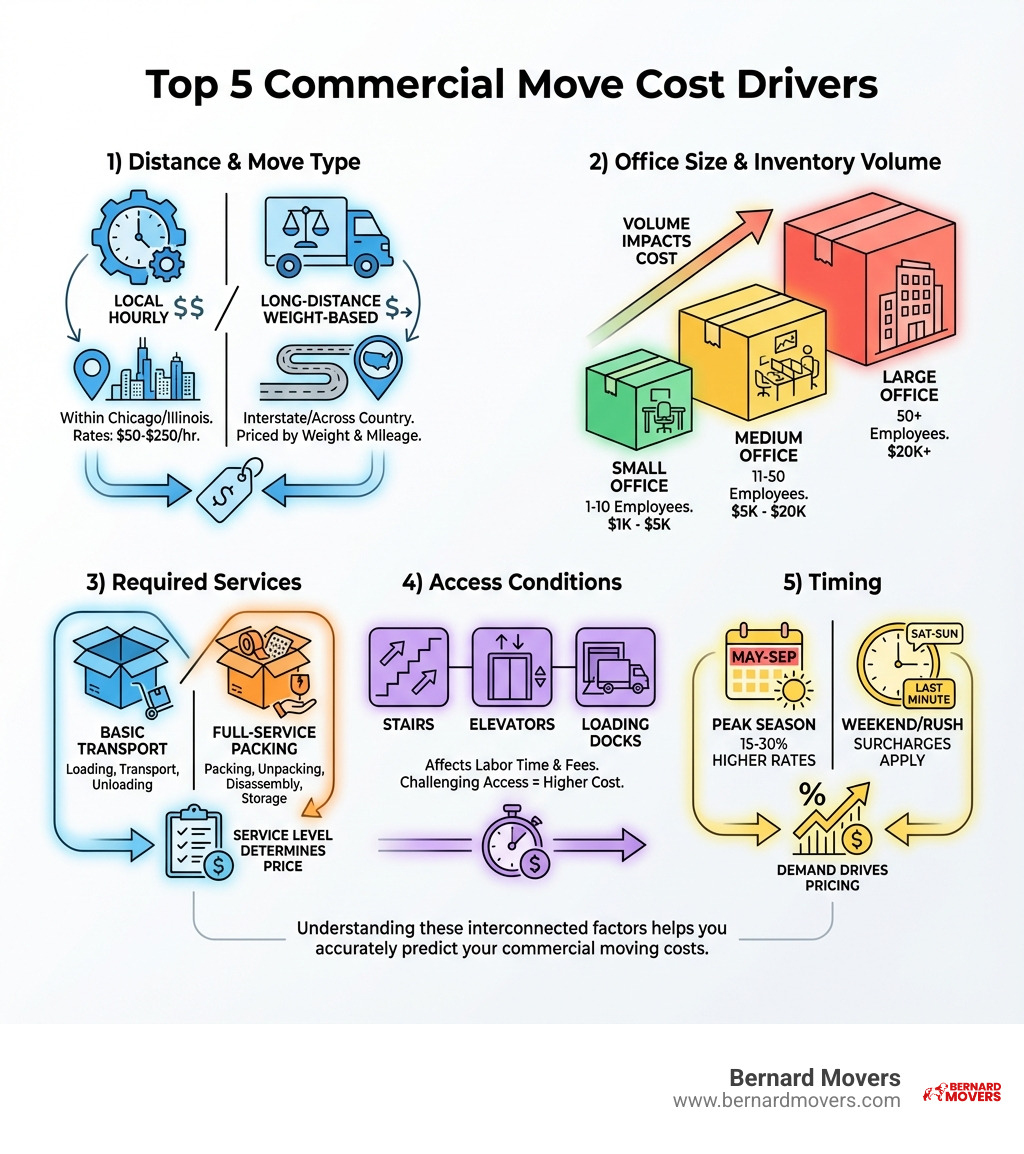
How moving services determine pricing for commercial moves is determined by several key factors that combine to create your final quote. Here’s what you need to know:
Primary Pricing Factors:
- Distance of the Move – Local moves within Chicago and Illinois are charged hourly ($50-$250/hour), while long-distance relocations are priced by weight and mileage
- Size and Complexity – The volume of inventory, specialized equipment (servers, IT infrastructure), and office furniture directly impact labor and transportation costs
- Services Required – Basic moving (loading, transport, unloading) vs. full-service options (packing, unpacking, disassembly, storage)
- Building Access – Stairs, elevators, long carries, and loading dock availability affect labor time and fees
- Timing – Peak season (May-September), weekends, and last-minute bookings typically cost 15-30% more than off-peak, mid-week moves
- Insurance Coverage – Basic liability ($0.60/lb) is standard, while full-value protection costs an additional 1-2% of total shipment value
Average Commercial Move Costs:
- Small office (1-10 employees): $1,000-$5,000
- Medium office (11-50 employees): $5,000-$20,000
- Large office (50+ employees): $20,000-$50,000+
When starting a move, whether it’s a short trip within Chicagoland or a long-distance move across the country, it’s crucial to understand the complex pricing structure that moving companies utilize. The moving industry is now worth about $23.3 billion, which makes it especially important for Chicago and Illinois businesses to know how quotes are put together and what they are really paying for.
I’m Mina Georgalas, owner and president of Bernard Movers, with nearly 30 years of experience helping Illinois businesses understand how moving services determine pricing for commercial moves and budget effectively for their relocations. Throughout this guide, we’ll break down exactly what goes into your commercial moving quote so you can plan and budget with confidence.
How Moving Services Determine Pricing for Commercial Moves
Understanding the factors that shape your commercial moving quote is the initial step toward a smooth and budget-friendly relocation. At Bernard Movers, we believe in transparency, ensuring our clients in Chicago, Melrose Park, and across Illinois know exactly what they’re paying for. How moving services determine pricing for commercial moves involves a careful assessment of several interconnected variables, all designed to provide an accurate and fair estimate.

The cost of commercial moving services is fundamentally driven by the resources required: the labor, equipment, and time needed to safely and efficiently transport your business assets. This calculation starts with a detailed moving estimate, which takes into account everything from the number of office chairs to the complexity of your IT infrastructure. Our goal is to provide a comprehensive breakdown, covering labor costs, transportation fees, and any specialized handling your items may need, ensuring you have a clear picture of your investment.
Core Pricing Models: Local vs. Long-Distance
The distance of your business’s relocation plays a pivotal role in how your moving costs are calculated. Moving services typically employ different pricing models for local versus long-distance commercial moves.
For local moves within Chicago, Melrose Park, or other areas in Illinois (typically under a 100-mile radius), we bill by the hour. This rate includes the truck, equipment, packing materials, and the moving team. The hourly fee increases with the size of the crew and number of vehicles needed, generally ranging from $120 to $240 per hour or more. Our full-service moving options ensure every aspect of your local relocation is handled with expertise.
In contrast, long-distance moves (over 100 miles) for businesses relocating from Illinois are priced differently due to greater logistical complexity. The primary cost factors are the shipment’s total weight and the travel distance. A flat-fee model is common, incorporating weight, mileage, and any extra services. While local moves can range from $1,000 to $8,000, long-distance commercial relocations often cost $10,000 to $30,000 or more, depending on the specifics.
Key Cost Drivers: What Inflates Your Commercial Moving Quote
Several factors can significantly increase your commercial moving quote, often stemming from the unique demands of a business relocation. Understanding these key cost drivers helps in accurate budgeting.

First, the size and complexity of your inventory are major cost drivers. A small office (1-10 employees) may cost $1,000-$5,000, a medium office (11-50 employees) $5,000-$20,000, and a large corporation (50+ employees) over $30,000. Costs are influenced by the volume and nature of items. Modular furniture requires disassembly/reassembly, and sensitive IT equipment (servers, lab gear) needs special handling and packing. Specialty items like heavy safes or pianos can add $200-$1,500 each to the cost. For such needs, our commercial equipment movers are expertly trained.
Next, poor building access at either location can increase costs. Navigating stairs may result in fees of $25-$75 per flight. Inefficient elevators or those requiring reservations might also incur charges. A “long carry fee” of $100-$300 may apply if the truck must park more than 75 feet from the entrance. The absence of a loading dock can also add to labor time and costs.
Finally, the timing of your move significantly affects price. Peak season (May-September) rates can be 15-25% higher due to demand. You can save by moving during the off-peak season (October-April). Weekend and holiday moves are also more expensive, so choosing a mid-week date is a cost-effective strategy that offers better availability.
Decoding Your Estimate: Included Services vs. Add-Ons
When you receive a commercial moving estimate from Bernard Movers, understand what services are typically included and what might be considered an add-on. This clarity helps you manage your budget and ensures no surprises on moving day.
Here’s a general comparison:
| Standard Services (Typically Included) | Add-On Services (Extra Cost) |
|---|---|
| Loading of items onto the truck | Full or partial packing services |
| Transportation to the new location | Unpacking services |
| Unloading items at the destination | Debris removal |
| Basic Liability Coverage ($0.60/lb) | Short-term or long-term storage |
| Custom crating for fragile items | |
| Furniture disassembly/reassembly | |
| Specialized handling for IT equipment/heavy items | |
| Additional packing materials |
Our standard service covers loading, transportation, unloading, and basic liability coverage. Many businesses choose add-ons to simplify their move. Professional packing and unpacking services save employee time and protect delicate items, with costs ranging from $300 to $1,500+ depending on volume. Another popular add-on is furniture disassembly and reassembly for items like cubicles and large desks. If you need temporary storage, we offer office moving and storage solutions, with monthly fees typically from $50 to $300. While these services add to the cost, they reduce stress and let your team focus on core operations.
Protecting Your Assets: Insurance and Liability Explained
Protecting your business assets is paramount. Understanding insurance options is key to managing risk.
The standard, included option is Basic Liability Coverage (Released Value Protection), which provides minimal compensation at $0.60 per pound per item. For example, a damaged 10-pound, $500 monitor would only be compensated for $6.00. This is insufficient for valuable equipment.
For comprehensive coverage, we recommend Full Value Protection. This covers the repair, replacement, or current market value of any damaged or lost items. It typically costs an additional 1-2% of your shipment’s total declared value and provides essential peace of mind for valuable business assets.
Some businesses also opt for third-party insurance for high-value items or broader coverage. Always clarify insurance options and costs with your mover to prevent significant financial loss.
Budgeting Smart: Avoiding Hidden Fees and Reducing Costs
A successful commercial move involves more than just getting your business from point A to point B; it’s about doing so efficiently and within budget. At Bernard Movers, we help our clients in Illinois with meticulous planning and proactive strategies to avoid unpleasant surprises. Effective financial planning is key, and having an office relocation project manager can be invaluable in navigating the complexities of commercial moving costs and ensuring accurate quotes.
Uncovering Potential Hidden Fees in Commercial Moves
Unexpected or “hidden” fees can be a frustrating component of any move. While we practice full transparency, businesses should be aware of common additional charges that can affect the final cost.
Here’s a breakdown of potential hidden fees you should always inquire about:
- Stair Fees: For moves involving multiple flights of stairs without an elevator, fees of $50-$75 per flight may apply for the extra labor.
- Long Carry Fees: Applied when movers must carry items over a long distance (typically >75 feet) from the truck to the building entrance.
- Elevator Fees: May be charged for use of small or slow elevators, or if a reservation or operator is required.
- Fuel Surcharges: Common for long-distance moves from Illinois, these reflect fluctuating fuel prices and can add 5-15% to the cost.
- After-Hours Fees: Moving on evenings or weekends can increase rates by 25-50%.
- Parking Permits: In cities like Chicago, permits for the moving truck are often required and come at an extra cost.
- Shuttle Service Fees: If a large truck can’t access your building, a smaller shuttle vehicle may be needed, adding to the cost.
- Last-Minute Scheduling Fees: Booking late, especially in peak season, can increase costs by 20-30%. Rescheduling with short notice may also incur fees.
To avoid surprises, ask your mover these critical questions to uncover potential fees:
- “Is this a binding estimate, a non-binding estimate, or a not-to-exceed estimate?”
- “Are there any additional charges for stairs, elevators, or long carries at either location?”
- “What are your policies on fuel surcharges?”
- “Are there extra fees for weekend or after-hours moves?”
- “Do I need to arrange for parking permits, or is that included/handled by you?”
- “What happens if there are unforeseen delays or access issues?”
- “Are packing materials and services itemized separately, and what are their costs?”
- “What are your cancellation or rescheduling fees?”
Getting a detailed, itemized quote in writing, signed by both parties, is always the best practice to ensure full transparency.
Strategies to Lower Your Illinois Commercial Moving Bill
While commercial moves have inherent costs, Illinois businesses can use several smart strategies to reduce their bill without sacrificing quality.
- Decluttering: The most effective method for saving money is to move less. Before the move, sort through all office items and dispose of, donate, or sell what’s no longer needed. Lower volume and weight directly reduce costs.
- Booking in Advance: Plan ahead. Booking your move 4-6 weeks in advance (or 8-12 weeks in peak season) secures better rates and availability, potentially saving you up to 30%.
- Scheduling Off-Peak: Timing is key. Schedule your move during the off-peak season (October-April) and on a mid-week day (Tuesday-Thursday) to save 15-25% compared to weekends or peak season.
- Partial DIY Packing: Save on labor by having your staff pack non-fragile items like files and personal desk contents. Just ensure boxes are clearly labeled.
- Getting Multiple Quotes: Contact several reputable Illinois movers to compare quotes. This gives you negotiating power and helps you find the best value.
- Leverage Special Offers: Look for promotions. For instance, Bernard Movers is offering a 20% additional discount on moves to Georgia and Florida booked for delivery by March 15, 2025, a great deal for businesses relocating from Illinois.
By implementing these strategies, your business can significantly reduce the overall cost of its commercial move. Our team at Bernard Movers is always ready to provide a transparent moving estimate and discuss how our commercial movers can help you achieve a cost-effective and efficient relocation.